

Look Ahead: Low-temperature PVD coating
The Look Ahead department covers a low-temperature PVD coating, free of charge, in the February 2017 issue of Cutting Tool Engineering.
A physical vapor deposition coating protects the edge of a cutting tool, for example, from the wear and tear of everyday use. However, many common industrial materials can’t take advantage of such protection because the coating process would be more damaging to them than that wear and tear. Deposition of PVD coatings commonly takes place at high temperatures—from 385° to 750° F (196° to 399° C). That has ruled out its application on some common materials, such as hardened steel.
And there’s been another limitation: The material to be coated has to be able to conduct electricity. Most PVD coating processes depend on biasing the part that’s to be coated, which means to charge it electrically and make it attract the coating molecules. That has meant that materials such as ceramics, which are able to take the heat but are nonconductive, couldn’t effectively be PVD-coated.
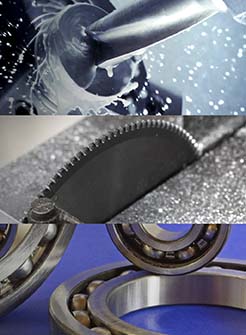
A PVD coating can extend the life of cutting tools,
such as drills and saws, as well as bearings. Image courtesy of SurfTech.
Review the print ads from this magazine to continue
This quick advertiser review unlocks the rest of the article and keeps the full-screen reader focused on the ads instead of the page chrome.
Advertisers included in this article experience
Print placements connected to this article
Nachiamerica
Nachi Tool America Inc.
Greenwood, Indiana facilities Manufacturing, Regrinding & Coating Broaches • Carbide Drills Shaper Cutters • Skiving Cutters • Hobs Shave Cutters • Forming Racks Largest Global Gear Cutting Tool Company.
Nachi Tool America Inc. Greenwood, Indiana facilities Manufacturing, Regrinding & Coating Broaches • Carbide Drills Shaper Cutters • Skiving Cutters • Hobs Shave Cutters • Forming Racks Largest Global Gear Cutting Tool Company 888-340-8665 Cutting Tool • 317-530-1004 Gear Tool
Visit Nachiamerica View this placement in the issue recordPrint ads from this magazine
Greenwood, Indiana facilities Manufacturing, Regrinding & Coating Broaches • Carbide Drills Shaper Cutters • Skiving Cutters • Hobs Shave Cutters • Forming Racks Largest Global Gear Cutting Tool Company.
Nachi Tool America Inc. Greenwood, Indiana facilities Manufacturing, Regrinding & Coating Broaches • Carbide Drills Shaper Cutters • Skiving Cutters • Hobs Shave Cutters • Forming Racks Largest Global Gear Cutting Tool Company 888-340-8665 Cutting Tool • 317-530-1004 Gear Tool
Continue reading
February 2017
Now SurfTech has created a PVD coating process that can be done at temperatures as low as 200° F (93° C). This process also doesn’t depend on biasing (making it, in a sense, “free of charge”). Not only ceramics, but other nonconductive materials, including carbon composites, cermet, silicon nitride, silicon carbide, pure alumina, PCD and PCBN, can now benefit from PVD coating.
The SurfTech process foregoes high temperatures and biasing by using two patented nanotechnologies: ion activation devices for plasma-beam processing and nanostructured material synthesis of the coating material. Put more simply, the precise control of plasma beams conforms the coating layer to the surface topography of the substrate. Coatings are deposited with mean thicknesses from less than 40µin. to greater than 100µin. (1µm to 3µm) with a tolerance of ±5 percent. The plasma-beam particle energies and number are controlled independently, putting the necessary thermal and chemical energy into the surface treatment process, not into heating the processing chamber and the bulk mass of the components. The benefits of a hard, lubricious, smooth, porous-free PVD coating are now available to a much larger group of materials.
For more information about SurfTech and parent company Euclid Refinishing Co. Inc., Austinburg, Ohio, visit www.ercsurftech.com or call (440) 275-3356.
Related




Subscribers can use MFGAxis notes, saves and discussion tools with their innoNET account.


