

A combination tool for thread forming
The Look Ahead department includes a combination broaching and tapping tool for thread forming in the January 2017 issue of Cutting Tool Engineering.
Engineers at German carmaker Audi AG and toolmaker Emuge-Franken, with help from the Institute of Machining Technology at Dortmund (Germany) Technical University, have put a new spin on the way that threads are formed in materials such as aluminum. They call the process “helical thread forming.”
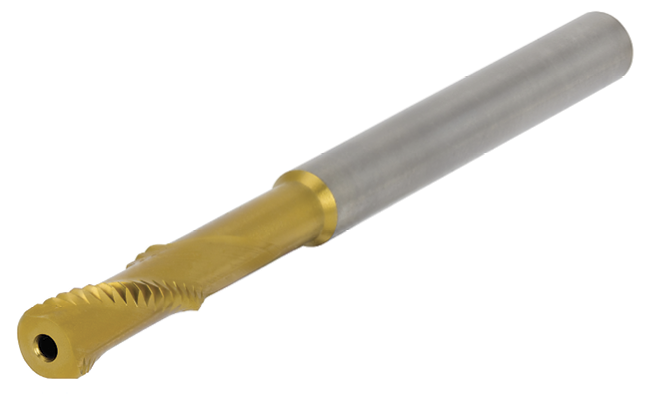
The punch-tap helical thread-forming tool was developed by Audi and Emuge-Franken. Image coutesy of Emuge.
Their “punch-tap” tool differs from a conventional or cold-forming tap. Instead of a continuous thread profile, the tool has two twisted rows of teeth that are offset 180° to each other. The tool head has two broaching teeth. When the tool punches—quickly—into a predrilled tap hole, it simultaneously turns on a steep helical path, and the broaching teeth generate spiral grooves on opposing sides of the hole. Then the spindle turns another 180° while the axial feed axis moves half a pitch, causing the teeth lining the sides of the tool to cut all of the threads at once. That 180° turn lines the broaching teeth back up with the helical grooves they cut, and the tool is retracted along that same path—which, if you are making a standard M6 thread that’s 0.59″ (15mm) deep, is about 15 times shorter than the thread path itself would be. The entire process takes less than half a second, reducing threading time about 75 percent compared to cold forming, said Emuge.
Review the print ads from this magazine to continue
This quick advertiser review unlocks the rest of the article and keeps the full-screen reader focused on the ads instead of the page chrome.
Advertisers included in this article experience
Print placements connected to this article
Ceratizitpromos
RELIABILITY
MATTERS Depend on carbide solutions from CERATIZIT: For an extensive range of standard sizes and cut-to-length rods As a dependable source of superior carbide rods and preforms For quick quote turnaround For high percentage of on-time delivery For innovative custom solutions with ROI you can trust To view the catalogs and video.
RELIABILITY MATTERS Depend on carbide solutions from CERATIZIT: For an extensive range of standard sizes and cut-to-length rods As a dependable source of superior carbide rods and preforms For quick quote turnaround For high percentage of on-time delivery For innovative custom solutions with ROI you can trust To view the catalogs and video,
Visit Ceratizitpromos View this placement in the issue recordPrint ads from this magazine
MATTERS Depend on carbide solutions from CERATIZIT: For an extensive range of standard sizes and cut-to-length rods As a dependable source of superior carbide rods and preforms For quick quote turnaround For high percentage of on-time delivery For innovative custom solutions with ROI you can trust To view the catalogs and video.
RELIABILITY MATTERS Depend on carbide solutions from CERATIZIT: For an extensive range of standard sizes and cut-to-length rods As a dependable source of superior carbide rods and preforms For quick quote turnaround For high percentage of on-time delivery For innovative custom solutions with ROI you can trust To view the catalogs and video,
Continue reading
January 2017
According to Dortmund Technical University, test results indicated the geometry and holding forces of the internal threads punch-tapped in aluminum for an M6 thread is comparable to conventionally machined threads.
Audi had been the originator of the punch-tap technology; it brought in Emuge-Franken, Lauf, Germany, to partner on its development. With that in mind, the two companies agreed that the competitive advantage the technology brings should stay exclusive to Audi, at least for a while and at least in the automotive industry. Other automotive OEMs won’t be able to use it until January 2018. Automotive suppliers and parts manufacturers in other industries, however, reportedly will be able to use the punch-tap starting in January 2017.
For more information, contact Emuge-Franken’s U.S. office, Emuge Corp., West Boylston, Mass., at (800) 323-3013 or visit www.emuge.com.
Related




Subscribers can use MFGAxis notes, saves and discussion tools with their innoNET account.


