

A new tooling, software combination to speed blisk production
Autodesk CAM software developer Delcam Ltd., working with toolmaker Technicut Ltd., has created a software and cutting tool combination for machining blisks that reportedly reduces machining time and costs about 50 percent compared to traditional methods.
Autodesk CAM software developer Delcam Ltd., working with toolmaker Technicut Ltd., has created a software and cutting tool combination for machining blisks that reportedly reduces machining time and costs about 50 percent compared to traditional methods.

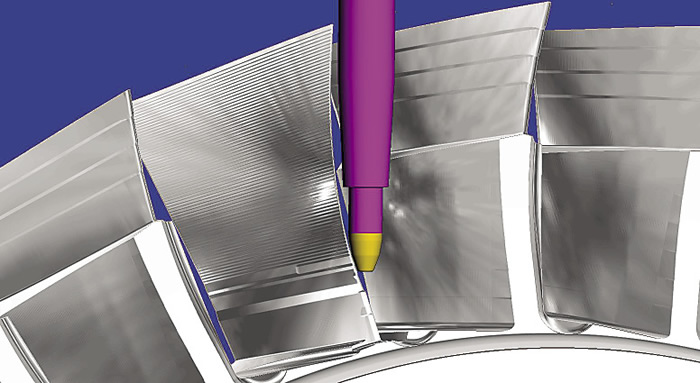
PowerMILL image of a finishing operation on a blade barrel. Image courtesy Delcam.
The blisk has been an important turbo-engine component since it was introduced in the mid-1980s; prior to that, a rotor disk with individually attached blades was used. The blisk features blades and a disk as a single component, machined from a single piece of hard metal. Blisks offer advantages in weight, operating efficiency and through-life servicing but are challenging to manufacture because of their highly complex shapes and the difficulty of machining the materials used, usually a titanium or nickel-base alloy.
As with most machining projects, it comprises roughing, semifinishing and finishing. The initial roughing operation creates the blades with a series of slotting cuts using Technicut’s Titan X-Treme Ripper endmill.
Review the print ads from this magazine to continue
This quick advertiser review unlocks the rest of the article and keeps the full-screen reader focused on the ads instead of the page chrome.
Advertisers included in this article experience
Print placements connected to this article
Tungaloyamerica
Ad Index
ADVERTISER NAME PAGE # CONTACT NAME CONTACT PHONE CONTACT EMAIL / WEBSITE The Advertisers Index is provided as a courtesy to advertisers. Every effort is made to avoid errors, but should one occur, CTE is not responsible. Reviewed by the Engineering Index. Cutting Tool Engineering® (ISSN:0011-4189) is published monthly. Copyright 2016 by CTE Publications.
Ad Index ADVERTISER NAME PAGE # CONTACT NAME CONTACT PHONE CONTACT EMAIL / WEBSITE Tungaloy America Inc. 43 Lisa Penzick 888-554-8394 [email protected] / www.tungaloyamerica.com Tungco Inc. 171 Cliff Nance 614-214-5122 [email protected] / www.tungco.com Tungsten Toolworks 112 John Forrest 800-564-5832 [email protected] / www.tungstentoolworks.com UNISIG Deep Hole Drilling Systems 88-89 Jeff Price 262-252-3802 ext. 214 [email protected] / www.unisig.com Unison Corp. 64 Dave Swider 248-544-9500 [email protected] / www.newunison.com Unist Inc. 147 Nate Pegman 616-949-0853 [email protected] / www.unist.com UNITED GRINDING 49 Ted Neckel 937-847-1229 [email protected] / www.grinding.com USCTI 83A 216-241-7333 [email protected] / www.uscti.com
Visit Tungaloyamerica View this placement in the issue recordPrint ads from this magazine
ADVERTISER NAME PAGE # CONTACT NAME CONTACT PHONE CONTACT EMAIL / WEBSITE The Advertisers Index is provided as a courtesy to advertisers. Every effort is made to avoid errors, but should one occur, CTE is not responsible. Reviewed by the Engineering Index. Cutting Tool Engineering® (ISSN:0011-4189) is published monthly. Copyright 2016 by CTE Publications.
Ad Index ADVERTISER NAME PAGE # CONTACT NAME CONTACT PHONE CONTACT EMAIL / WEBSITE Tungaloy America Inc. 43 Lisa Penzick 888-554-8394 [email protected] / www.tungaloyamerica.com Tungco Inc. 171 Cliff Nance 614-214-5122 [email protected] / www.tungco.com Tungsten Toolworks 112 John Forrest 800-564-5832 [email protected] / www.tungstentoolworks.com UNISIG Deep Hole Drilling Systems 88-89 Jeff Price 262-252-3802 ext. 214 [email protected] / www.unisig.com Unison Corp. 64 Dave Swider 248-544-9500 [email protected] / www.newunison.com Unist Inc. 147 Nate Pegman 616-949-0853 [email protected] / www.unist.com UNITED GRINDING 49 Ted Neckel 937-847-1229 [email protected] / www.grinding.com USCTI 83A 216-241-7333 [email protected] / www.uscti.com
Continue reading
August 2016
In addition to removing the bulk of the material between what will be the blades, roughing relieves any stresses in the billet introduced during the forging process.
Both the semifinishing and finishing operations on the individual blades are then undertaken in a series of vertical sections, working from the tip downwards. The lower sections are left in the rough state to maintain the stiffness of the blade in the area being machined and, therefore, minimize push off of the blade tip by the cutter.
In addition to the specific toolpaths for blisk machining in Delcam’s PowerMILL software, the key to the new method is the use of barrel cutters from Technicut for semifinishing and finishing. The tools incorporate a much larger radius on their cutting surfaces than the ballnose endmills that would normally be applied, enabling the barrel cutters to achieve the same cusp height with a step-over up to three or four times as large. This larger step-over means fewer cutting passes are needed to achieve the specified surface finish, significantly reducing machining time.
A demonstration of the system, which can be seen on YouTube by entering tinyurl.com/CTE-bliskvideo, begins with a billet of 804mm-dia. (31.6″) Ti6Al4V titanium that is machined into a completed blisk with 31 blades, each 84mm (3.3″) in length with a root radius of 4mm (0.157″) and a scallop height of 10µm. The complete cycle time was 35 hours—less than half the time that would have been needed using conventional methods—while the cost of milling was reduced by 45 percent.
For more information about Delcam Ltd., Windsor, Ontario, call (877) 335-2261 or visit www.delcam.ca. For more information about Technicut Ltd., Sheffield, UK, e-mail enquiry@technicut.ltd.uk or visit www.technicut.ltd.uk.
Glossary terms in this article
Related



Subscribers can use MFGAxis notes, saves and discussion tools with their innoNET account.


