Get With The Program: Barrel-cutter CAM strategies
Barrel cutters are applied for specialized milling applications, and recent advancements in CAM software expand the use of these tools. Geometrically, a barrel cutter has a large cutting radius on its side that closely matches the curvature of a part's surface and allows a large step-over between passes.
Barrel cutters are applied for specialized milling applications, and recent advancements in CAM software expand the use of these tools.
Geometrically, a barrel cutter has a large cutting radius on its side that closely matches the curvature of a part’s surface and allows a large step-over between passes. The result is cycle-time reductions of up to 90 percent when finishing while imparting fine surface finishes.

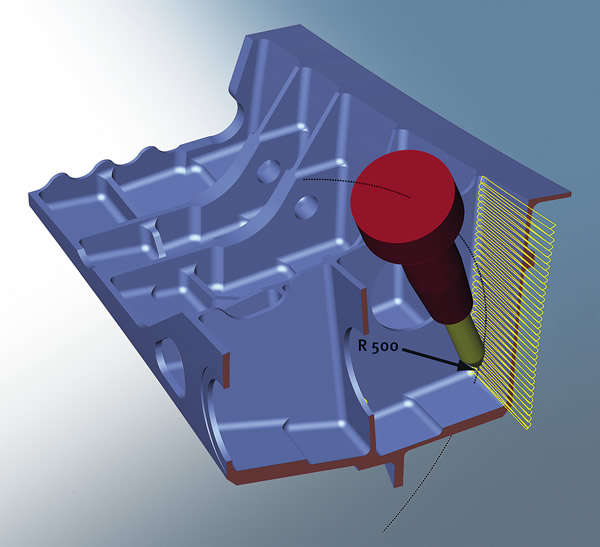
A segment of a structural part is cut with a conical barrel cutter using hyperMILL’s tangent-plane-machining strategy. The conical barrel cutter’s 500mm (19.68″) radius is significantly larger than an equivalent ball endmill, as defined by the cutter shank size.
Open Mind Technologies AG in Germany has developed new programming strategies with its MAXX Machining performance package, which utilizes novel geometry adaptations to barrel cutters. The CAD/CAM software developer innovated the conical barrel cutter, and the tool is now a catalog item from Emuge Corp., West Boylston, Mass. In addition, the tool can be readily ground to order by other toolmakers.
The conical barrel cutter follows the general design of a barrel cutter, with a small arc segment of a large radius on its profile. However, the adaptation positions the arc segment at an angle to the axis of the cutter. This opens the conical barrel cutter to a broader set of applications while delivering the same beneficial results.
The conical barrel cutter also has a radius ground into its bottom. This allows the same cutter to be used for blending, creating fillets and detailing organic shapes.
Review the print ads from this magazine to continue
This quick advertiser review unlocks the rest of the article and keeps the full-screen reader focused on the ads instead of the page chrome.
Advertisers included in this article experience
Print placements connected to this article
Visit www.AMAMCOTool.com/ready_to_ship.
READY TO SHIP:
compression router One of the most popular and effective tools in the aerospace industry—the AMAMCO Compression Router—is now ready to ship, whenever you’re ready to order!
READY TO SHIP: compression router One of the most popular and effective tools in the aerospace industry—the AMAMCO Compression Router—is now ready to ship, whenever you’re ready to order! Visit www.AMAMCOTool.com/ready_to_ship. Or call: 800.833.2239
Visit Visit www.AMAMCOTool.com/ready_to_ship. View this placement in the issue recordPrint ads from this magazine
compression router One of the most popular and effective tools in the aerospace industry—the AMAMCO Compression Router—is now ready to ship, whenever you’re ready to order!
READY TO SHIP: compression router One of the most popular and effective tools in the aerospace industry—the AMAMCO Compression Router—is now ready to ship, whenever you’re ready to order! Visit www.AMAMCOTool.com/ready_to_ship. Or call: 800.833.2239
Continue reading
May 2016
The application set includes machining large automotive molds and dies, which can have a planar surface to facilitate mold locks and clearance surfaces. The tool can also be used to produce large aerospace structural components with pockets that are too deep for traditional swarf milling.
The combination of the new CAM programming strategies and special barrel cutters provides technical benefits. The cone angle on a barrel cutter allows the cutter axis, toolholder and machine spindle to be tilted away from the part surface. Accordingly, applying short barrel cutters can lower cutter costs, enable faster machining parameters and impart finer surface finishes compared to longer ballnose endmills. With proper collision detection and avoidance in the CAM software, the holder, and even the spindle, can confidently enter deep part pockets.
Note that not all CAM software has robust-enough mathematics to ensure that the placement of a cutter does not collide with the workpiece surface. Without high confidence in the CAM calculation, the user may revert to trial and error to define cutter locations in relation to a workpiece.
Open Mind’s hyperMILL machining strategies—tangent plane machining for planar surfaces and tangent machining for ruled or gently arched surfaces—further improve barrel cutters. Surface selections are simple; approach and retract macros effectively control the large radius in corners; additional passes can be taken with the ball end on the bottom of the cutter to clean up and blend fillets and adjoining surfaces; and obstacles can be identified and easily avoided.
The strategies are suitable for 5-axis, simultaneous motion and 3+2 automatic indexing. Some large machines do not readily allow simultaneous motion because of their need to move large machine masses. Automatic indexing, however, produces acceptable surfaces with imperceptible blends.
Because of the large step-overs taken by the barrel cutters, the total toolpath length for a surface is far less than with ballnose endmills. This enables a barrel cutter to produce more parts. For example, a ball endmill cutting a steel block will experience more wear than the barrel cutter, and the potential for a mismatch between different machined regions is greater, especially because more tool wear will dictate more tool changes.
A less obvious application for a barrel cutter is machining the bottom surface of a large pocket, including undercut areas. The conical barrel cutter has a 60° or 70° angle at which the barrel radius is ground into the side of the cutter. The step-over can be five to 10 times larger than that of a ball endmill.
Barrel cutters can play tricks with experienced users who see large step-over witness marks and expect the same rough surface finish that a ball endmill imparts. Test cuts, however, allow tactile feedback, and profilometer readings confirm the surface-finish benefits of a large cutting radius. These benefits will augment the capabilities of CAM software and lead to more applications for conical barrel cutters.