



Walk the line: General Industry Coverage
Part Time column from the January 2010 issue of Cutting Tool Engineering magazine.
View print ads from this spread
Review the ads on this magazine spread to continue reading. Each ad takes two seconds; a two-page ad counts once.
Advertisers on this magazine spread
Print placements on this magazine spread
Phillipsprecision CC
ple, the beam at the floor of the workpiece cavity with a Data Flute 2-flute, ½"- tie everything in together.”
is about 0.200". “If you made that 1⁄32" it dia. ARF (aluminum rougher/finisher) The roughing passes left 0.030" on isn’t going to work. The beam has to reach run at 5,500 rpm and 80 to 100 ipm. the part for finish milling, which was out ½" and support that part,” he said. At this point, programming for the rest performed at 30 to 40 ipm. To put cor-.
ple, the beam at the floor of the workpiece cavity with a Data Flute 2-flute, ½"- tie everything in together.” is about 0.200". “If you made that 1⁄32" it dia. ARF (aluminum rougher/finisher) The roughing passes left 0.030" on isn’t going to work. The beam has to reach run at 5,500 rpm and 80 to 100 ipm. the part for finish milling, which was out ½" and support that part,” he said. At this point, programming for the rest performed at 30 to 40 ipm. To put cor- To machine the computer compo- of the part was incomplete because Phil- ner radii on the top edges of two bosses nent, Phillips worked with a customer- lips wanted to get the part running. He in the cavity, a 3⁄8"-dia. ball mill was em- supplied SolidWorks CAD model and didn’t want to spend time perfecting the ployed. Total run time for the first side programmed the part in Mastercam for program before hitting cycle start because wa
Visit Phillipsprecision CC View this placement in the issue recordPrint ads from this magazine
is about 0.200". “If you made that 1⁄32" it dia. ARF (aluminum rougher/finisher) The roughing passes left 0.030" on isn’t going to work. The beam has to reach run at 5,500 rpm and 80 to 100 ipm. the part for finish milling, which was out ½" and support that part,” he said. At this point, programming for the rest performed at 30 to 40 ipm. To put cor-.
ple, the beam at the floor of the workpiece cavity with a Data Flute 2-flute, ½"- tie everything in together.” is about 0.200". “If you made that 1⁄32" it dia. ARF (aluminum rougher/finisher) The roughing passes left 0.030" on isn’t going to work. The beam has to reach run at 5,500 rpm and 80 to 100 ipm. the part for finish milling, which was out ½" and support that part,” he said. At this point, programming for the rest performed at 30 to 40 ipm. To put cor- To machine the computer compo- of the part was incomplete because Phil- ner radii on the top edges of two bosses nent, Phillips worked with a customer- lips wanted to get the part running. He in the cavity, a 3⁄8"-dia. ball mill was em- supplied SolidWorks CAD model and didn’t want to spend time perfecting the ployed. Total run time for the first side programmed the part in Mastercam for program before hitting cycle start because wa
Continue reading
January 2010
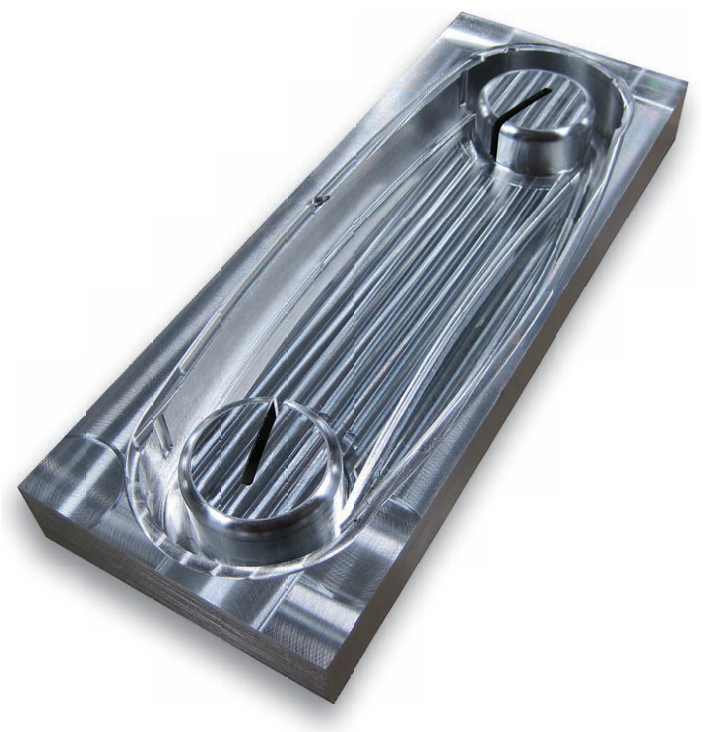
Steve Phillips, owner of full-service prototype and light-run CNC machine shop Phillips Precision Inc., Boylston, Mass., adjusts machining strategies to match customer requirements. To make one prototype copy of an approximately 4 “×14 “×1½ ” aluminum computer component on a rush basis, he employed workholding and machining approaches focused on producing the part as quickly, accurately and reliably as possible.
He calls the workholding method “line-to-line frame support.” The technique can be described as a tightened version of picture framing, in which the workpiece acts as the fixture. In a typical picture-framing situation, a shop machines a part out of the center of a large piece of stock, leaving the part attached to the surrounding “frame” via tabs or tags. The tags are then cut, and their stubs are removed separately. “Support tags are not a bad thing, but then you’ve got a lot of hand work to do,” Phillips said.
In the line-to-line approach, Phillips machines directly to the specified part dimensions. The tool is programmed to cut around the part’s nominal periphery, so stock does not remain, and to the full part depth. Then the stock is flipped on the machine table, and “on the other side, you machine to the line. So you are going line to line on the outside and line to line on the inside,” he said.
Phillips said the process seems counterintuitive. “Your brain is telling you there is no way that thing is going to fall out [of the frame]. In a perfect world, if the cutter was truly dead sharp and there was no tool deflection, it would probably break through.” However, the part remains connected to the frame, hanging by 0.0005 ” to 0.001 ” of material all the way around. The reason, he said, is that the carbide cutters the shop uses “always come in under size” and never cut exactly to size because of side load and tool deflection.
Courtesy of Phillips Precision
Phillips Precision made one prototype copy of an aluminum computer component using a “line-to-line frame support” workholding and machining strategy. The part is shown still encircled in the workpiece stock from which it was machined.
“The corner of the cutter is never going to be perfectly sharp,” Phillips continued. “I’m sure it has a 0.0005 ” to 0.001 ” radius, especially after it has been used. I’ve found you don’t have to fear breaking through.” When machining on both sides of the part is finished, “All you do is take the stock out, give it a rap on the bench and the part will fall out of the frame,” Phillips said.
The key to stability during machining is the small amount of material left between the part and the frame. According to Phillips, the part may be held by a bridge of material about 0.001 ” thick, but there is virtually no gap between the part and the frame. “If you had 0.010 ” gap between the outside and the inside, that 0.001 “-thick bridge isn’t going to be too strong. But the gap is almost nothing.” Any tab material that remains can be removed with minimal hand work.
Phillips said the technique reduces the time required to devise a fixture, especially if the part is delicate or has an irregular shape. The component in this example has a few wall thicknesses of about 0.125 “. “It doesn’t have too many flat surfaces,” Phillips said. “It’s a fairly difficult part to hold, without getting really involved with making fixtures. You’d have to make soft jaws, but they are not going to hold it as accurately as this. This way allows you to hold it very efficiently.”
Although some may think the method consumes too much stock, “we didn’t spend any time making fixtures,” Phillips said. “The price of stock was $44. You can’t make much of a fixture for under $50.”
Another benefit is the part is machined from the heart of the material. Therefore, the final product “is actually more stable because you are not taking it out of one side or the other of the stock, where you have stresses,” Phillips said.
He cautioned that because the frame supports the part, it is important not to skimp on raw stock dimensions. “If you get chintzy with your frame, you are not going to have much to hold onto.”
For example, the stock left at the bottom of the part has to be sufficiently thick. The floor material between the frame and the intersecting cut lines “is what that part is hanging from,” Phillips said. “People may try to machine right down to the floor, then the part starts dancing around in there.” In this example, the beam at the floor of the workpiece is about 0.200 “. “If you made that 1⁄32 ” it isn’t going to work. The beam has to reach out ½ ” and support that part,” he said.
To machine the computer component, Phillips worked with a customer-supplied SolidWorks CAD model and programmed the part in Mastercam for milling on a Haas VF3 YT vertical machining center. Clamped in two vises, the 2 “×6 “×16 ” 6061 aluminum workpiece had about 1 ” of excess material around the part’s periphery for support.
First, Phillips faced the top of the stock at a 100-ipm feed rate and 4,000 rpm with a 2 “-dia. Shear-Hog high-shear facemill from AB Tool. “We face the top so we can get our tool heights off the machined surface,” Phillips said. “The bar stock can be kind of rough, and we try to get that so it is squared up and decent.”
Then Phillips began to rough the part cavity with a Data Flute 2-flute, ½ “-dia. ARF (aluminum rougher/finisher) run at 5,500 rpm and 80 to 100 ipm. At this point, programming for the rest of the part was incomplete because Phillips wanted to get the part running. He didn’t want to spend time perfecting the program before hitting cycle start because the machine is sitting idle in the meantime. The first roughing program consumed an hour and provided “an hour of free programming time,” Phillips said. While that program ran, he programmed the next longest cycle and put it in the queue on the machine.
DOC for the cavity roughing was 0.050 “. “We didn’t want to rough with ¼ ” DOC, because then you lose detail,” Phillips said. In the same program, “we shifted our Y-axis and put a nice clean edge on that part, so when we flipped it we could pick up the machined edge and tie everything in together.”
The roughing passes left 0.030 ” on the part for finish milling, which was performed at 30 to 40 ipm. To put corner radii on the top edges of two bosses in the cavity, a 3⁄8 “-dia. ball mill was employed. Total run time for the first side was about 3 hours.
Phillips said machining the back side involved pocketing and minor details, and consumed about 1 hour and 50 minutes.
Phillips said the shop was confident about the effectiveness of its strategies, and cut just one piece of stock for the one-part job. “Our customer was anxious to get the part,” Phillips noted, adding that he turned the project around in 4 business days. CTE
For more information about Phillips Precision Inc., call (508) 869-3344 or visit www.phillipsprecision.cc.
Glossary terms in this article
Related



Subscribers can use MFGAxis notes, saves and discussion tools with their innoNET account.


