


Finish line: Drilling Performance
Finishing hardened workpieces on multitask machines that provide grinding and hard turning and/or hard milling capabilities can prove beneficial.
View print ads from this spread
Review the ads on this magazine spread to continue reading. Each ad takes two seconds; a two-page ad counts once.
Advertisers on this magazine spread
Print placements on this magazine spread
Abrasive Tech
MaZgdlmh:Ml hg&lbm^oblbm %p^bg\k^Zl^]
hnk\r\e^mbf^l bfikho^]^_Û\b^g\r' Hnk\nmmbg`kZm^bl 1q`k^Zm^knlbg` :Mllni^kZ[kZlbo^`kbg]bg`pa^^el' P^\Zeebmma^ FbkZ\e^Pa^^e ;rl^e^\mbg`:MlI';'L'pa^^el%p^ \nm\hlml[r/) ' Mnkgbg`rhnk\aZee^g`^lbgmhln\\^lllmhkb^l' We pride ourselves on the lasting impressions we’ve made with customers. You’ll find our superabrasive.
MaZgdlmh:Ml hg&lbm^oblbm %p^bg\k^Zl^] hnk\r\e^mbf^l bfikho^]^_Û\b^g\r' Hnk\nmmbg`kZm^bl 1q`k^Zm^knlbg` :Mllni^kZ[kZlbo^`kbg]bg`pa^^el' P^\Zeebmma^ FbkZ\e^Pa^^e ;rl^e^\mbg`:MlI';'L'pa^^el%p^ \nm\hlml[r/) '
Visit Abrasive Tech View this placement in the issue recordPrint ads from this magazine
hnk\r\e^mbf^l bfikho^]^_Û\b^g\r' Hnk\nmmbg`kZm^bl 1q`k^Zm^knlbg` :Mllni^kZ[kZlbo^`kbg]bg`pa^^el' P^\Zeebmma^ FbkZ\e^Pa^^e ;rl^e^\mbg`:MlI';'L'pa^^el%p^ \nm\hlml[r/) ' Mnkgbg`rhnk\aZee^g`^lbgmhln\\^lllmhkb^l' We pride ourselves on the lasting impressions we’ve made with customers. You’ll find our superabrasive.
MaZgdlmh:Ml hg&lbm^oblbm %p^bg\k^Zl^] hnk\r\e^mbf^l bfikho^]^_Û\b^g\r' Hnk\nmmbg`kZm^bl 1q`k^Zm^knlbg` :Mllni^kZ[kZlbo^`kbg]bg`pa^^el' P^\Zeebmma^ FbkZ\e^Pa^^e ;rl^e^\mbg`:MlI';'L'pa^^el%p^ \nm\hlml[r/) '
Continue reading
January 2010
Finishing hardened workpieces on multitask machines that provide grinding and hard turning and/or hard milling capabilities can prove beneficial.
Multitask machines are typically thought of as providing milling and turning operations, but applications are increasing for machines that perform grinding and turning and/or milling to finish workpieces hardened up to about 65 HRC in one setup.

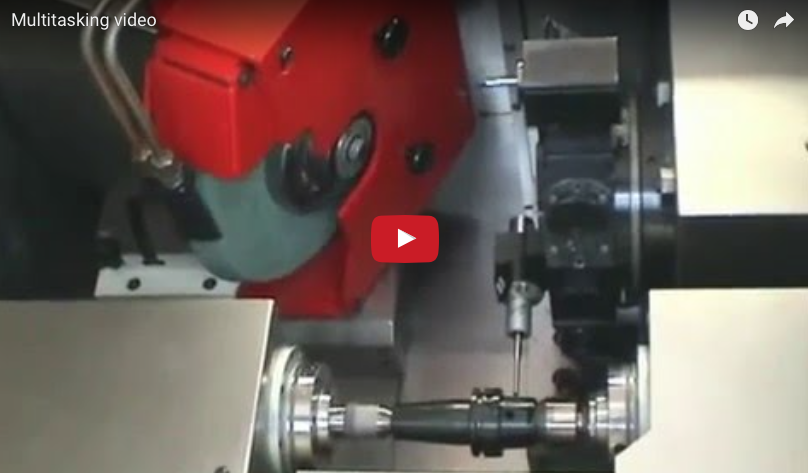
View a video courtesy of United Grinding Technologies. A Studer brand S242 machine, which combines hard milling and grinding, is shown hard milling a toolholder without coolant, then grinding the holder’s taper with coolant to achieve the required surface finish.
The trend is being driven by the need to have the highest quality part at the lowest cost per component, according to Gary Hulihan, who recently retired from EMAG LLC USA. The Farmington Hills, Mich., machine tool builder offers an array of equipment for “hard finishing,” such as the VTC 315 DS for vertical turning and grinding of demanding shaft-type components. “Hard finishing to complete a part merits that type of machine because it eliminates handling between separate machines, increasing accuracy,” he said.
Jeff Reinert, president and CEO of INDEX Corp., Noblesville, Ind., agreed that finishing a part in one operation increases part accuracy by never releasing the part before it’s completed. “It maintains part alignment and the orientation between part features,” he said.
Courtesy of INDEX
The C200 CNC production turning machine from INDEX can be configured to provide grinding. (Additional information on this machine is available in the online version of this article at ctemag.com.)
Courtesy of Bohle Machine Tools
The work area on a Buderus Schleiftechnik multitask machine from Bohle Machine Tools with an ID grinding wheel on the left and a turning tool on the right.
INDEX has been building its V product line of vertical lathes for turning, milling and grinding in one machine and recently introduced the C200, which can be configured for hard finishing. “In the C machines, we may reposition the part from the main spindle to the counterspindle, so there would be minimal possibility of misalignment and the orientation is never changed because the spindles are in sync with each other,” Reinert said. “The part is never released from the main spindle until the counterspindle has clamped on it.”
For example, when a part is turned and ground in one clamping, the TIR between the machined diameters is only about 2μm, noted Wolfgang Henkel, vice president of Bohle Machine Tools Inc., Plymouth, Mich., which distributes the German-made multitask machines from Buderus Schleiftechnik. “Each reclamping can generate a TIR error of 10μm,” he said.
Hard finishing for the roughing operation can also reduce cycle time. That’s the case, Henkel pointed out, when the stock to be removed is greater than the 0.2mm to 0.3mm (0.008 ” to 0.012 “) typical for removal via grinding, and then only about 0.05mm (0.002 “) remains for grinding after hard turning.
Hard turning is faster than grinding but it is not able to impart as fine a surface finish as grinding, and turning is unable to remove material in increments as small as grinding can. Grinding can remove millionths of an inch of material, according to Guenter Schad, technical manager at INDEX. “If you’re hard turning, you need to allow for sufficient depth of cut, and this depends on tool geometry,” he said. “This is typically 0.002 ” or more to permit the insert to break the part surface.”
“That comes with the territory when dealing with hardened materials—you get one chance to do hard turning,” concurred Tyler Economan, proposal engineer at INDEX, who noted that with hard turning and grinding in the same operation, the end user could leave as little as 0.02mm (0.0008 “) of material for grinding, thereby reducing grinding time.
Hard milling might also rough a feature prior to grinding, and it could be used to machine features not accessible to a conventional grinding wheel. Reinert noted that an end user, for example, can stop the main spindle on the C200 and move a second grinding wheel in and out using the Y-axis capability of the machine’s lower tool turret to grind a flat across the part. “You can’t do that on a regular grinder,” he said.
Gone with Grinding?
Hard turning and hard milling to tolerance specifications have long been considered alternatives to grinding, but the applications where those processes could effectively substitute for grinding were fewer than they are today, according to Jim Endsley, product specialist for machining centers at Okuma America Corp., Charlotte, N.C., which doesn’t build special multitask machines for hard finishing. He noted that 5 to 10 years ago, about 5 percent of hard milling applications could achieve single-digit microfinishes comparable to grinding without tool marks or lead lines. “Today, it’s as high as 60 or 70 percent of the time, and it’s mainly through tooling and technique” Endsley said, adding that developments in cutting tools and machine tools are now advancing together, which benefits hard milling, rather than leapfrogging each other. “You could never get that happy balance.”
To determine which machine processes a customer needs to achieve the required part specifications, United Grinding Technologies Inc. uses a matrix, explained Hans Ueltschi, vice president of the Miamisburg, Ohio, machine tool builder. “It depends on the quality requirement,” he said, “and there is a band where we can go either way: grinding or turning.”
Courtesy of United Grinding Technologies
The interior of the Schaudt CombiGrind S242 machine is shown equipped with a grinding wheel and the tool magazine.
United Grinding’s Schaudt brand offers the CombiGrind for grinding IDs and ODs, hard turning, milling, brushing and gaging in one setup. The vertical version is a chucker and the horizontal version is more for shaft-type work. According to the company, Combi- Grind machines are for mass production of components and subassemblies in the automotive and supply industries. That would include a parts manufacturer supplying a family of parts to different OEMs that have varying standards. “Fundamentally, there’s no difference in the part [family] other than maybe size and shape,” Ueltschi said. He noted that a job shop would probably opt for separate machines.
In addition, the company’s Mägerle MGC surface profile grinder is capable of milling and drilling.
Ueltschi outlined several examples where it makes sense to hard turn and grind on one machine. More toolholders are processed that way because they have many features suitable for hard turning, but the tapered area that interfaces with the machine tool spindle must be ground. A multitask machine allows the customer to changeover with minimal setup time because he doesn’t necessarily have to reprofile grinding wheels, where one set of wheels is sufficient to grind different toolholder tapers and different toolholder sizes.
Components with interrupted surfaces can be another suitable application. “Interrupted surfaces have a negative impact on turning tooling and they usually determine whether a part can be hard turned or not,” Ueltschi said.
In addition, long, highly cylindrical, small-diameter bores often require finish grinding to impart the needed surface finish after turning because it’s difficult to avoid generating a taper when grinding them completely, according to Ueltschi.
Conversely, as end users continue to process more exotic alloys that are increasingly difficult to machine, hard turning is eliminated as an option when a material can only be effectively ground, Ueltschi noted.
Courtesy of Usach Technologies
Hard milling (top) a precision three-lobe tapered polygon removed 1⁄8 ” or more of material per lobe before grinding took off the remaining 0.008 ” per side.
Martin Nobs, engineering manager for Usach Technologies Inc., an Elgin, Ill., grinding machine tool builder, recalled an application where an end user needed to produce a precision three-lobe tapered polygon from a cylinder that justified the combination of hard milling and grinding in one operation. Hard milling removed 1⁄8 ” or more of material per lobe and grinding took off the remaining 0.008 ” per side. In addition, the part required nonround ID grinding. The processing of the male part, using OD hard milling and OD grinding, and the female part, using ID hard milling and ID grinding, is achievable in one machine with a multiple-spindle turret.
According to Nobs, the finish grinding accuracy requirement was the determining factor with a form accuracy tolerance of less than 0.0001 “. Achieving that accuracy for a nonround and tapered part on two machines would have been challenging because the end user would have needed to determine exactly where the zero position was in the rotary axis when reorienting the part on the second machine. “If you machine it in the same setup, you don’t need to worry about it because you know where it is,” Nobs said. “Multitasking made sense in this application, simplifying the overall process by eliminating part reorientation.”
Selecting the Process
On the other hand, Bohle Machine Tools’ Henkel noted that multitasking isn’t always the best route to finish hardened parts. It’s not appropriate when only a single grinding pass is needed to remove a small amount of stock. Another example is if the required cutting speed of 150 to 200 m/min. for hard turning cannot be achieved; then only grinding is appropriate because significantly less rpm is required.
Excessive chip generation can also make multitask hard finishing impractical. If, for example, hard turning produces a large quantity of long chips that might get caught in the part and damage the grinding wheel if not manually removed, then multitasking doesn’t make sense, according to Nobs. “After all, a grinding machine is not a turning machine and vice versa,” he said. “It’s a combination that has to make sense. You don’t want to do it just for the sake of doing it.”
The small chips, or swarf, grinding produces and the grit from the grinding wheel can also cause problems on a multitasking machine, according to Okuma’s Endsley. He noted that, traditionally, a grinder is sealed more completely than a multitasking lathe or machining center, where the swarf and grit can penetrate way covers and wiper systems and cause long-term damage to the machine.
For customers interested in performing grinding, Endsley noted that Okuma can help seal the machine with a graphite electrode machining package because graphite accesses machine locations similar to grinding swarf and grit. “We can seal a machine much better today than even 5 years ago,” he said.
Courtesy of INDEX
Taper grinding is one of the grinding operations end users can perform on the INDEX C200 CNC production turning machine.
Schad countered that grinding swarf isn’t much of an issue in this application because only a small amount of stock is ground. Economan added that fine coolant filtration using paper media to remove particles as small as 5μm ensures that all of the coolant returning to the machine contains only a minute amount of particulate matter. Magnetic chip removal is another option. “The ferrous grinding dust that sinks to the bottom of the coolant in the machine can be removed with a magnetic chip conveyor if that works for a customer’s particular process,” Economan said.
In addition, some multitask machines for hard finishing are initially intended for grinding and sealed accordingly. “As we come from the grinding field, these machines are more designed and engineered as a primary grinding machine where we’re adding turning or milling—where other people are probably coming more from the machining center and turning field and adding grinding capabilities,” said United Grinding’s Ueltschi.
Applications Abound
Although some multitask machines that provide grinding and hard turning and/or hard milling capabilities are for producing a specific product or product family, others are suitable for processing various parts, including turbocharger shafts, bearings and hydraulic valve spools. “The C200 is versatile for any part of an appropriate size for the machine,” Reinert said. “And, absolutely, it is suitable for prototyping or small lot sizes.”
He added that hard finishing parts complete in one chucking provides numerous benefits. One machine is needed instead of two, reducing the overhead cost, the cost of in-process inventory between two machines and the associated labor expenses. “One operator can tend a grinding machine and a turning machine, but this requires two setups and therefore a greater possibility of scrap,” Reinert said. “Neither machine is dropping complete, finished parts and the total in-process time is much longer.
In addition, hard finishing can reduce cycle time. For example, turning and grinding of a control gear in one chucking on United Grinding’s CombiGrind can reduce processing time by 25 percent, according to the company.
Bohle Machine Tools’ Henkel pointed out that hard turning and grinding in one machine is a common application for finishing gears for cars, trucks and heavy transmissions, particularly in Europe, and multitasking can reduce the cycle time by 20 percent. “The cycle time should be calculated each time before deciding on multitasking,” he said.
Hard finishing can also open the door to new applications. “Any new technology a job shop brings in the door will cause whoever does the quoting or estimating to say, ‘I’ve been looking at parts like these for a long time and we never had the capability of doing them. Now we do,'” said Economan. “So when you quote them, you may win those jobs.” CTE
About the Author: Alan Richter is editor of Cutting Tool Engineering, having joined the publication in 2000. Contact him at (847) 714-0175 or alanr@jwr.com.
Courtesy of Mori Seiki
Mori Seiki and Tyrolit are developing Grind Hardening to heat treat parts via grinding with special wheels. Mori Seiki is working to commercialize the technology and reviewing applications for beta-testing sites.
Heat treatment via grinding
Parts manufacturers have identified the elimination of heat treatment as the single greatest opportunity for reducing energy consumption in and the environmental footprint of typical machining of ferrous materials, according to Mori Seiki USA Inc., Hoffman Estates, Ill. Together with grinding wheel manufacturer Tyrolit, the machine tool builder’s Machining Technology Laboratory is developing a grinding process called “Grind Hardening” that heat treats a workpiece using special grinding wheels instead of sending it out for heat treatment. The capability to surface-harden carbon steels to 52 to 62 HRC with a hardness depth of 0.5mm to 2.5mm has been demonstrated in trials.
Another test hardened 4140 steel to 60 HRC, noted Tomohiko Hayashi, team leader, engineering for Mori Seiki. The process, however, is not without challenges. “The grinding conditions must be tailored to the specific alloy and are particularly sensitive to carbon content,” he said. “Considering the great range of potential alloys and customer specifications in terms of hardness and depth, hundreds of trials will be required to map out solutions for every application.”
Mori Seiki stated that additional trials will determine the cutting conditions required to extend the range of hardness, depth and materials to which the process can be applied. Many materials suitable for flame or induction surface hardening have proven to be suitable.
Hayashi added that Grind Hardening can be integrated with other machining operations, such as hard turning, on machines such as Mori Seiki’s NT4200DCG. There, grinding is performed on the upper turret and the lower turret has the rotary dresser. The lower turret’s built-in motor can control the coolant nozzle direction, and coolant is applied for cleaning the wheel and not for cooling.
Special options are required, such as a wheel cover in case the wheel breaks, to assure safe operation.
According to Mori Seiki, the process is “green” because it reduces carbon emissions and energy consumption. Two recent case studies documented energy reductions of 72 and 73 percent.
—A. Richter
Courtesy of Usach Technologies
Simultaneous grinding of a transmission shaft.
Multigrinding in one setup
Multitask machining isn’t always about combining different processes. It sometimes involves multiple operations, such as different grinding operations completed in a continuous cycle in one machine. Martin Nobs, engineering manager for Usach Technologies Inc., provided the example of a combination of ID and OD grinding in one setup where both setups are optimized. “You can choose the correct grinding wheels and the correct grinding spindles for each operation, and combine that in a machine to achieve the proper features in one part clamping,” he said.
He noted that Usach’s specialty is combining grinding tasks in one setup. In one example, Usach replaced five grinding machines with one for a customer producing crankshafts, which also reduced part handling fivefold. “It would still be a multitasking operation—task means to grind one operation—if you can combine five different ones that are quite different in nature even though they’re still all grinding,” Nobs said.
He also mentioned that multitasking can take place simultaneously in a grinding machine. For example, Usach completed a large automotive project that involved several grinding machines setup to simultaneously grind the two ends of a transmission shaft in one operation using two independent wheelheads. This type of multitasking allowed the end user to purchase four machines instead of eight, reducing the required floor space and simplifying the automation system.
—A. Richter
Contributors
Bohle Machine Tools Inc.
(734) 414-8220
www.bmtbohle.com
EMAG LLC USA
(248) 477-7440
www.emag.com
INDEX Corp.
(317) 770-6300
www.index-usa.com
Mori Seiki USA Inc.
(847) 472-9107
www.moriseikius.com/mtl
Okuma America Corp.
(704) 588-7000
www.okuma.com
United Grinding Technologies Inc.
(937) 859-1975
www.grinding.com
Usach Technologies Inc.
(847) 888-0148
www.usach.com
Courtesy of INDEX
An INDEX C200 CNC production turning machine configured with two upper turrets and one lower turret.
Rigid by design
Taking heavier rather than typical cuts (greater than 0.010 ” to 0.020 ” per pass) during hard turning operations with minimal vibration extends tool life and boosts productivity. To achieve that requires an exceptionally rigid machine tool. According to INDEX Corp., its C200 CNC production turning machine has a unique slide way system with single-slide technology, providing two degrees of freedom in one plane and increased rigidity.
“With the single-slide technology, the slide for the tool carrier with metal-on-metal contact is assembled around an opening in the machine bed, allowing for a very rigid, high-dampening, highly dynamic situation for the X- and Z-axis movements,” said Tyler Economan, proposal engineer at INDEX. He added that the design can increase tool life up to 30 percent.
Jeff Reinert, the machine tool builder’s president and CEO, explained that the way system consists of two surface-hardened and match-ground solid ways—top and bottom—which are bolted together through an opening in the casting. This enables the X-axis and Z-axis to move simultaneously within that space. The ways are lubricated through the central oil system and one of the ways has a ceramic coating that significantly reduces wear and friction.
“With the C200, we are using a box-type machine only modernized,” added Guenter Schad, the company’s technical manager. “Instead of having a bed slide and a top slide for the X and Z movement, everything is combined in one slide.”
By having one integrated slide system and not having an X-axis slide system on top of a Z-axis slide system to move the tool carrier, the tool carrier is as close as possible to the machine bed, the spindles and the area where cutting occurs. “Any time you’re locating a tool carrier farther away from where you need it to be for cutting, you’re adding an opportunity for reduced vibration dampening and rigidity and, as a result, for quality to suffer,” Economan said.
As an example of the machine’s stability, Reinert noted that during a test cut on an Inconel part, half the test was performed one day, the machine was turned off, and the second half was performed the next without a warm-up cycle. “The accuracy of the first part on the second day was very close to the last part on the first day, far less than 0.001 ” difference,” he said, “and the subsequent parts on the second run were right on.”
INDEX can configure the C200 three ways: with two upper turrets and one lower turret, with one upper and one lower turret and with a grinding wheel on top and a lower turret.
—A. Richter
Glossary terms in this article
Related


Subscribers can use MFGAxis notes, saves and discussion tools with their innoNET account.