



Made in America: repeatable precision
Part Time column for March 2010 issue of Cutting Tool Engineering magazine.
View print ads from this spread
Review the ads on this magazine spread to continue reading. Each ad takes two seconds; a two-page ad counts once.
Advertisers on this magazine spread
Print placements on this magazine spread
©2010 Makino WHERE NEW THINKING TAKES SHAPE.
OUR APPLICATION ENGINEERS LOVE THE SCARY PARTS.
Makino Engineering Services has an unmatched history of creating robust production-ready processes—including machinery, fixtures, tools, programs and documentation—for parts with complex geometries, demanding deadlines, challenging budget constraints and Six Sigma standards. We’ve solved production challenges and engineered tightly integrated manufacturing.
OUR APPLICATION ENGINEERS LOVE THE SCARY PARTS. Makino Engineering Services has an unmatched history of creating robust production-ready processes—including machinery, fixtures, tools, programs and documentation—for parts with complex geometries, demanding deadlines, challenging budget constraints and Six Sigma standards. We’ve solved production challenges and engineered tightly integrated manufacturing systems for hundreds of manufacturers. All with a guaranteed cycle time, lower cost per part and improved quality. Don’t be afraid of the part. Visit us at www.makino.com/engineering or call 1-800-552-3288. ©2010 Makino WHERE NEW THINKING TAKES SHAPE. IS #40
Visit ©2010 Makino WHERE NEW THINKING TAKES SHAPE. View this placement in the issue recordPrint ads from this magazine
Makino Engineering Services has an unmatched history of creating robust production-ready processes—including machinery, fixtures, tools, programs and documentation—for parts with complex geometries, demanding deadlines, challenging budget constraints and Six Sigma standards. We’ve solved production challenges and engineered tightly integrated manufacturing.
OUR APPLICATION ENGINEERS LOVE THE SCARY PARTS. Makino Engineering Services has an unmatched history of creating robust production-ready processes—including machinery, fixtures, tools, programs and documentation—for parts with complex geometries, demanding deadlines, challenging budget constraints and Six Sigma standards. We’ve solved production challenges and engineered tightly integrated manufacturing systems for hundreds of manufacturers. All with a guaranteed cycle time, lower cost per part and improved quality. Don’t be afraid of the part. Visit us at www.makino.com/engineering or call 1-800-552-3288. ©2010 Makino WHERE NEW THINKING TAKES SHAPE. IS #40
Continue reading
March 2010
Henry Repeating Arms Co., Bayonne, N.J., sells collectable repeating rifles and vows its products “will only be made in America or they won’t be made at all.” Helping fulfill that pledge is Lesleh Precision Inc. (LPI), Belle Vernon, Pa., which machines aluminum-bronze receivers and trigger plates for Henry Repeating Arms’ version of the 147-year-old-design, lever-action rifle that “won the West.”
LPI has been providing CNC machining services to the electrical, mining, military and other industries since 1999. About 2 years ago, following a reference from PIAD Precision Casting, Greensburg, Pa., which makes castings for the receivers, LPI began machining the castings.
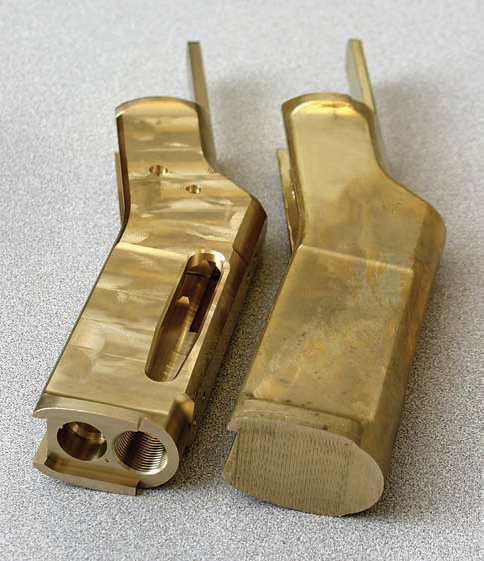
The machining process that LPI developed for the approximately 7.5 “×1.8 “×1.3 ” receivers emphasizes efficiency and quality. Kevin Yuhas, LPI’s manufacturing engineer, programmed the parts in GibbsCAM, noting that the aluminum-bronze casting material “makes pretty nice chips, but it is abrasive.” As a result, most of the machining is done with coated carbide tools, primarily from Iscar Metals. “We’ve had good luck using their tools with carbide shanks and screw-on cutting heads for milling,” he said.
Much of the machining is accomplished in two groups of operations performed on two Doosan Daewoo horizontal machining centers. To maximize throughput in the first set of operations, LPI designed a fixture to hold eight castings at a time. The shop enlisted PRZ Technologies, Lancaster, N.Y., a builder of hydraulic and manual workholders, to engineer hydraulics for the fixtures, which LPI’s machinist built in-house.
Key operations performed in the first fixturing include drilling an axial 0.681 “-dia. hole for the cartridge magazine and using a custom solid-carbide, through-coolant drill applied at 2,000 rpm and 10 ipm. Then, to accept the threaded end of the octagonal rifle barrel, a 0.702 “-dia. hole is drilled above the magazine hole and threaded with an Iscar ¾×20 thread mill. Project Engineer Tom Lofink said making the thread “is a little tricky” because it must be timed, or started, at a certain location to assure that when the barrel is screwed into the receiver at a specified torque, the flats on the barrel line up with the receiver’s top and side surfaces. Yuhas said Henry Arms provided a reference point at which he programmed the thread to begin.
Other operations performed in the first fixturing include milling of various contours, drilling and tapping. Tolerances are generally ±0.002 “.
When the operations on the first machine are complete, the receivers are loaded into a vibratory deburring unit where they are tumbled in a ceramic medium for about 30 minutes.
Courtesy of B. Kennedy
In a process that includes custom fixtures and tools, Lesleh Precision machines an aluminum-bronze casting (right) for the receiver of a lever-action rifle.
In the second HMC, a fixture holds four receivers at a time. Contours of the receiver sides are milled with an Iscar 1¼ “-dia. endmill tooled with two inserts and run at 4,000 rpm and 33 ipm. Yuhas said the cutting parameters are “not particularly fast” and were chosen to minimize vibration generated by the relatively large tool and thereby preserve surface finish. Next, a ½ “-dia., solid-carbide, ballnose mill radiuses the edges of the receiver at 9,000 rpm and 120 ipm. The tool runs fast “because we can,” Yuhas said. “We just kept pushing it and settled on something where we weren’t getting a lot of tool wear and it was getting done fast.” Other operations in this fixturing include drilling and tapping bolt holes in the sides of the receiver.
Depending on demand, LPI makes about 500 receivers a week, including one version for 0.30-30 cartridges and another to accommodate 0.357, 0.44 magnum and 0.45 caliber rounds.
After the operations on the two HMCs, the receivers move to a vertical machining center with three different fixtures on the machine table. Three sets of operations take place on the machine, and the operator moves the receivers in sequence from fixture to fixture as the operations are completed.
In the first fixture, an Iscar 5⁄16 “-dia. interchangeable-head milling cutter plunges into the part to cut a 0.530 “-wide × 2.90 “-long ejection port slot and put a 0.040 “×45° chamfer on the slot edge. The endmill also machines some details in the receiver interior.
In the second fixture, LPI employs a custom T-shaped, 2-flute keyseat cutter manufactured by Custom Tool and Grinding, Washington, Pa., to cut an interior slot that provides clearance for the rifle lever. The flutes span a diameter of 0.750 ” but are only 0.480 ” wide × 0.188 ” thick, enabling them to fit through the 0.530 “-wide ejector slot cut in the previous fixturing. The tool is stationary when it is moved down through the ejector slot, spins to cut the clearance feature and then is stopped for withdrawal. Yuhas, who designed the cutter, said, “It doesn’t run real fast–1,000 rpm and 7 ipm–due to its small 0.250 “-dia. shank.” A 3mm-dia., 2-flute endmill with a relatively long 1¾ ” reach then finishes interior details.
In the last fixture on the VMC, a 0.156 “-dia., solid-carbide endmill machines a 0.050 “-deep × 1.0 “-long × 0.156 “-wide pocket where the serial number will be engraved.
A locking bolt slot inside the receiver features square shoulders that can’t be cut with a round endmill, so the receiver next goes to a punch press, where it is clamped in a hydraulic fixture for broaching. “We get the slot as close as we can with the endmill, but broaching is the only way to make the square shoulders,” Lofink said. “We go down in one shot with an M-2 steel broaching tool from Anchor Danly Co.” The tool cuts the square corners and 0.005 ” to 0.006 ” from each side of the slot.
Finally, the receivers are put in a programmable Pannier Corp. engraving machine, where each one is marked with an individual serial number.
Total cutting time per receiver is 44 minutes, but a part is completed every 18 minutes because of the way they are cycled through the HMCs. CTE
For more information about Lesleh Precision Inc., call (724) 489-4538 or visit www.lesleh.com.
Glossary terms in this article
Related


Subscribers can use MFGAxis notes, saves and discussion tools with their innoNET account.


