

Smooth flight: Medical Manufacturing
Jet-engine manufacturing typically requires through-holes that accommodate fasteners for various components and subassemblies. These through-holes must be chamfered, free of burrs and have radiused edge transitions.
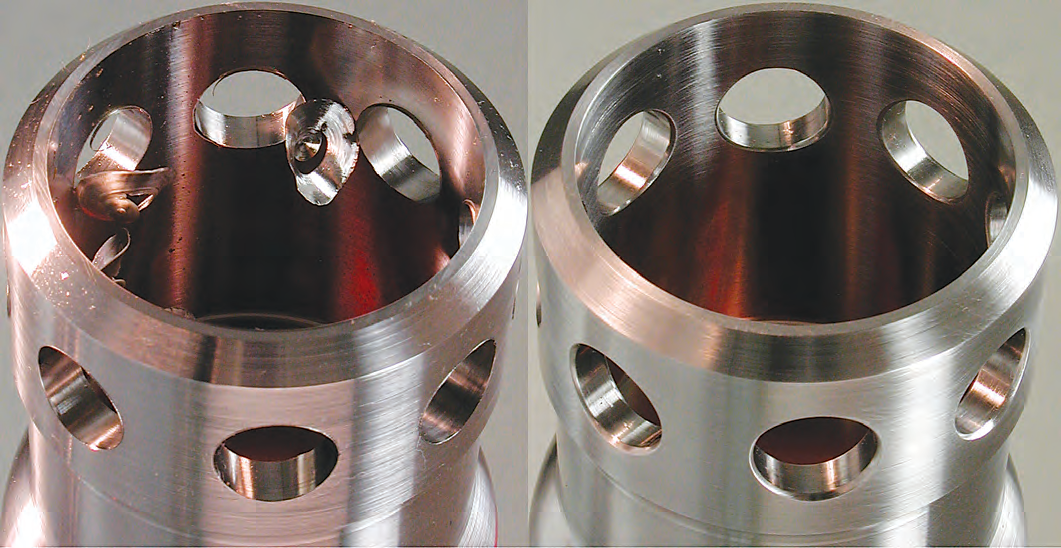
Courtesy of All images: Brush Research Manufacturing
Heule cutting tools, along with BRM’s Flex-Hone tools, remove burrs and caps created when drilling holes in nickel, Inconel, Waspalloy, titanium and stainless steels. A precise, smooth though-hole is critical for aerospace parts.
A set of tools is used to automate drilling, reaming, deburring and edge blending of chamfered through-holes for jet-engine fasteners.
Jet-engine manufacturing typically requires through-holes that accommodate fasteners for various components and subassemblies. These through-holes must be chamfered, free of burrs and have radiused edge transitions.
“Every jet engine includes many static and rotating parts,” said Gary Brown, vice president and general manager of Heule Tool of North America Corp., Cincinnati. “Hole drilling and edge-breaking processes must be performed perfectly so that these parts stay together—particularly rotating parts. We stress making good through-holes by drilling, milling or reaming—whatever process is called for.”
Brown added that aircraft engine manufacturers demand controlled holemaking and edge-breaking processes so the parts come off their CNC machines finished and to spec. In particular, these manufacturers want to avoid costly and time-consuming bench operations, where components are deburred and finished by hand.
When cutting nickel-base and titanium alloys, drills and reamers quickly dull and can create large, extruded burrs that are difficult to remove. Burrs created from improper machining are also difficult to remove because they tend to workharden.
Combination of Tools
To avoid delays and reduce tool costs, some aerospace manufacturers are automating holemaking and finishing processes that incorporate cutting, edge-breaking and deburring tools as well as ball-style flexible hones for the edge blending process. Some jet-engine manufacturers are recommending or requiring that suppliers use these automated processes.
One such combination uses Heule’s DEFA chamfering tool, its COFA universal deburring tool and a miniature Flex-Hone tool from Brush Research Manufacturing Co. Inc. (BRM), Los Angeles.
The DEFA tool, available in sizes from 0.157 ” to 1.750 “, is a double-bladed chamfering tool that creates pre-adjusted front and back chamfers in a single pass without stopping or reversing the spindle. Using this tool, Heule reports that exact chamfer diameters can be set without trial and error.
The COFA tool blade, available in sizes from 0.157 ” to 1.614 “, cuts a smooth, tapered edge break from 0.005 ” to 0.020 “, based on the tool size. A cassette option is available for larger holes. The patented design incorporates a unique TiN- or TiAlN-coated carbide blade that allows for faster feeds and speeds and provides long tool life, according to Heule.
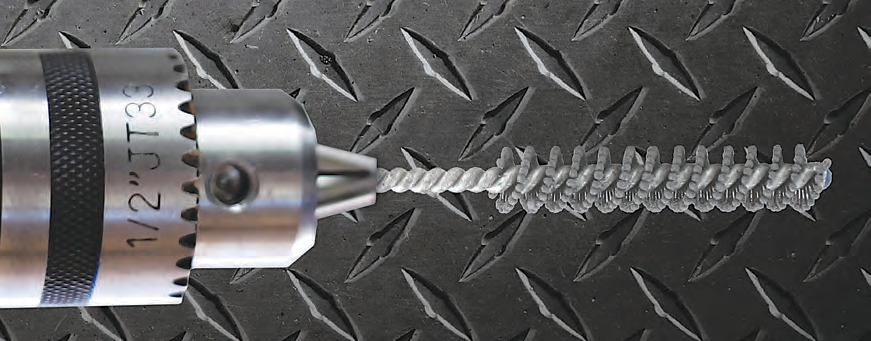
In combination with Heule cutting tools, a major jet engine component manufacturer applies the Flex-Hone from Brush Research Manufacturing on the machining center for final deburring of through-holes, which is usually an expensive and time-consuming manual operation.
In combination with Heule cutting tools, the BRM Flex-Hone is used for final deburring and edge blending of through-holes. “Our tool produces radiused edges on the front and back of the metal part and removes the drill burrs and drill caps created by the drill, reamer or endmill,” Brown said. “Our tools also perform the edge-breaking step, but we recommend the Flex-Hone to go in after the beveled edges have been created to round the transition between the beveled edge and the hole.”
Brown noted that drilling workpiece materials that produce long chips, such as stainless steel and titanium, can create raised material around the hole. The Flex-Hone is effective for removing such burrs up to 0.003 ” in length.
Review the print ads from this magazine to continue
This quick advertiser review unlocks the rest of the article and keeps the full-screen reader focused on the ads instead of the page chrome.
Advertisers included in this article experience
Print placements connected to this article
Visit Toolmex at:
c SMART EXPERTS c INSIDER SAVVY c INDUSTRY EXPERTISE c A PARTNER YOU CAN COUNT ON
For more than 40 years, Toolmex has been your trusted source for the world’s most durable and reliable Workholding and tooling products. And now, we’ve redefined the standard of excellence: we are moving to the next level with Toolmex TMX Chucks for all of your Workholding needs. From manual chucks and power chucks to customized.
c SMART EXPERTS c INSIDER SAVVY c INDUSTRY EXPERTISE c A PARTNER YOU CAN COUNT ON For more than 40 years, Toolmex has been your trusted source for the world’s most durable and reliable Workholding and tooling products. And now, we’ve redefined the standard of excellence: we are moving to the next level with Toolmex TMX Chucks for all of your Workholding needs. From manual chucks and power chucks to customized Workholding solutions, we have a full range of quality products that help you achieve unparalleled productivity with confidence. When you need the right products for the job, turn to Toolmex for simple, reliable, high-value chucks to make your job easier. Visit Toolmex at:
Visit Visit Toolmex at: View this placement in the issue recordPrint ads from this magazine
For more than 40 years, Toolmex has been your trusted source for the world’s most durable and reliable Workholding and tooling products. And now, we’ve redefined the standard of excellence: we are moving to the next level with Toolmex TMX Chucks for all of your Workholding needs. From manual chucks and power chucks to customized.
c SMART EXPERTS c INSIDER SAVVY c INDUSTRY EXPERTISE c A PARTNER YOU CAN COUNT ON For more than 40 years, Toolmex has been your trusted source for the world’s most durable and reliable Workholding and tooling products. And now, we’ve redefined the standard of excellence: we are moving to the next level with Toolmex TMX Chucks for all of your Workholding needs. From manual chucks and power chucks to customized Workholding solutions, we have a full range of quality products that help you achieve unparalleled productivity with confidence. When you need the right products for the job, turn to Toolmex for simple, reliable, high-value chucks to make your job easier. Visit Toolmex at:
Continue reading
August 2010
The Flex-Hone is available in various abrasive types and grit selections to provide optimal surface finishes on base materials. It is commonly used to reduce Ra, Rk and Rpk values while maintaining Rvk and Vo volume for oil retention.
Heule typically recommends that customers specify Flex-Hone sizes with 180- to 240-grit silicon-carbide abrasive and speeds and feeds of between 800 and 1,200 rpm and 40 to 60 ipm, respectively.
“Simply inserting the tool for three strokes in both directions (in and out) will normally produce a smooth transition between the breakage and the finished hole,” Brown said.
He also recommends the Flex-Hone for use in other parts where secondary burrs are created from chamfer cutters, such as automotive, semiconductor and medical components. “Anytime you drill a hole into nickel, Inconel, Waspaloy or any type of titanium or stainless, you will create a burr,” he said.
Smoothing Production
A major jet-engine manufacturer began using this process after evaluating several alternatives. In many cases, the company had to provide an edge radius at the transition of the chamfer and through-hole and remove microburrs from the surface at the major diameter of the countersink. To investigate a solution, the company contacted BRM. “We’ve worked with them on and off for about 30 years on different projects,” said Mike Miller, the toolmaker’s vice president of global sales.
Manufactured in standard sizes beginning at 4mm, the Flex- Hone is characterized by small, abrasive globules permanently mounted to flexible filaments. A relatively low-cost tool also available in custom sizes, it is used for ultrafine surface finishing, deburring, plateau finishing and edge blending.
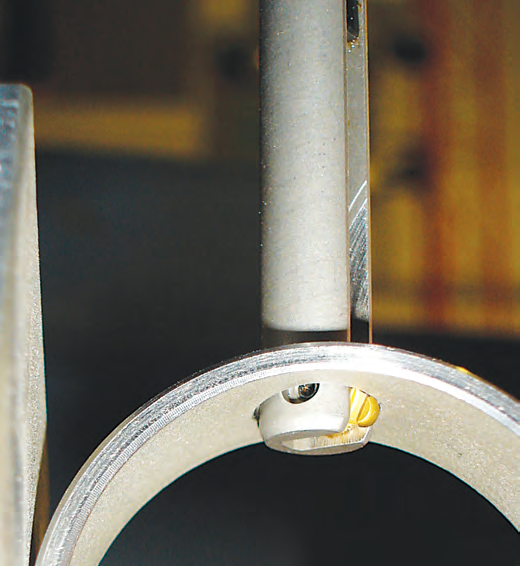
Large burrs in stainless, Inconel 718 and titanium are difficult to remove. In the finishing process described in this article, Heule’s carbide radial COFA deburring tool (shown) removes the burr and is followed by the Flex-Hone, which rounds the transitions of the edge breaks.
BRM soon determined a special would be required. “The tricky part was the diameter difference between the main bore that goes though a little web piece and the size of the countersinks,” Miller explained. The tool must be large enough to reach entirely to the outside, effectively deburr and radius that transition, pass through the hole and do the same procedure on the backside of the hole, he added.
To further complicate matters, the tool could only enter the front of the part because of the setup on the machine, but a standard-diameter Flex-Hone wouldn’t be flexible enough to reach through the small-diameter bore and “pop out” the backside to simultaneously perform the required deburring and edge radiusing. “A tool sized for that large of a diameter would be too stiff to pass all the way through the part,” Miller added.
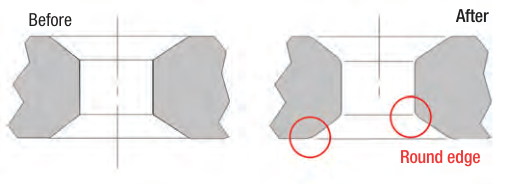
The solution was a special tool much larger in diameter than would be normally applied based on the specific through-hole diameter. To ensure the tool could enter the through-hole and perform the same operations on the backside of the part, BRM designed it with lighter-diameter filaments and lighter gauge stem wire.
“If we attempted to pass a standard tool through the small through-holes, the balls would have sheared off,” Miller said. “With our custom design, we are able to handle combinations of through-holes with countersinks as large as 0.050 ” over the size of the hole. We also worked with the customer’s surface-finishing lab to develop operating parameters that maximize tool life.”
A standard size Flex-Hone works well where only a radius is required at the transition of the bore and countersink, according to BRM.
In addition, the aerospace parts manufacturer performs a “little trick” to extend tool life, Miller noted. “They treat the front portion of the countersink with the tip of the tool and then pass it completely through to the backside and do a special stroke scheme there using the backside of the tool,” he said. “They are wearing the tool from the two ends towards the middle.” CTE
For more information about Brush Research Manufacturing’s Flex-Hone tool, contact the company at (323) 261-2193, by e-mail at info@brushresearch.com, on the Web at www.brushresearch.com, or enter #360 on the I.S. form. For more information about Heule Tool’s products, contact the company at (513) 860-9900, by e-mail at info@heuletool.com, on the Web at www.heuletool.com, or enter #361 on the I.S. form.
Glossary terms in this article
Related
 MFGAxis Discussion
Be part of the shop-floor conversation
Like, save, or comment on this CTE story.
MFGAxis Discussion
Be part of the shop-floor conversation
Like, save, or comment on this CTE story.


MFGAxis Discussion