



Mark of distinction: Inspection Efficiency
Advancements in marking technology can lead to lower integration costs and more benefits for the end user.
Advancements in marking technology can lead to lower integration costs and more benefits for the end user.
The marking process has its origins in the least complex of methods, such as simple inspection stamps applied with a steel die and hammer. Today, advances in marking and traceability technology enable sophisticated product identification and tracking solutions. However, these advances have also produced added costs.
The demand for more traceability, in particular, has led to higher integration costs when considering what marking equipment must be used. Simple, single-character approval stamps or symbols have given way to marking production date and time, serial number, part number and bar code all on a single part. The demand for this capability has posed a significant challenge to the marking industry: How to provide a marking and traceability solution at a price end users can justify.
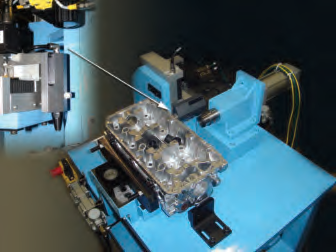
Courtesy of All images: Columbia Marking Tools
Operating in a 600° F environment, a Square-Dot scribe system from Columbia Marking Tools marks an engine block at a foundry.
Many marking equipment manufacturers have answered the call from both a controls and hardware standpoint. They are taking advantage of the latest in motion-control technology by providing controls that allow them to drive not only stepper motors but also servos, which provide faster printing (marking) speeds and thus shorter cycle times. Hardware has become more robust and versatile, allowing users to apply the equipment in parts of the manufacturing process previously unusable for traceability. For example, marking systems are now integrated into robot-assisted machining cells, welding stations and at foundries.
Integration Issues
By far the largest obstacle to overcome is integration into a variety of control platforms. This is especially challenging when new marking technology must be integrated into older manufacturing lines and controls. With users and their customers demanding vital statistics about how, when and where parts were produced, process engineers are tasked with trying to mate new marking technology with old production equipment, and do so with minimal difficulty and cost. Marking technology suppliers have responded with systems that are versatile enough to integrate with most any programmable logic controller.
Systems now provide options for users to send marking data to the controller via serial port, Ethernet/IP, Profibus DP, Modbus TCP or other communication protocols. Of course, for less complex applications users can program a date stamp with serial number and the marking controller will do the rest.
When integrating into newer manufacturing lines, users can interface with the controller on various levels. Integration can be via 24v DC digital I/O, or, to save time and the added cost of wiring, the marking system can communicate with the production system via Ethernet, Modbus or Profibus.
Because marking companies recognize the need for value-added features on their equipment, many offer features that allow users to save money elsewhere. For example, some marking controllers have the ability to control ancillary devices such as shuttles, clamps or Z-axis positioning devices. This helps users save money by eliminating I/O in their PLC that would normally be dedicated to these devices. In some instances, the marking control can completely take the place of a PLC if one does not already exist.
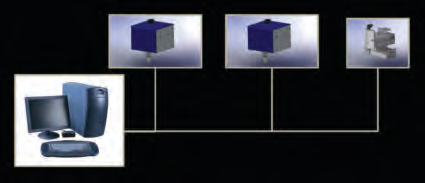
A marking controller (left) can be programmed via LAN or Ethernet, enabling multiple marking systems (top) on the shop floor to be programmed simultaneously.
Many marking systems are being integrated side by side with vision systems. Thus, the need arises to communicate with the camera system and verify the marking data is correct and usable. With advances in communication to marking controls, some systems can communicate seamlessly with vision systems to simplify the entire process. In some cases, the marking system can even provide real-time camera data within its software interface.
Control Options
While PC-based controls for marking equipment allow programming for a variable mark, the PC interface has limitations in an automated environment. The most important is use of a keyboard entry for a cycle-start command. Also, the ability of operators to inadvertently or intentionally change the marking program may hinder efficient automation. Finally, users must consider the added expense of having a dedicated PC in the application.
On the plus side, marking systems requiring a PC can work well in low-volume applications where a graphical representation of the marking layout makes changes easy and straightforward.
Some marking controllers are still programmed directly through an LCD screen. These systems are inherently difficult to use. Marking layouts are not graphically evident, and controllers usually lack communications options and the ability to expand the controls.
Today’s most advanced controllers offer the same technology available in the newest PLCs. These controllers have no built-in user interface—they must be programmed with a separate computer. But they represent the next level of marking technology, enabling marking equipment to offer many of the capabilities that usually require a PLC.
Users of such systems can download programs via Ethernet or LAN and program multiple marking systems simultaneously. Advanced control capabilities also allow the marking system to output fault logging and monitoring via a LAN. The logging information contains the exact time stamps for all operations within a cycle and may be studied to see where the operation might be improved. The historical log files contain detailed information about the marking process and show exactly where in the process a fault has occurred.
In addition, detailed monitoring of the machine shows the exact information provided to the marking system from external sources, including operational commands and data strings to print. This combination provides machine information that improves the marking process and troubleshooting.
Seamless Integration
Integrating easily into automated processes requires the ability to support a variety of communications protocols. The most flexible marking controls allow users to select which elements are required for their operations and how they want them to communicate. Seamless integration allows the marking system to function within the automation process.
Marking systems are no longer driven by basic drive boards; instead, they use motion-control cards that allow flexible integration of a variety of device types. Expanding control capabilities to allow for additional movements is as easy as adding additional cards. Each card may be independently configured to control anything from basic slides to advanced linear motors.
The flexibility of such systems results from using resident firmware instead of static boards. Firmware is a term often used to denote fixed, usually small programs or data structures that internally control various electronic devices.
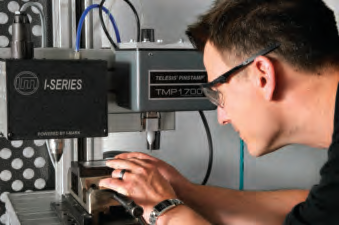
Because drive controls are flexible, each marking controller may be configured with a variety of settings to allow it to be easily changed from marking head to marking head, even ones from different manufacturers.
There are no strict boundaries delineating firmware and software; both are loose descriptive terms. However, the term firmware was originally coined to contrast to higher-level software that could be changed without replacing a hardware component. Firmware is typically involved with basic low-level operations without which a device would be completely nonfunctional.
In this case, the firmware settings contain the basic information for the motor or device being driven by the motion-control board. Expanded marking controllers may take on more motion related to the marking process, from rotation to include positioning of a camera for 2-D mark verification to controlling the part or marker movement with slides or clamps.
Some marking applications may need two closely positioned marking heads. An example would be simultaneous marking of the left and right sides of a part. Cost savings of more than 25 percent can be achieved by controlling both heads using a single control. This includes not only the savings of using one controller, but the lower cost of installing only one controller rather than two.
Control flexibility also allows for integration of different marking systems, depending on application requirements. If the marking head is functioning properly, then the controller alone may be upgraded to take advantage of networking and expanded features. Because drive controls are flexible, each controller may be configured with a variety of settings to allow it to be easily changed from marking head to marking head, even ones from different manufacturers. In other words, marking machines have advanced to plug-and-play technology.
Marking processes are often integrated with other operations in automated parts production, leading to cost savings. Advances in marking controller technology include the ability to handle a variety of communication protocols, the ability to expand and control more devices, and, with firmware, easy upgrading from older controllers with limited capabilities. CTE
About the Author: Michelle Krembel is president of Columbia Marking Tools Inc., Chesterfield, Mich., and has been an owner of the company since 1995. For more information about the company’s metal and plastic marking equipment, call (586) 949-8400, visit www.columbiamt.com or enter #340 on the I.S. form on page 3.
Glossary terms in this article
Related



Subscribers can use MFGAxis notes, saves and discussion tools with their innoNET account.


