


Maximizing multitasking with CAM: General Industry Coverage
END USER: Central Utah Tool, (801) 374-2745, centralutahtool.com. CHALLENGE: Minimize time for programming complicated machining on a multitask machine. SOLUTION: CAM software for multitasking.
—————
END USER: Central Utah Tool, (801) 374-2745, centralutahtool.com. CHALLENGE: Minimize time for programming complicated machining on a multitask machine. SOLUTION: CAM software for multitasking. SOLUTION PROVIDER: DP Technology Corp., (805) 388-6000, www.dptechnology.com
—————-
With an array of machine tools ranging from grinders to lathes to manual and CNC mills to wire EDMs, Central Utah Tool handles a host of low-volume, job shop-type work. That includes parts other shops can’t or won’t produce, according to Matt Watters, CNC machinist. “We have some pretty sharp guys here,” he said. “Plus, our tool and cutter shop and wires give us a lot of flexibility.”
After purchasing a 4-axis lathe with live tooling and a subspindle, the Provo, Utah, shop realized the high level of part complexity and productivity that type of machine can achieve. To tackle even more complicated machining tasks, the company purchased a 7-axis Okuma Multus B300 multitask machine with opposed headstocks and a dual-function upper turret. “We stepped it up 30 notches and bought this Multus,” Watters said. “It’s a beast of a machine that does a lot.”
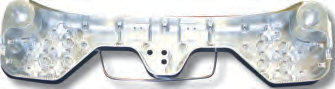
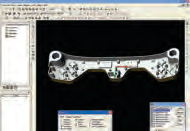
Courtesy of Central Utah Tool
The underside of a prototype aluminum handlebar (top) that holds a joystick for a quilting machine was produced on an Okuma Multus B300 multitask machine using ESPRIT CAM software from DP Technology (shown above).
Central Utah Tool previously relied on its experienced staff to manually program G code, but performing that task for the new machine became too complicated when a part required multiple operations. “Even though each operation by itself may not be that complicated, you end up with one pretty good-size program by the time you add three, four or five operations,” Watters said. “These machines are extremely difficult to program manually.”
Therefore, he began shopping for CAM programming software even though the shop already had two CNC programming software packages. “I took a close look at our software packages and did not feel confident that either of them were up to the challenge of programming a multifunction machine,” Watters said.
A contact at another Utah shop with the same multitask machine told Watters the CAM package the shop was using was sufficient, but also relayed to Watters a glowing review from a customer about a different package: ESPRIT software from DP Technology Corp., Camarillo, Calif. Other multitask machinists echoed that sentiment via online machining bulletin boards. Central Utah Tool then purchased two ESPRIT seats: one for mill/turn machines and one for mills.
Watters noted that the first two parts he programmed with the new software were easy but the third put ESPRIT to the test. The part was a prototype of a 6061 T-6 aluminum handlebar that holds the joystick for a quilting machine along with 10 lights and wiring. The part is about 20 ” long × 6 ” wide and consists entirely of curved surfaces. The piece is machined from a large piece of bar stock, and one of the biggest challenges is machining the pads for the light-emitting diodes, which means each one has a different compound angle, he explained.
The customer planned to have the parts cast, but the foundry couldn’t produce the first one in time for a trade show where the quilting machine was being introduced. “They just needed a functioning part a few days in advance of the show so they could assemble the machine and make sure everything worked,” Watters said. “I was under the gun big time for this part.”
Producing the handlebar on a conventional 3- or 4-axis machining center would require removing the workpiece and setting up a sine plate for each LED feature, a time-consuming prospect, he noted. Fortunately, the Multus’ B-axis milling head enables machining compound angles without a new setup. That’s because the C-axis spindle rotates the workpiece into position while the B-axis orients the milling head at the proper compound angle.
Programming the machine to make the part, however, was a challenge. “It would take at least a month to create the program with G code,” Watters said, “and I’m not confident I could have done it regardless of the amount of time I spent on it.”
Having suitable CAM software for generating the program and knowing how to use it, however, wasn’t all that was required, because no two CNC machines program exactly the same. Central Utah Tool also needed a post-processor developed specifically for the machine to integrate and synchronize noncutting functions with the cutting actions and machine a part as programmed without G-code editing. “Post-processors are the most challenging part of programming multifunction machines,” Watters said.
According to Watters, DP Technology had the needed post-processor. However, once he started using that post-processor, Watters ran into a hiccup. “It became very apparent, very quickly that it was not working well at all,” he said.
The CAM software developer initially attempted to fix and then rewrote the post-processor, but problems persisted. After Watters expressed his sincere displeasure about the situation, DP Technology sent a representative to the shop to be onsite until the issues were resolved and the part was completed, meeting the customer’s deadline. “I cannot say enough about their customer support,” Watters said.
Similar to the CAM software itself, the only constant for a post-processor is change. When a change is needed, the software developer delivers it within an hour 90 to 95 percent of the time, Watters noted.
“The post on a machine like the Multus is never going to be 100 percent because there is so much the machine can do, and there is no way you can plan for every possibility,” he said, adding that CAM software upgrades exacerbate the gap. “Our post is probably 98.5 percent there. All in all, ESPRIT has enabled us to take advantage of the enormous power of a multifunction machine while substantially reducing programming time.”
Glossary terms in this article
Related


Subscribers can use MFGAxis notes, saves and discussion tools with their innoNET account.