



Modulated toolpaths for chip breaking
Machine Technology column from Cutting Tool Engineering's January 2011 issue discusses the need for modulated toolpaths to ensure chip breaking when turning.
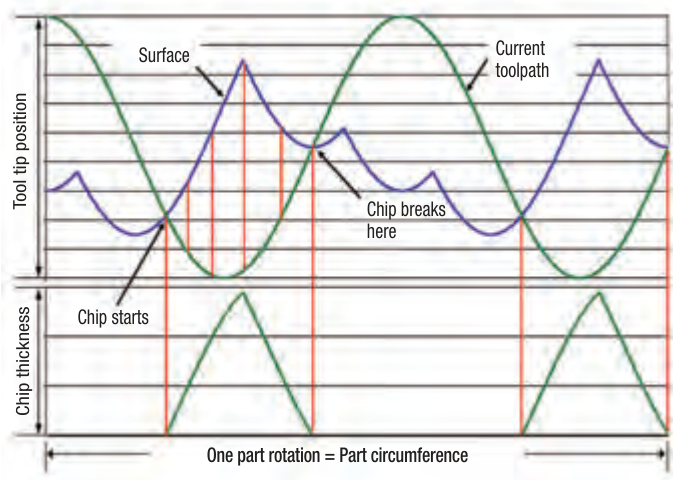
Figure 1. When using an experimental modulated toolpath, chip length is selectable.
When turning, the formation of long, stringy chips is undesirable because they can become tangled around the tool and dragged back through the cutting zone, potentially damaging the tool and workpiece. In contrast, short, comma-shaped chips easily fall out of the cutting zone, away from the tool and workpiece. Ensuring chips reliably break is a challenge, especially for ductile workpiece materials. Among the common techniques to combat long, stringy chips are chip breaking geometries and high-pressure coolant.
“Chip breaking geometry” means the rake face of the cutting tool is modified by the addition of a sudden step change in the profile. The step, which may be a separate component clamped in place or an integral part of an insert, causes the chip to bend and break. The chip may break when its free end contacts the tool, the workpiece or the chip itself, or when the bending stress becomes high enough. There are various chip breaking geometries, and substantial effort is spent on selecting a suitable one for a particular application.
“High-pressure coolant” means that a stream of coolant with a pressure of hundreds of atmospheres or more is directed down the tool’s rake face toward the chip. The coolant helps break chips by providing a force that causes the chip to curl, and by providing rapid cooling of the hot chip.
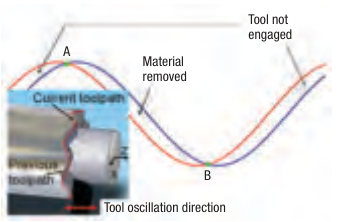
Figure 2. Modulated toolpath in profile turning.
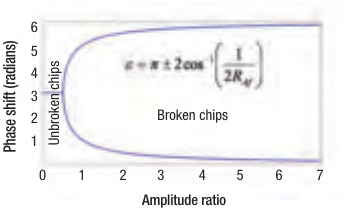
Figure 3. Conditions under which chips break.
Researchers at UNC Charlotte (including the author) and at the U.S. Department of Energy’s Y-12 National Security Complex have recently shown a new way to ensure chip breaking when turning. In NC machines, the toolpath can be modulated along the feed direction to cause interrupted cuts and ensure chip breaking. Although interrupted cuts are usually not desired, that’s not the case here because the interruption is in the material to be removed later and not on the surface of interest. Essentially, a sinusoidal motion is superimposed on top of the nominal toolpath (Figure 2).
Because the oscillating motion is created using the machine axes, the oscillatory motion can follow the workpiece surface and be used for any turned surface geometry, including faces, profiles, tapers, spherical surfaces and internal and external surfaces. The frequency and amplitude of the oscillating motion are selectable parameters, but the frequency of motion required is generally small—on the order of a few cycles per second.
If the amplitude of the oscillation is too small, or if the timing is such that the waviness created on one rotation lines up with the wave created on a previous rotation, then the chip will be continuous and not broken. Figure 3 shows the conditions under which broken chips form.
In Figure 3, the vertical axis is the alignment between the current oscillation and the oscillation one revolution back (imprinted on the surface). Zero corresponds to perfect alignment as does 2π (a little more than 6), while π (a little more than 3) corresponds to a peak aligned with a valley. The horizontal axis is the ratio of the amplitude of the motion to the feed per revolution. The chips break when the amplitude of the oscillation is greater than half of the feed per revolution and when the current and prior oscillations are not well aligned.
Figure 1 shows the surface created by a number of overlapping oscillating tool motions (blue line), and the current motion of the tool (green line). When the green line is above the blue line, the tool is cutting air. When the green line is below the blue line, the tool is cutting metal and forming chips. Chip length and thickness are shown in the lower portion of the figure.
It is interesting that through amplitude selection and oscillation frequency, chip length can even be programmed. Because the oscillation is tangent to the desired surface, the chip breaking waviness appears in material that is later removed. The remaining surface is often quite good, and the oscillating tool motion can even act like a wiper, taking the peaks off of the cusps of the feed marks.
This strategy works in all kinds of materials, from nickel alloys to polymers, and the chips always break. More recent research has focused on testing to ensure programmed amplitudes and frequencies are within machine capabilities and on selecting chip breaking parameters that lead to the finest surface finishes. CTE
 About the Author: Dr. Scott Smith is a professor and chair of the Department of Mechanical Engineering at the William States Lee College of Engineering, University of North Carolina at Charlotte, specializing in machine tool structural dynamics. Contact him via e-mail at kssmith@uncc.edu.
Related


Subscribers can use MFGAxis notes, saves and discussion tools with their innoNET account.


