


Know how to hold ’em
END USER: The Boeing Co., www.boeing.com. CHALLENGE: Boost productivity and reduce setup time when machining carbon fiber-reinforced plastic aircraft components. SOLUTION: Abrasive waterjet cutting technology and flexible workholding.
—————-
END USER: The Boeing Co., www.boeing.com. CHALLENGE: Boost productivity and reduce setup time when machining carbon fiber-reinforced plastic aircraft components. SOLUTION: Abrasive waterjet cutting technology and flexible workholding. SOLUTION PROVIDER: Flow International Corp., (800) 446-FLOW, www.flowwaterjet.com
—————-
Strong, lightweight carbon fiber-reinforced plastic is the go-to structural material for aircraft makers seeking fuel efficiency. A 1⁄16 “-thick CFRP wing skin, for example, has the same strength as a ¼ “-thick aluminum one but weighs 30 percent less. As a result, CFRPs are finding increasing application in new aircraft. A prime example is Boeing’s 787 Dreamliner, which is about 80 percent CFRP by volume and 50 percent by weight.
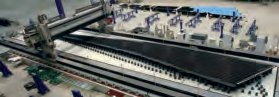
Courtesy of MHI Proprietary
On a 120 ‘-long waterjet machine, a reconfigurable fixture from Flow employs 342 servocontrolled, vacuum-tipped actuators to hold a 100 ‘-long CFRP wing skin for a Boeing 787 airliner.
After CFRPs are laid up and cured, they must be trimmed, drilled and milled to final specifications. The traditional way to machine composites is with diamond-coated carbide tools featuring application-specific cutting geometries. But because CFRPs are composed of graphite fibers embedded in a polymer matrix, they are difficult to machine. The fibers are abrasive and, depending on their orientation in the matrix, can fray when mechanically machined. Layers of the material also can delaminate, and rough edges that remain after machining may require a secondary operation to finish them. In addition, the cutting forces produced demand rigid workholding, especially for thin components.
Abrasive waterjet technology addresses many of those machining issues. According to Mark Saberton, chief engineer at waterjet machine builder Flow International Corp., Kent, Wash., the abrasive jet smoothly cuts without delamination, even on a microscopic level, so the machined edge does not require secondary finishing. “When you cut it with an abrasive jet, it is ready to go on the airplane,” he said.
Saberton noted that the first waterjet applications for CFRP aircraft structural parts were in the mid-1980s for machining F-117 stealth fighter components. Since then, waterjet technology has evolved to include specialized machines like Flow’s 5-axis, gantry-style Composites Machining Centers.
The CMCs are modular, and different combinations of machine beds, bridge lengths and heights permit handling of large workpieces, such as an approximately 17 ‘-wide × 100 ‘-long wing skin. To minimize handling and setup time while maximizing accuracy, such large parts must be machined in one fixturing. Even so, Saberton noted that it can take up to a day to load fixturing on a machine bed that can securely hold a highly contoured, large CFRP part and resist the heavy cutting forces characteristic of conventional machining.
However, the forces generated when waterjet cutting parts are minimal in comparison. Abrasive waterjet machining, Saberton said, “is an ultrahigh-speed erosion process; there are almost no forces involved.”
The latest workholders for waterjet machining of CFRPs speed changeovers between parts while maintaining cutting accuracy. Flow calls its newest patent-pending workholding system a “Flexible Header System.” Saberton pictured it as “a bed of nails.” In this case, the nails are servocontrolled actuator cylinders, each capped with a swiveling 75mm- to 150mm-dia. vacuum cup. The FlowPAC cylinders have a standard stroke of 915mm and are mounted on headers that can be adjusted to within 0.075mm tolerance. The actuators have an air blow-off feature to float a part to position, while the vacuum pulls the part to location.
The system is guided by the CATIA CAD design file for the component to be machined. When the file is downloaded into the waterjet, the actuators raise, lower and conform to the contour of the component being cut. On a 120 ‘-long waterjet machining center, 342 actuators are employed to fixture a 787 wing skin. Reconfiguring the fixturing for another part takes about 2 minutes, as opposed to a day, and some versions of the machining centers can handle up to 80 different parts, according to Saberton.
Glossary terms in this article
Related


Subscribers can use MFGAxis notes, saves and discussion tools with their innoNET account.