

The Hole Edge: Drilling Performance
Machining a clean, straight and in-tolerance hole through a part is not the only requirement for many holemaking applications. In many cases, hole entrances and exits are also critical to part functionality.
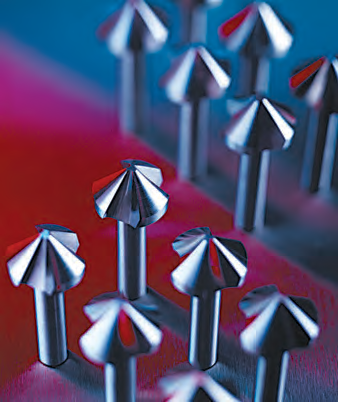
Courtesy of EXACT
Countersinking tools from EXACT GmbH & Co. KG Präzisionswerkzeuge, Remscheid, Germany. For more information, contact the company. Telephone: +49 2191.36250-0. E-mail: info@exact.info. Web: www.exact.info.
Countersinking holes to increase part functionality.
Machining a clean, straight and in-tolerance hole through a part is not the only requirement for many holemaking applications. In many cases, hole entrances and exits are also critical to part functionality. There are many reasons that hole edges must be further refined, including hiding screw heads, minimizing air and liquid turbulence, improving compressor efficiency and increasing fatigue strength.
Three main processes are used to improve hole entrances and exits—countersinking, radiusing and squaring off. Tapering and other special-shape processes may also be needed in some applications. This article concentrates mainly on countersinking.
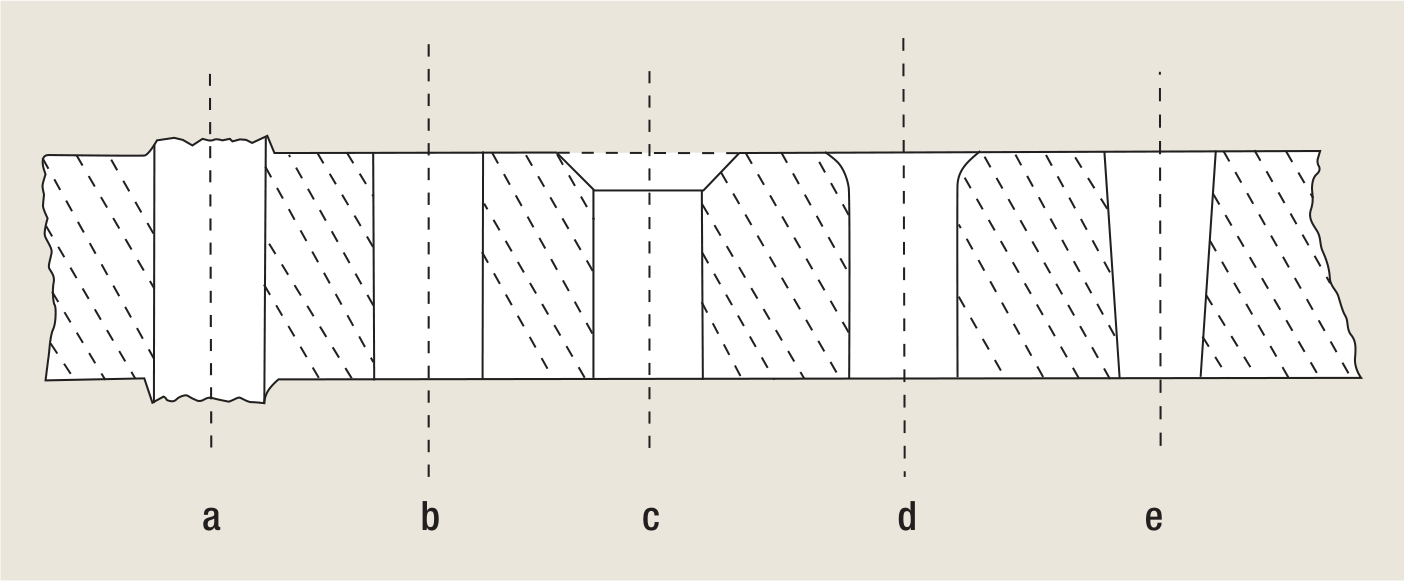
Figure 1 (below) illustrates the most common edge conditions. Burrs, which are allowable in many situations, are almost always found on hole entrances and exits when metal is conventionally drilled or otherwise cut (Figure 1a). Gaskets and other products require straight or tapered holes with sharp edges (Figure 1b and 1e), but most machined products require or desire countersunk (Figure 1c) or radiused (Figure 1d) holes.
Countersinking bevels or tapers the work material around the periphery of a hole to create a conical feature. The surface cut by the conical countersinking tool is concentric with and at an angle of less than 90° to the centerline of the hole.
Radiusing, or corner rounding, produces a smooth, blended or rounded edge as opposed to a cone. (See sidebar below.)
Tapered holes differ from countersunk holes only in that the length of the angle is much steeper in a tapered hole (see sidebar). Tapers serve various purposes, such as controlling fluid flow, assuring leak-proof joints, providing tight—almost press—fits and guiding long pins into tight-fitting holes. Tapered holes are more challenging to produce than countersinks because of their longer length and often tighter tolerances.
Tool Designs
My book, “Countersinking Handbook,” published by Industrial Press, illustrates 147 different cutter designs to finish hole edges. Countersinks come in six standard angles (60°, 80°, 82°, 90°, 100°, 120°) and hundreds of sizes. Countersink tools come in left- and right-hand cut, a variety of flute shapes and piloted, nonpiloted, screw-on and slip-on configurations. Some countersinks come as an integral part of the drill. In short, countersinks are almost as ubiquitous as drills themselves.
There are as many variables when finishing hole edges because applications range from printed circuit boards to titanium skins, from aerospace composites to castings, and from sealing critical surfaces to simple deburring. With the exception of the aerospace industry, there are few comparative studies about countersinking tool effectiveness and economics, and few of these studies are published outside company walls.
U.S. and German standards exist for countersink tool designs, but cover only the outer configurations of the more common tools—not the critical flute configurations, rake and relief angles, coatings and unusual designs.
Courtesy of L. Gillespie
Figure 1. Five common hole entrances: (a) burred or raised metal, (b) sharp edged, (c) countersunk, (d) radiused and (e) tapered.
While most countersunk holes are produced on CNC machines, the aircraft industry still finishes millions of holes using manual or robotic tools. These tools use a pilot to assure the countersink is concentric with the drilled hole. In addition to a pilot, aerospace manufacturers also use a pressure pad device to assure material does not crawl up the tool, or delaminate, and to produce the exact depth.
Flutes play a key role when countersinking. Large flutes enhance chip evacuation. Multiple-flute tools generally provide longer life than 1- or 2-flute tools. An odd number of flutes minimizes chatter, but an even number of flutes can also reduce chatter in some instances. Countersinks with multiple flutes cannot be applied for heavy stock removal because there is not enough open area in the flutes for effective chip removal.
The elliptical hole-style tool, often called a Weldon countersink, provides a slicing action to freely cut most workpiece materials. Unlike a multiflute tool, it produces a continuous chip. A Weldon countersink is particularly effective in softer materials because of its high-shearing cutting angles.
Courtesy of EXACT
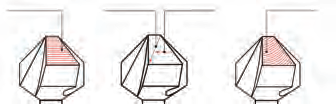
Figure 2. Countersinks can have radial relief, axial relief and combinations of both.
Countersinks can have radial relief, axial relief or a combination of both (Figure 2). In addition, an external relief, or clearance, reduces heat from rubbing, and a cam relief allows faster feeds in aircraft materials.
Typical coatings for countersinks include TiN, TiCN, TiAIN, AlTiN, PCD and electroplated diamond. The electroplated diamond coating produces a tool for grinding a countersink into a hole.
Because countersinking cycle time is short, many shops have not taken an in-depth look at potentially more economical tool designs.
Table 2. Time in cut for various depths of cut and feeds (seconds)
Depth of cut (in.)
Feed rate (ipm)
1.00
3.00
5.00
10
20
30
60
100
250
500
1000
2000
0.001
0.06
0.02
0.012
0.006
0.003
0.002
0.001
0.003
0.18
0.06
0.036
0.018
0.009
0.006
0.003
0.002
0.005
0.30
0.10
0.060
0.030
0.015
0.010
0.005
0.003
0.001
0.010
0.60
0.20
0.12
0.060
0.030
0.020
0.010
0.006
0.002
0.020
1.2
0.40
0.24
0.120
0.060
0.040
0.020
0.012
0.004
0.002
0.030
1.8
0.60
0.36
0.180
0.090
0.060
0.030
0.018
0.007
0.004
0.002
0.060
3.6
1.20
0.72
0.360
0.180
0.120
0.060
0.036
0.014
0.007
0.004
0.002
0.100
6.0
2.00
1.20
0.600
0.300
0.200
0.100
0.060
0.024
0.012
0.006
0.003
0.125
7.5
2.50
1.5
0.750
0.375
0.250
0.125
0.080
0.030
0.015
0.008
0.004
0.250
15.0
5.00
3.0
1.50
0.750
0.500
0.250
0.160
0.060
0.030
0.016
0.008
0.375
22.5
7.50
4.50
2.25
1.125
0.675
0.338
0.225
0.090
0.045
Review the print ads from this magazine to continue
This quick advertiser review unlocks the rest of the article and keeps the full-screen reader focused on the ads instead of the page chrome.
Advertisers included in this article experience
Print placements connected to this article
800.521.9520 | mscmetalworking.com
Available exclusively at MSC Industrial Supply Co.®
IS #41.
Available exclusively at MSC Industrial Supply Co.® IS #41 800.521.9520 | mscmetalworking.com
Visit 800.521.9520 | mscmetalworking.com View this placement in the issue recordPrint ads from this magazine
IS #41.
Available exclusively at MSC Industrial Supply Co.® IS #41 800.521.9520 | mscmetalworking.com
Continue reading
March 2011
0.022
0.011
“If it’s working, let’s work on more important problems,” is the general attitude. Other shops realize they need to achieve savings when finishing holes. These shops calculate the cost of countersinking and then examine two major issues: time required per hole and tool cost per hole. The latter involves considering tool life and use of integral and inserted tools.
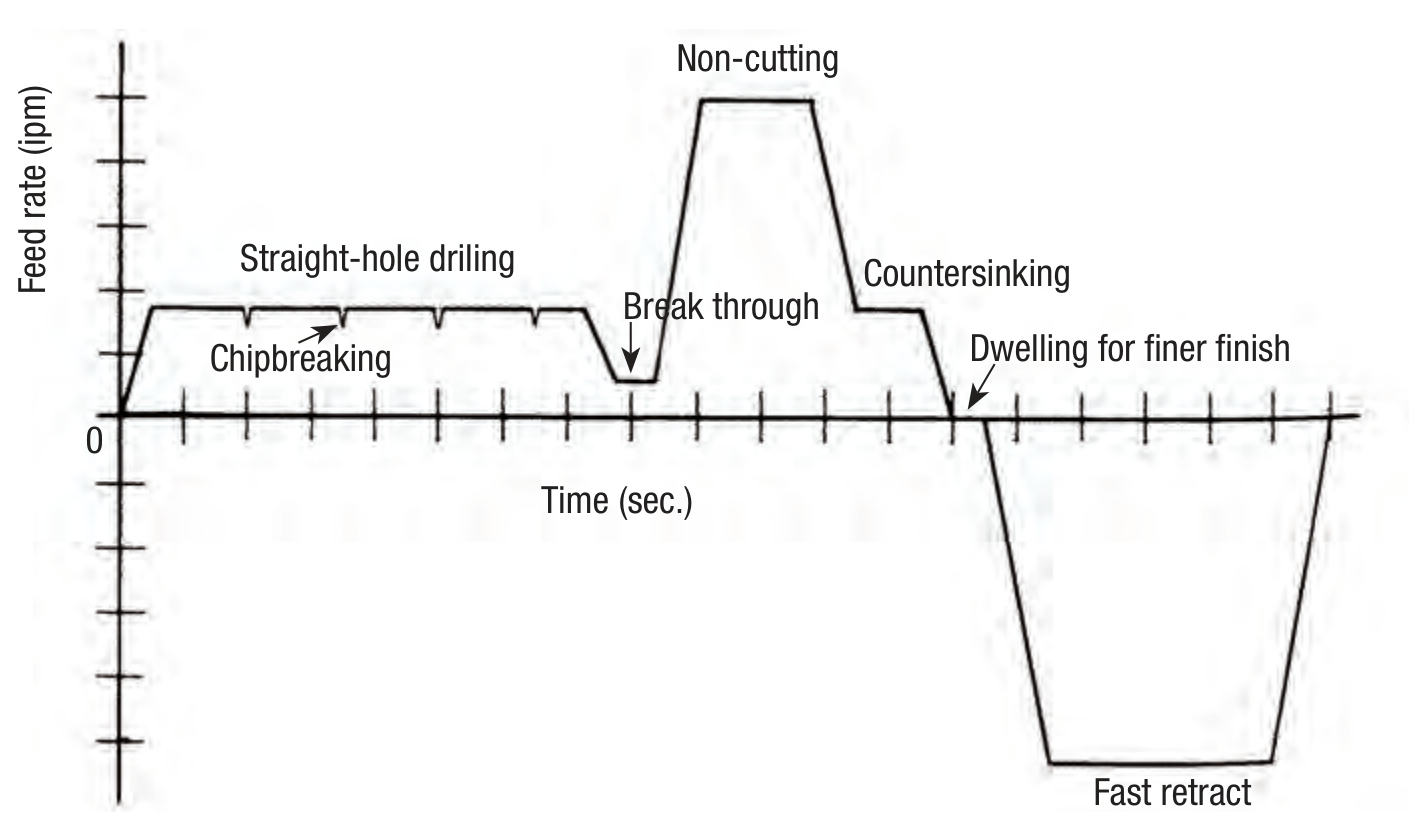
Plotting drilling and countersinking cycle times quickly reveals the short time required for cutting a countersink (Figure 3 below). In most instances, the time needed to change to a countersink and bring it to the hole edge is much longer than the cutting time. To obtain the smoothest countersink, surface dwelling the tool briefly before retracting it imparts a finer finish.
Approach time and tool change time can be significant, but countersinking itself requires very short run times. For example, a 0.250 “-dia. drill at 100 sfm and 0.006 ipr drilling 0.750 ” deep requires 5 seconds to drill a hole. Providing a 0.010 ” chamfer at 10 ipm requires 0.06 seconds. If an integral drill/countersink tool were to produce the hole, users would save the time of countersink tool indexing, approach and retraction from the hole, as well as 0.060 seconds for countersinking. If a 20-hole pattern is produced with integral drill/countersinking tools using a drill head that drills all holes at the same time, a great deal of time is saved.
Typical Applications
When the part’s top surface is always constant at the same vertical height, micro- stop tools with a cage provide accurate depth whether run with hand tools or on drill presses. Cages for these tools can be adjusted in 0.005 ” or 0.001 ” increments to assure depth control.
The CNC program may provide the required depth control, but when workpieces are warped, have cast surfaces that vary in height or when countersinking the top layer in a metal/composite stack, an adjustable override holder may be needed in conjunction with the microstop tool. These are common in the aerospace industry to assure countersink depths are always within tolerance, particularly when robots are performing countersinking.
Courtesy of Horng–SME technical paper
Figure 3. Feed rate chart for CNC and robotic drilling.
If the countersink cuts through to the back of thin sheets to meet topside depth tolerances, it is important to have a backup sheet under the hole to prevent burrs and material bulging. Countersinking very thin materials may not be possible. In those instances, companies dimple the hole entrance to provide a formed countersink. Dimpling is fast and chip-free, and can be performed with a simple dimple tool in a drill press.
Generally, 0.032 ” is the minimum sheet thickness for countersinks, and common practice limits countersink depth to two-thirds the thickness of the sheet. Boeing’s structural repair manual SRM 51-40-08, for example, notes that countersink depth must not exceed 60 percent of material thickness. Going deeper than that produces a near knife-edge, which under some stress loads results in poor fatigue properties. For composite aircraft skins, the rule of thumb for maximum countersink depth is approximately 70 percent of structural laminate thickness.
For thin sheets of plastics, manufacturers typically sandwich the sheets between layers of stiffer plastic sheet or fiberboard. When countersinking plastics, router bits and Weldon countersinks are often used because of their free-cutting ability and low cost. A spindle speed of 18,000 rpm and a feed rate up to 200 ipm are common when countersinking plastics.
Recommended speeds and feeds depend upon the work material, number of teeth in the tool, tool material and design, and tool coating. Table 1 (see below) provides recommended cutting speeds for uncoated HSS and carbide countersinks in various materials.
Table 1. Recommended speeds for countersinking.
Material
Recommended surface speed (sfm)
HSS cutter
Carbide cutter
Aluminum/aluminum alloys
150-250
300-500
Brass/bronze (ordinary)
75-125
150-250
Iron – cast (soft)
75-125
125-225
Iron – cast (medium hard)
50-100
100-175
Iron – hard chilled
10-20
20-35
Iron – malleable
80-90
90-150
Magnesium/magnesium alloys
125-250
250-400
Monel, high-nickel steel
30-50
50-75
Plastics, bakelite
100-250
250-400
Steel – mild (0.2-0.3 percent carbon)
80-100
120-170
Steel – mild (0.4-0.5 percent carbon)
70-80
80-150
Steel – tool (1.2 percent carbon)
50-60
60-100
Steel – forgings
40-50
50-80
Steel – alloy (300-400 Brinnell)
20-30
30-50
Steel – high tensile (35-40 HRC)
30-40
40-60
Steel – high tensile (40-45 HRC)
25-35
35-55
Steel – high tensile (45-50 HRC)
15-25
25-40
Steel – high tensile (50-55 HRC)
7-15
15-20
Stainless steel – free machining
30-80
80-125
Stainless steel – workhardening
15-50
50-75
Ti-75A (commercially pure titanium)
50-60
60-90
Inconel alloys
15-20
25-35
Hastelloy (wrought)
15-20
25-35
Hastelloy (cast)
5-7
7-15
Rene
15-20
20-30
Courtesy of M.A. Ford Manufacturing
Different Designs
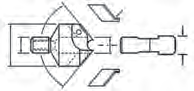
To assure that no sharp edges exist on countersunk holes, Craig Tools International produces an inserted blade design that incorporates a fillet radius where the pilot meets the end of the countersink (Figure 4). The design allows the same blades to be used for any hole size regardless of the pilot diameter.
Courtesy of Craig Tools
Figure 4. Craig Tools Versi-Sink allows a single blade to produce the same edge rounding regardless of hole diameter. Only the pilot has to be changed.
Several designs provide countersinks or radii on the bottom (exit side) of holes without turning the part over. Most use some form of expanding cutter head when the head exits the bottom of the hole. Retracting it vertically provides the countersink. Lowering the tool and then reversing the spindle rotation one more time retracts the cutter, allowing the tool to be withdrawn without marring hole walls.
When users want to impart fine surface finishes and quickly cut most metals, rotary burs are recommended because of their small chip loads. Most rotary burs are for small holes, with standard tools available as small as 0.004 ” in diameter. Because of their many teeth and the small chips they produce, rotary burs can run at much faster spindle speeds than conventional countersinks.
Table 3. Recommended maximum speeds for uncoated solid carbide rotary burs in metals.
Tool diameter (in.)
Standard cut
Coarse cut
Fine cut
1⁄16
183,000
244,000
123,000
1⁄8
91,000
122,000
61,000
3⁄16
61,000
81,000
41,000
¼
46,000
61,000
30,000
5⁄16
36,000
49,000
24,000
3⁄8
30,000
40,000
20,000
7⁄16
26,000
35,000
17,000
½
22,500
30,000
15,000
5⁄8
18,500
25,000
12,000
¾
15,000
20,000
10,000
1
11,250
15,000
7,500
1 1⁄8
10,000
13,000
7,000
Courtesy of Menlo Tool
Some holes only require deburring to finish their entrances and exits, but when the part specification calls for a countersink, knowing what tool design provides the lowest cost enables a shop to countersink productively. CTE
About the Author: Dr. LaRoux K. Gillespie has a 40-year history with precision part production as an engineer and manager. He is the author of 12 books on deburring and over 220 reports and articles on machining. He can be e-mailed at laroux1@earthlink.com.
Tips for radiusing and tapering holes
Most basic tool designs for producing a cylindrical chamfer have variations for creating a radius. The tools generally have some designed runout, which serves as a small lead into the radius. That helps assure the tool does not produce an undercut in the workpiece because of slight differences in tool positioning. In other words, it is not an exact, full 90° radius.
For holes smaller than 1/8″ in diameter, some users find dental or miniature rubber polishing tools produce the desired edge rounding and smoothing, particularly in manual operations. They can provide 0.001 ” to 0.003 ” radiused edges with a high polish (4 to 8 µin. Ra). That is advantageous when radiusing miniature holes in stainless steel.
Tapering a hole via mechanical cutting generally involves reaming with a tapered cutter. In addition to tapering for enhanced fluid flow, applying tapered pin reamers enables standard taper pins to fit properly. Best results will be attained if the hole is drilled a few thousandths smaller than the small diameter of the finished reamed hole. Tapered holes are also used to properly fit ball joints and tie rod ends to spindles.
Clarkson & Foreman Inc., a maker of tapered reamers, indicated that straight-flute reamers may have an advantage in blind-holes because left-hand spiral flutes tend to push chips forward. Reaming speeds should be approximately 50 percent of the speed used for drilling the same material. Faster speeds are generally not an advantage, but may be possible in exceptionally rigid and efficient machines. Reaming feeds should be approximately double the drilling feed. Insufficient feed may degrade hole finish and roundness and increase tool wear.
—L. Gillespie
Glossary terms in this article
Related




Subscribers can use MFGAxis notes, saves and discussion tools with their innoNET account.


