

Critical Mass: Inspection Efficiency
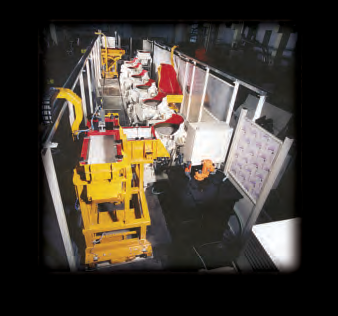
Courtesy of Rosler Metal Finishing USAA six-load, centrifugal disc mass-finishing system from Rosler features automatic loading and auto screening.Mass finishing parts at the machining center offers economic advantages.There are major economic and scheduling advantages to having a part come off a machining center complete.
Courtesy of Rosler Metal Finishing USA
A six-load, centrifugal disc mass-finishing system from Rosler features automatic loading and auto screening.
Mass finishing parts at the machining center offers economic advantages.
There are major economic and scheduling advantages to having a part come off a machining center complete. Most machinists think parts are finished at this point because part dimensions are correct. However, they forget that most parts must be deburred, cleaned, weighed or counted and then packaged before shipping. In most shops, that involves moving the machined parts to another part of the shop, putting them on shelves and eventually having someone perform the final operations prior to shipment.
Done at the Machine
Deburring parts at the machine means that they are truly ready to ship. Joe Gaser, vice president of Osborn International, Cleveland, a manufacturer of industrial brushes and surface finishing tools, noted that manufacturers would obviously like to receive payment for their parts earlier than they do. His solution: “Finish your parts at the machine instead of having them sit for days or weeks waiting to be deburred.”
There are other benefits to finishing parts at a machining center. Shops find and fix problems earlier, better understand the impact of keeping burrs small, prevent mistakes from using the wrong finishing process, do not lose parts, and possibly prevent oils from drying on parts, which makes the oils difficult to remove. In addition, one person is responsible for the completed part.
There are three major ways of producing a burr-free part at the machine: preventing and minimizing burrs, brush deburring during the machine cycle, and cellular manufacturing that includes deburring.
Robotic deburring is the most recognized avenue of cellular deburring, but a lower-cost solution exists: placing small, portable mass-finishing machines at (but not on) the machine tool. These finishing machines have been available for at least 30 years, but have become more popular recently due to lean manufacturing initiatives and the availability of many smaller, lower-cost and faster finishing machines. Shops considering mass finishing must answer several key questions:
- How do I conveniently get machined parts into the finishing unit?
- How much floor space is required?
- How much cleaning do I need? (Mass finishing also cleans.)
- How do I handle waste products?
- How much finishing capacity do I need at any one machine tool?
- How much does an appropriate finishing machine cost?
There are at least 40 suppliers of mass finishing machines operating in the U.S., as well as job shops that specialize in deburring, that can help answer these crucial questions.
Determining how many parts must be finished per hour at each machine is the next question. Knowing part size, edge and finish requirements and production rates allows mass-finishing machine builders to calculate the required capacity and floor space. That information also helps determine the electrical power needed, water usage (if any) and drying requirements.
Courtesy of Rosler Metal Finishing USA
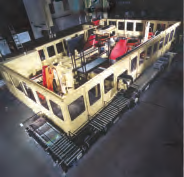
A Rosler automated centrifugal disc system finishes parts, separates them from the media and feeds the parts to final packaging.
Next, determine the method for feeding parts into the mass finishing machine and handling them as they are removed. For many job shops, manual placement and removal of parts is adequate. For higher production and more continuous flow, a direct feed from the machining center or lathe into the finisher is needed. For complex and expensive parts, an overhead load/unload robot might be the answer. The last issue is to calculate equipment payback. Machine builders can help estimate that.
Some shops will choose roll-in finishing machines that can be moved from one machine to another. In most instances, users will want to use overhead power. Water is generally included in tanks under the machine, so a direct water hookup isn’t required. One critical issue is how to treat and dispose of wastewater because it contains metal and fine abrasive particles from the deburring media or plastic particles if plastic media is used.
Typical Machines
James Krier, sales and marketing manager for Burr King, Warsaw, Mo., noted that in the past 2 years he has seen more applications for deburring equipment at lathes and mills. While others provide roll-around units, Burr King offers a small, skid-mounted system that is moved with a floor pallet jack.
For the 1.3-cu.-ft. finishing machines typically found at machine tools, operators either chute the parts straight into the finishing machine, manually place them one at a time or input a batch at a time, depending upon part size. Vibratory machines are available in many sizes. Smaller machines fit well next to a machining center, whereas larger ones, such as a 3-cu.-ft. machine that measures 3 ‘ to 4 ‘ in diameter, are better suited for placement at the end of a cell.
Burr King vibratory machines have a filtration pack that removes fines from the unit’s recirculating 8-gal. water tank. The 2-sq.-ft. footprint of its 1.3-cu.-ft capacity machine is one of the smallest in the market, according to Krier. That system and the company’s 4.5-cu.-ft. machine use 15-amp, 120v power, normally from an overhead drop. Not requiring 220v is a major advantage for many shops because it simplifies moving the deburring machine.
In addition, the machines do not normally use abrasives, eliminating the need to remove abrasive particles from parts. If necessary, users can mount a small ultrasonic cleaner on the machine to provide final parts cleaning. Burr King’s small finishing system sells for around $3,000.
Some of the workpiece material transfers onto the media and into the machine liner, which can then rub off on the next batch of parts, Krier noted. Cross contamination can present corrosion, color and plating problems when machining a variety of materials, such as aluminum, brass and steel. Dedicating small units to specific materials is the easiest solution.
Cellular Arrangements
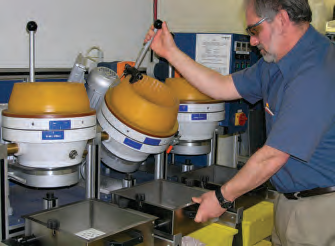
For quickly finishing parts in a work cell, centrifugal disc machines are available. Steve Alviti, president of Bel-Air Finishing Supply Corp., North Kingston, R.I., noted that centrifugal discs used in cellular manufacturing have typical cycle times of 5 to 30 minutes, with a load/unload time of 2 minutes. The 10G centrifugal force in an open-top centrifugal disc machine allows users to apply very small media, which reaches into small part features. However, this size of media is not effective in vibratory operations because vibratory forces cannot move the media with enough force to deburr.
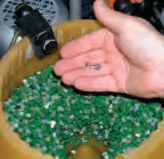
One Bel-Air cellular system finishes bone screws. The traditional way of making bone screws involved machining, deburring, secondary operations, passivation, inspection and inventorying them in lots of 2,000 parts. When QC at one part manufacturer found even a few rejects, it typically meant the entire lot of 2,000 had to be scrapped. It took 21 days, the process’ cycle time, until the next lot could be produced. By reducing lot size to 200 parts and putting a deburring machine and an ultrasonic cleaner at the machine, the manufacturer’s cycle time fell to 4 days, reject rates decreased dramatically and inventory shrank by 400 to 500 percent.
Review the print ads from this magazine to continue
This quick advertiser review unlocks the rest of the article and keeps the full-screen reader focused on the ads instead of the page chrome.
Advertisers included in this article experience
Print placements connected to this article
Dmgmoriseikiusa
360º SUPPORT IS STAYING AHEAD
OF THE CURVE SO YOU CAN STAY AHEAD OF THE COMPETITION. How can the right support make your business better? IS #78.
360º SUPPORT IS STAYING AHEAD OF THE CURVE SO YOU CAN STAY AHEAD OF THE COMPETITION. How can the right support make your business better? www.dmgmoriseikiusa.com IS #78
Visit Dmgmoriseikiusa View this placement in the issue recordFor More Info, Go To: Www.Idays2011.Com
your hands. Our Digital Technology Laboratory and Machining Technology Laboratory enable new machining methods that make
Innovation is in our DNA. So we invest in leading-edge research and development that keeps the world’s most advanced tools in you more profitable and competitive. It’s just one part of 360º Support—a fresh take on customer care from the world’s largest supplier of machining solutions. / MAY 3-5.
Innovation is in our DNA. So we invest in leading-edge research and development that keeps the world’s most advanced tools in your hands. Our Digital Technology Laboratory and Machining Technology Laboratory enable new machining methods that make you more profitable and competitive. It’s just one part of 360º Support—a fresh take on customer care from the world’s largest supplier of machining solutions. / MAY 3-5 FOR MORE INFO, GO TO: WWW.IDAYS2011.COM
Visit For More Info, Go To: Www.Idays2011.Com View this placement in the issue recordPrint ads from this magazine
OF THE CURVE SO YOU CAN STAY AHEAD OF THE COMPETITION. How can the right support make your business better? IS #78.
360º SUPPORT IS STAYING AHEAD OF THE CURVE SO YOU CAN STAY AHEAD OF THE COMPETITION. How can the right support make your business better? www.dmgmoriseikiusa.com IS #78
Continue reading
April 2011
Courtesy of Bel-Air Finishing Supply
Centrifugal disc systems from Bel-Air are suitable for finishing an array of parts, including small ones.
In another application, Bel-Air provided a firearms maker with a finishing machine that had to fit into a cell that performed boring, assembly, deburring and surface finishing, as well as other operations on multiple parts. Every operation had to be finished within a 4-minute takt, or cycle, time. The machined forging required 24 minutes to finish, but the required time was met by ganging six small bowl units for finishing to make a larger deburring machine. The first six parts each went into a different bowl unit. When the seventh part came to the deburring machine after 24 minutes, the first one was finished and from that time onward a 4-minute time was achieved.
Large vibratory deburring machines are used for cellular operation in which several machining centers feed parts into a single finishing machine or for finishing large parts. The larger machines provide automated or semiautomated handling, complete mass finishing, washing, rinsing and even drying.
Bill Sherman, technical sales administrator for Almco Inc., Albert Lea, Minn., a manufacturer of large vibratory machines, noted that Almco has sold several systems with its 2.5-cu.-ft. tub machines for cellular applications in a batch mode without automated handling.
Courtesy of Burr King
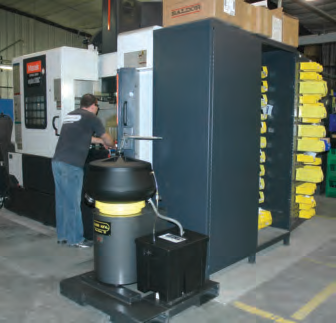
A pallet-mounted vibratory system from Burr King is positioned at a machining center to finish parts after they’re machined.
Larry Bevins, vice president of sales and marketing for Almco, indicated that once a system is in place and the production rate increases, users tend to purchase a larger machine to meet the increased production rate. Large machines, such as 3- to 10-cu.-ft. ones, typically use ceramic media and abrasive or polishing compounds and include filters or sediment settling tanks to capture media fines. However, some applications use only smooth metal balls to finish surfaces. While large machines last 15 to 30 years and longer, bearings need lubrication roughly every week, which can be done automatically or manually.
More cellular finishing, including automated and semiautomated, is performed in Europe than in the U.S., noted Harold Wagenknecht, president of Rosler Metal Finishing USA LLC, Battle Creek, Mich. Rosler makes cellular systems for finishing small to large parts. For example, Rosler manufactures machines as small as ½ cu. ft. with bowls from 1.5 cu. ft. to 64 cu. ft. for finishing a host of parts, such as orthopedic implants, as well as machines for parts up to almost 2 sq. ft.
While most cellular systems have relatively standard layouts, sometimes Rosler designs vertical systems rather than horizontal ones because the cost of floor space is so high in some plants.
Rosler’s philosophy is that rather than just having a machine in a cell, users need a system that provides appropriate equipment life and repeatable results using acceptable media and compound usage—something that will not usually be achieved with machines that offer a low up-front cost, according to Wagenknecht. Instead, the system approach requires a machine that produces the desired results at the lowest cost per piece based on media cutting ability, media wear rate and machine life.
If integration with other machines is required, users also need to consider who will interface the software of existing systems to the finishing portion of the cell. (Electrical control integration is not essential for many small applications.)
Wagenknecht added that centrifugal disc machines, which finish parts 10 times faster than vibratory machines, are experiencing higher demand—especially in automated applications. Rosler has installed many single- and double-cell systems. The unique design of its centrifugal disc gap allows for constant adjustment. This extends the life of the tub and spinner and allows users to fine-tune the machine according to the media and part size so they can handle a range of part sizes. Recalibrating the equipment for finishing different parts simply requires changing screens for separating different size media and parts.
Multiple methods with varying equipment costs are available for finishing parts at the machine tool or work cell they were produced on, but they all enable manufacturers to more efficiently complete and ship parts. CTE
About the Author: Dr. LaRoux K. Gillespie has a 40-year history with precision part production as an engineer and manager. He is the author of 12 books on deburring and over 220 technical reports and articles on precision machining. He can be e-mailed at laroux1@earthlink.com.
What is mass finishing?
Mass finishing includes all processes that use a tumbling action of media over parts such that parts are inserted as a mass, or group, of parts. The most common processes are barrel tumbling, centrifugal barrel tumbling, centrifugal disc (also called roll flow) and vibratory finishing. Cryogenic vibratory finishing requires low-temperature control with consequent safety considerations and is less amenable to at-machine finishing.
Barrel tumblers normally require hours to finish parts and thus are not well suited for at-machine finishing. They require closed-unit operation and come in sizes as small as 1 pint. Centrifugal barrels use closed tops, which makes them less amenable to true continuous flow, but they can still be considered for some work cells because they are much faster than vibratory units. For example, a 3-hour vibratory cycle is completed in 20 minutes in a centrifugal machine.
Centrifugal disc machines have open tops with programmed cycles for automatic dumping and offer low cycle times.
Bowl vibratory units are for true continuous flow operation. They also are well suited for compartmentalized finishing of parts that must not contact another part in the tumbling operation to prevent part-on-part damage. They are the lowest-cost mass finishing machine. Several tub-style vibratory units are available as portable units. They come in sizes as small as 1 pint, which makes them ideal for finishing small screw-machined parts.
—L. Gillespie
Contributors
Almco Inc.
(800) 521-2740
www.almco.com
Bel-Air Finishing Supply Corp.
(401) 667-7902
www.belairfinishing.com
Burr King
(800) 621-2748
www.burrking.com
Osborn International
(800) 720-3358
www.osborn.com
Rosler Metal Finishing USA LLC
(269) 441-3000
www.rosler.us
Glossary terms in this article
Related


Subscribers can use MFGAxis notes, saves and discussion tools with their innoNET account.


