

Identifying workpiece materials: General Industry Coverage
The Shop Operations column from the May 2011 issue of Cutting Tool Engineering addresses the importance of identifying workpiece materials with sight and touch.
Machinists and metalworkers need workpiece materials to make parts. There are literally hundreds of different materials that are considered common.
When considering all the different metalworking operations a workpiece material might be subjected to during production, the knowledge required to keep track of the different material characteristics is daunting. A single source doesn’t exist to learn all these characteristics; unfortunately, most are learned the hard way.
At one place I worked, I was subjected to six distinctly different materials during my first 2 days. Each material had a specific set of do’s and don’ts.
For the modern metalworker, a solid knowledge of materials and their characteristics goes with the trade. When given an unfamiliar material to work with, take a minute to look up or ask about its common characteristics and potential problems. Some materials are so sensitive to common shop chemicals and substances that they can be permanently damaged without intentionally doing anything.
The ability to quickly identify different materials by their look, feel and mechanical qualities takes time to develop, but the practice required to learn how is well worth the effort. Any given shop has a varied cross-section of different materials—at least several dozen—that a metalworker meets. How many times have you picked up a piece of unmarked material and wondered exactly what it was? The following are some quick methods that can be used to minimize doubt.
The human hand and eyes are extremely sensitive comparative instruments—if you learn to trust them. Properly trained, they can discern minute differences in color, thermal conductivity, magnetism, density and mechanical condition. These are not absolute measurement methods, of course, but they help narrow the field and tip the scales in your favor when examining and choosing different materials.
The more you know about the different materials you work with, the more you will be attuned to each of their special qualities. This intimate knowledge of materials is especially useful when building or designing parts with different functional requirements.
Always try to make your comparisons with a piece of known material in hand. If you think something is 7075 aluminum, have a piece of known 7075 with you while checking the unknown material. This improves the accuracy of your observations.
Courtesy of T. Lipton
Review the print ads from this magazine to continue
This quick advertiser review unlocks the rest of the article and keeps the full-screen reader focused on the ads instead of the page chrome.
Advertisers included in this article experience
Print placements connected to this article
For more information, view this interactive ad at www.iscar.com
Cutting Down Production Costs
IS #70 with Winning Combinations for Optimal Productivity ITA recommends the optimal tool based on application parameters and your machine power. 3 tool options, 25 alternatives, cutting data, power consumption, cutting time, metal removal rates, engineering support and more.
Cutting Down Production Costs IS #70 with Winning Combinations for Optimal Productivity For more information, view this interactive ad at www.iscar.com ITA recommends the optimal tool based on application parameters and your machine power. 3 tool options, 25 alternatives, cutting data, power consumption, cutting time, metal removal rates, engineering support and more
Visit For more information, view this interactive ad at www.iscar.com View this placement in the issue recordIscarmetals
Cutting Down CBN Inserts for
Production Costs with Cost Effective Grooving the High Productivity and Turning of Hardened Steel Tangential Parting System 5 Cornered Precision Double Ended Insert Insert for Deeper for Parting Grooving and Parting Exotic Materials Powerful Wide Inserts New Line of GIQR/L for Grooving, Turning Inserts for Small Diameter.
Cutting Down CBN Inserts for Production Costs with Cost Effective Grooving the High Productivity and Turning of Hardened Steel Tangential Parting System 5 Cornered Precision Double Ended Insert Insert for Deeper for Parting Grooving and Parting Exotic Materials Powerful Wide Inserts New Line of GIQR/L for Grooving, Turning Inserts for Small Diameter and Profiling at High Feeds Deep Internal Grooving and Turning
Visit Iscarmetals View this placement in the issue recordPrint ads from this magazine
IS #70 with Winning Combinations for Optimal Productivity ITA recommends the optimal tool based on application parameters and your machine power. 3 tool options, 25 alternatives, cutting data, power consumption, cutting time, metal removal rates, engineering support and more.
Cutting Down Production Costs IS #70 with Winning Combinations for Optimal Productivity For more information, view this interactive ad at www.iscar.com ITA recommends the optimal tool based on application parameters and your machine power. 3 tool options, 25 alternatives, cutting data, power consumption, cutting time, metal removal rates, engineering support and more
Continue reading
May 2011
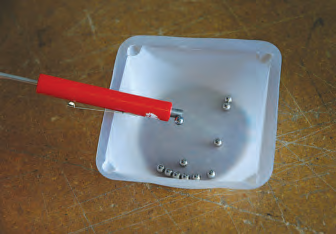
The small magnet on a pocket screwdriver can tell you a lot about a metal based on its level of magnetic attraction.
Don’t rely on any one characteristic. Use as many as you can compare to minimize doubt.
• Color. Aluminum and steel have distinctly different colors. Both are silver, but aluminum has a slight bluish tinge that steel lacks. The color difference between steel and stainless steel is less obvious, with stainless having a slightly more silvery color and steel appearing grayer. Copper is redder than brasses, and brass is yellower than most bronzes.
• Thermal conductivity. Aluminum feels warmer to the touch than stainless steel with a similar finish.
• Magnetism. The small magnet on a pocket screwdriver can tell you a lot based on a metal’s level of magnetic attraction when you are hip deep in the metal rack or see an odd looking dowel pin in the stainless steel box. I always have one of these cheap magnetic screwdrivers in my apron pocket. It’s my combination pry bar and metal identifier.
• Density. You can identify many materials based on their density or lack of it. For instance, 7075 aluminum is noticeably heavier than 6061 for an equal-sized part, even if it’s only 3 percent heavier. This density, combined with higher hardness, makes 7075 stand out from the more common 6061.
• Mechanical condition. A harder material with a higher tensile strength rings at a higher pitch when dropped or tapped with a tool than a softer one with a lower tensile strength.
In addition, stock up on catalogs from metal and plastic suppliers. These provide a wealth of useful information about material properties and processing. It’s easy to flip back and forth in these books to compare different qualities. Once you have some experience with some of the materials, you can easily correlate the observed differences with the book data.
I also maintain a big binder that I call my “Big Book of Knowledge.” It has all the data sheets and information I have had to look up in the course of doing my job. Whenever I get a nice piece of information on, say, the factory flatness standards of stainless sheet metal or the corrosion qualities of titanium in nacho cheese sauce, I put it in the binder. It has been extremely handy over the years because it relates directly to personal experience. CTE
 About the Author: Tom Lipton is a career metalworker who has worked at various job shops that produce parts for the consumer product development, laboratory equipment, medical services and custom machinery design industries. He has received six U.S. patents and lives in Alamo, Calif. Lipton’s column is adapted from information in his book “Metalworking Sink or Swim: Tips and Tricks for Machinists, Welders, and Fabricators,” published by Industrial Press Inc., New York. The publisher can be reached by calling (888) 528-7852 or visiting www.industrialpress.com. By indicating the code CTE-2011 when ordering, CTE readers will receive a 20 percent discount off the book’s list price of $44.95.
Glossary terms in this article
Related




Subscribers can use MFGAxis notes, saves and discussion tools with their innoNET account.


