

Bulldozing big workpieces: Drilling Performance
END USER: MSI Corp., (724) 567-6500, www.msicorporation.com. CHALLENGE: Effectively cut a large amount of material on older machines without damaging cutting tools. SOLUTION: A milling cutter tooled with inserts that enable a large DOC at a low horsepower.
—————
END USER: MSI Corp., (724) 567-6500, www.msicorporation.com. CHALLENGE: Effectively cut a large amount of material on older machines without damaging cutting tools. SOLUTION: A milling cutter tooled with inserts that enable a large DOC at a low horsepower. SOLUTION PROVIDER: Sandvik Coromant Co., (800) SANDVIK, www.sandvik.coromant.com/us
————–
When removing 0.75 ” of material from a 50-ton forged steel workpiece in a single pass, you need a setup that can take serious abuse. Finding the right combination of satisfactory surface finish and profitable production was a challenge for MSI Corp. But a test of a new milling cutter led the company to a simpler and faster machining process when milling heat-treated 4340 alloy steel. When applied throughout the shop, the new cutter allowed MSI to increase productivity by 75 percent through taking on more work. In the process, the cutter got a nickname—”The Bulldozer.”
Vandergrift, Pa.-based MSI is a large, diversified steel and titanium processor. It performs first-stage machining (gauge reduction) and material conditioning (defect removal) on large workpieces for metal producers.
MSI also performs abrasive blasting, abrasive sawing, belt grinding, bar peeling, bandsaw plate and dial column sawing, centerless grinding, CNC turning, deep-hole drilling, heat treating, planer milling, vertical boring and waterjet cutting.
“We are in the middle of the entire process,” said Duke McLaughlin, CEO of MSI. “It’s not uncommon for the material to come to us multiple times for the same process between different production phases.”
Workpiece size and weight—up to 70 ‘ long and from 8,000 to 125,000 lbs.—make setup difficult. Add the task of cutting difficult-to-machine materials such as titanium, stainless steel, carbon steel and P/M and you have a machining challenge few companies can meet.
With a specialized solution, MSI is up to the task. The company uses older—50 years old in some cases—manual planers built with 100- to 150-hp motors and twin columns capable of managing unwieldy workpieces.
The large planers are effective but can abuse cutting tools. Because of their massive size and power, the mills typically create a great deal of heat when machining. And, with only a few speeds and feeds available on the planers, MSI often facemills at less than ideal conditions.
“We’ve always had difficulty with the forged material we receive from our customers,” McLaughlin said. “The material is forged or rolled oversized in case there are cambers, twists and other manufacturing defects, and we have to remove a huge amount of material—fast!” The hammer-forged parts have divots and gullies from being hammered during the forging process. Extra material containing the defects is left on during forging and MSI removes it to achieve a smooth, workable surface.
Review the print ads from this magazine to continue
This quick advertiser review unlocks the rest of the article and keeps the full-screen reader focused on the ads instead of the page chrome.
Advertisers included in this article experience
Print placements connected to this article
Numberall
are pleased that the first Leitz PMM-G coordinate measuring
machine to be installed in America was at a company like Mil- waukee Machine Works, which has the highest quality stan- dards and represents the best of American manufacturing,” said Jack Rosignal, vice president of sales for Hexagon Metrology. “This new CMM is a huge enhancement to our capabilities,” Manna concluded. “We are known for tackling the toughest.
are pleased that the first Leitz PMM-G coordinate measuring machine to be installed in America was at a company like Mil- waukee Machine Works, which has the highest quality stan- dards and represents the best of American manufacturing,” said Jack Rosignal, vice president of sales for Hexagon Metrology. “This new CMM is a huge enhancement to our capabilities,” Manna concluded. “We are known for tackling the toughest, highest precision turning and machining jobs. Now we have a measuring machine with the size, capacity and accuracy to handle the largest parts we are capable of making.”
Visit Numberall View this placement in the issue recordPrint ads from this magazine
machine to be installed in America was at a company like Mil- waukee Machine Works, which has the highest quality stan- dards and represents the best of American manufacturing,” said Jack Rosignal, vice president of sales for Hexagon Metrology. “This new CMM is a huge enhancement to our capabilities,” Manna concluded. “We are known for tackling the toughest.
are pleased that the first Leitz PMM-G coordinate measuring machine to be installed in America was at a company like Mil- waukee Machine Works, which has the highest quality stan- dards and represents the best of American manufacturing,” said Jack Rosignal, vice president of sales for Hexagon Metrology. “This new CMM is a huge enhancement to our capabilities,” Manna concluded. “We are known for tackling the toughest, highest precision turning and machining jobs. Now we have a measuring machine with the size, capacity and accuracy to handle the largest parts we are capable of making.”
Continue reading
October 2011
Courtesy of Sandvik Coromant
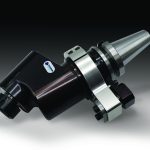
Below, MSI removes 0.75 ” of material from a 50-ton forged 4340 alloy steel workpiece in a single pass with the CoroMill 360 milling cutter (above) from Sandvik Coromant.
Needless to say, MSI is always in the market for cutters that can withstand these harsh conditions. When John Dolan, productivity engineer for Sandvik Coromant Co., Fair Lawn, N.J., brought the CoroMill 360 to MSI, McLaughlin agreed to a test cut on heat-treated 4340 alloy steel. “We’re always looking to take bigger cuts, or bites, due to the total amount of material we have to remove,” McLaughlin added. He was impressed with the results.
“We took a 12 “-dia. CoroMill 360 cutter, engaged 10 ” of the workpiece and took a ¾ ” cut without coolant,” McLaughlin said. “We cut for 2 days at 18 ipm. We were making chips bigger than my thumb.”
After cost-savings analysis and more testing, McLaughlin purchased left- and right-hand CoroMill 360s for every planer in the shop and uses the tools for nearly all of the materials processed by the shop, achieving major cycle time reductions. He noted that his first 360 body, installed in April 2009, is still operating.
In the example of machining 4340 alloy steel, what took five passes and a finish cut can now be done in just two passes: a 0.75 ” roughing cut and a 0.25 ” finish cut.
The CoroMill 360 accepts 60° inserts, which due to their chip-thinning effect allow for large DOCs and shorter machining times, but at a low horsepower suitable for 45° inserts. The result is a lighter cutting action. The use of a relatively large entry angle also permits the use of wide parallel lands on inserts with minimal compromise on cutting-depth capacity. The lands generate a fine surface finish without a wiper insert. Through optimal distribution of radial and axial cutting forces, the 60° inserts promote stability and lower vibration when entering and exiting the workpiece. The new tool generates less heat than the previous tool and allows MSI to machine dry.
Added McLaughlin, “The CoroMill 360 is cost effective for us because of its ability to hold two insert cassette sizes. We replace 28mm inserts with 19mm inserts for lighter DOCs.”
The new milling solution has also alleviated the risk of tool damage associated with inexperienced operators. “On the first cut, an inexperienced operator sometimes runs the cutter into a piece too fast or too deep and completely destroys the tool,” McLaughlin said.
“With the 360, if the operator goes in too fast or deep, it can take it. It has increased our capacity and simplified operations—all without adding capital equipment,” McLaughlin said.
Glossary terms in this article
Related


Subscribers can use MFGAxis notes, saves and discussion tools with their innoNET account.


