


Vision Quest: Drilling Performance
How microscopes and vision systems are used in machine shops for noncontact inspection and measurement.
Courtesy of Pointe Precision
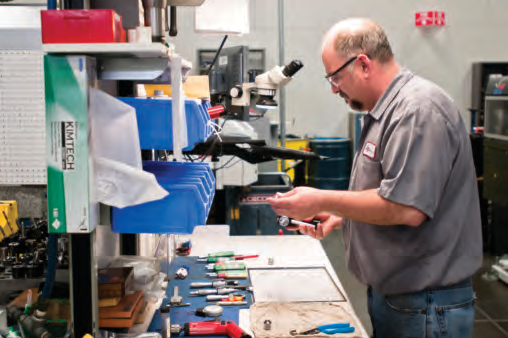
Pointe Precision’s machine operators have access to a 10× stereo microscope mounted on a swivel arm at every bench.
How microscopes and vision systems are used in machine shops for noncontact inspection and measurement.
When inspecting and measuring parts and part features on the shop floor, operators can choose among capabilities to see them, see them really well, and to document what they see. The equipment required to perform these functions varies in capability and price, and a machine shop must determine exactly what it wants to accomplish when choosing microscopes and vision measurement systems.
3-D Look
Stereo microscopes provide a 3-D view of the part and generally are used for visual inspection, not measurement. “A stereo microscope works like the human eye, which means it has good depth of field,” said Darrell Sanderson, national sales manager for Nikon Metrology Inc., Brighton, Mich. “You can see a 3-D image magnified maybe 20× or 30× on a stereo microscope.”
It is most common to look through the eyepiece when using stereo microscopes, but they also are available with a digital camera to view the part on a computer screen. Shops that want to document a defect can do so by adding the camera and software.
A common misconception with stereo microscopes is the part has to fit on the microscope stage. Instead, these microscopes can be removed from their stand and mounted on a boom stand or articulating arm. “You can bring the microscope to the part,” Sanderson said. “You can scan over an engine block or large turbine blade looking for very small defects.”
Stereo microscopes are appropriate for the shop floor as well as the QC lab to inspect a part after it has been machined. “It is popular for users to look for strange artifacts, defects or burrs,” Sanderson said. “Also, they might want to see the surface condition of the part.”
An example of a larger shop using stereo microscopes is Pointe Precision Inc., Plover, Wis. Founded in 1995, Pointe is a contract machine shop specializing in milling, turning, grinding and heat treating. About 75 percent of Pointe’s work is in the aerospace industry, 8 percent is in medical, and the rest is recreational, industrial and commercial.
The company has 2,000 part numbers. The smallest parts measure less than 0.100 ” in diameter and the biggest are 28 “×24 “×16 “. A simple part might have three or four features that need inspection but some have 200 or more features.
Pointe’s machine operators are responsible for inspecting their parts. They have access to a variety of inspection equipment, including a Unitron 10× stereo microscope mounted on a swivel arm at every bench. “We have additional microscopes that can go up to 30× for visual inspection located throughout the shop,” said Sam Crueger, Pointe’s director of engineering services.
Courtesy of Nikon
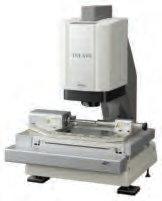
The iNEXIV VMA 2520 vision measurement system from Nikon has a black-and-white camera, 250mm × 200mm stage travel and up to 300× magnification.
Operators must document frequency of inspection as well. “We inspect every part feature using various methods with a dimensional tolerance accuracy from 0.020″ to 0.000040″,” Crueger said.
Pointe’s final inspection department visually inspects the parts, looking for scratches and burrs. “Controlling burrs is a major part of what we do,” said Tom Dickman, quality manager for Pointe. “We are accountable for the removal of all of the burrs on a part. The inspection department inspects all part features that have a tolerance of 0.003 ” or tighter. Pointe is dedicated to quality at the source, so our shop floor operators are just as skilled as our final inspectors.”
Another application for stereo microscopes is cutting tool inspection. Contract manufacturer Stark Industrial LLC’s operators use them on the shop floor. “We use a Mitutoyo stereo microscope on parts with small, intricate geometries, but also on cutting tools to get an idea of developing cutting tool wear patterns,” said Jonathan Wilkof, manufacturing engineer for Stark Industrial, North Canton, Ohio. “For instance, after drilling 250 holes, we might check the drill on a stereo microscope to determine what is happening on the edge or how the coating looks.”
Back to 2-D
While rough measurements can be performed on stereo microscopes, measuring microscopes, or toolmakers’ microscopes, produce a 2-D image for more critical measurements.
“Optical measuring systems have specific characteristics, notably a relatively small depth of field,” said Tim Sladden, director of marketing communications for Quality Vision International, Rochester, N.Y., a vision metrology company with divisions that include Optical Gaging Products and RAM Optical. “For precision measurements, it’s important that the feature of interest be in very good focus. Typically, the higher the magnification, the smaller the DOF and the greater the resolution. In other words, the ability to measure something small gets better because we see things in more detail at a higher magnification.”
There are tradeoffs, Sladden continued. “At a higher magnification, the imaging area is smaller, so you may be limited in the number of features you can image in a single field of view.”
While an eyepiece is typically used with stereo microscopes, with measuring microscopes the image is usually shown on a computer screen using a video camera. The measurement is made in the software using the image from the camera, not using the part itself.
Courtesy of Gradient Lens
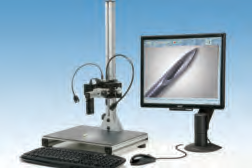
The Luxxor video microscope from Gradient Lens being used to measure a surgical needle.
“It is easier for the operator because they don’t have to strain their eyes,” Stark Industrial’s Wilkof said. “They can move the microscope stage in the X and Y direction and see the part moving around while looking comfortably at the computer screen. The operator takes a series of data points, say around a circle, and the software takes those points and calculates the circle that those points make up. He can take a number of points and measure diameters, lengths, arcs and angles.” If documented inspection is required, the data can be output in a spreadsheet or statistical process control program.
In addition to making parts for the medical, oil and gas and aerospace industries, Stark Industrial is a distributor of Mitutoyo and ST Industries measuring equipment.
The company specializes in small-hole drilling. “We produce holes from 0.008″ to 0.250″ in diameter. Depending on the hole size and depth, we can hit tolerances of less than 0.001″,” Wilkof said. “Placing a measuring microscope on a table with a vision setup is an excellent way to measure those features.”
These types of measuring microscopes are considered semi-automated. The operator is responsible for taking the data points and feeding them to the computer.
In a clean, well-maintained machine shop environment, these microscopes are suitable for the shop floor.
Manual Matters
The Luxxor video microscope from Gradient Lens Corp., Rochester, N.Y., is a manual video microscope. “It has great image quality and good capabilities, but it doesn’t have a lot of complex features,” said Doug Kindred, president and chief scientist. “The Luxxor provides the ease of video and the image capture and measurement capability of more expensive vision systems. The idea is very much like the traditional toolmaker’s microscope. You use it for measurements that are difficult to do with a caliper or micrometer.”
The lens and zoom are manually focused. “Higher priced systems have automated edge detection,” Kindred said. “With the Luxxor, the crosshairs are aligned on the part with the mouse, producing measurements accurate to ±0.001″.” The magnification of the Luxxor is from 15× to 83×; adapters are available that allow 200× magnification.
Courtesy of Optical Gaging Products
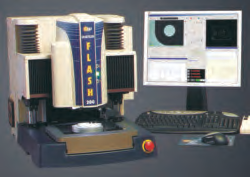
The SmartScope Flash 200 automatic multisensory measurement system from Optical Gaging Products has a measurement range of 200mm × 200mm × 150mm.
The Luxxor comes with Video Toolbox software. It allows the user to easily capture still images or video, which can be labeled and annotated. It also has the measurement features built in, allowing the user to measure dimensions, angles and radii.
View print ads from this spread
Review the ads on this magazine spread to continue reading. Each ad takes two seconds; a two-page ad counts once.
Advertisers on this magazine spread
Print placements on this magazine spread
800.521.9520 | mscmetalworking.com
MILLING • HOLEMAKING
THREADING • INDEXABLE For over 60 years, Hertel has been providing the metalworking industry with unsurpassed value. Hertel cutting tools are ideal for general machining applications and come in a wide variety of styles and sizes. Available exclusively at MSC Industrial Supply Co.® South-Tec 2011 • October 11-13 • Charlotte, NC • See us in Booth #936.
MILLING • HOLEMAKING THREADING • INDEXABLE For over 60 years, Hertel has been providing the metalworking industry with unsurpassed value. Hertel cutting tools are ideal for general machining applications and come in a wide variety of styles and sizes. Available exclusively at MSC Industrial Supply Co.® 800.521.9520 | mscmetalworking.com
Visit 800.521.9520 | mscmetalworking.com View this placement in the issue recordPrint ads from this magazine
THREADING • INDEXABLE For over 60 years, Hertel has been providing the metalworking industry with unsurpassed value. Hertel cutting tools are ideal for general machining applications and come in a wide variety of styles and sizes. Available exclusively at MSC Industrial Supply Co.® South-Tec 2011 • October 11-13 • Charlotte, NC • See us in Booth #936.
MILLING • HOLEMAKING THREADING • INDEXABLE For over 60 years, Hertel has been providing the metalworking industry with unsurpassed value. Hertel cutting tools are ideal for general machining applications and come in a wide variety of styles and sizes. Available exclusively at MSC Industrial Supply Co.® 800.521.9520 | mscmetalworking.com
Continue reading
October 2011
Parts to be examined are placed on the 10 “×15 ” stage. “But the Z-axis is actually 16 ” high,” Kindred said. “We intentionally made ours tall so large automotive parts, either machined parts or castings, can be inspected.”
Seeing Visions
Most vision measurement systems are fully CNC for automatic measurement. “All the vision measurement systems we make, with varying levels of automation, are modern variations on the measurement, or toolmaker’s, microscope,” QVI’s Sladden said. “They use a combination of very low-distortion optics, precision stages and high-resolution video that can be processed by the software to make automatic measurements.”
Because the measurement is always made the same way, it removes the subjectivity of manual measurements. “You can accurately make a measurement by determining the location of an edge or surface of a part or feature in your optical field of view. You can analyze that image electronically through software.”
The feature being measured doesn’t have to fit in a single field of view, according to Sladden. When measuring the diameter of a hole, a user can measure a portion of it, move the stage, measure another portion, and so on. The software can construct the actual feature from successive “snapshots” made by the camera.
With vision measurement systems, the user creates the program to measure common features and make typical constructions according to the CAD drawings.
“You are really just teaching it,” Nikon’s Sanderson said. “You have a one-time manual operation to teach the device how to measure the part. You basically go around the part in relation to the CAD drawing and tell the machine what to measure. It is just recording the steps you are making. Then you can save that program and run it over and over. The program is also easily edited to make other programs from it.”
Once a part is measured, the operator analyzes the resulting data to ensure the part fits the design of the CAD drawing and meets tolerances. “We can output the data to a spreadsheet or send the data to a program through a dynamic data exchange that would match the data to the CAD drawing,” Sanderson said.
Also, users commonly save the data in a statistical database. “They are comparing measurements from the hundreds or thousands of parts they make and looking for trends in the manufacturing process,” Sladden said. “They are trying to understand if their process is in control or whether it has too much variability. Using measurement data, they can analyze the source of variability and impose changes in their process to reduce it.”
Another step would be to export measured data points to sophisticated software that can apply geometric dimensioning and tolerancing. “You can take the measurement data and compare it to a CAD model to see if, when all the tolerances are applied, the part is in compliance,” Sladden said. “That is a more sophisticated process that is becoming more common. It is most often used in cases where the parts themselves are high value or where form and fit are extremely critical.”
More and more, a majority of these vision measurement systems are well suited to the shop floor. Operation does require training, and is typically performed by a QC technician.
While these vision systems would seem to lend themselves to high-volume parts inspection, they can benefit smaller runs too. That is the case at Challenge Machine Inc., Columbia Heights, Minn., a contract machine shop that cuts various materials, including difficult-to-machine plastics. Founded in 1999, Challenge specializes in micromachining parts for the semiconductor industry. “They are test sockets for microchips and processors,” said Sean Lewis, quality manager. “They repeatedly test a chip so the socket has to have high heat-resistance properties. Most are made from exotic plastics, such as Vespel, Torlon and Ultem.”
Most parts are 1.5 ” square or less, with features from 0.004 ” on up. Most tolerances are ±0.001 “, with some as tight as ±0.0005 “. Challenge uses two iNEXIV VMA 2520 vision measurement systems from Nikon, with black-and-white cameras and magnification up to 300×. “We get 0.0001 ” or better accuracy and you just can’t get that with a measuring microscope,” Lewis said.
Challenge is not a high-volume manufacturer. “A lot of the parts we do are prototypes or one-time runs.” Lewis said. “This means we’re doing a lot of programming and the iNEXIVs are running nonstop. Either someone is programming one of them or someone is running a part.”
The machines are kept in a QC lab and the shop’s quality inspectors generally write the programs. As long as there is a program, the operators can come into the lab and run their parts themselves whenever they need to.
Challenge purchased the systems based on a customer recommendation. “It works well because we can share programs with that customer,” Lewis said. “Many times, they send their program over and we compare how we check the part vs. how they check it.”
Advanced vision measurement systems can have multiple sensors. “When you see the phrase ‘multisensor’ they are referring to the different tools that can be used to make measurements,” Nikon’s Sanderson said. “So one sensor is the combined optical system and camera. In some cases, there might be a feature on the side of the part that you can’t see to measure without turning the part, so we might add a touch probe and that would be considered an additional sensor.”
Another is the laser sensor. “A laser can be used for fast, accurate focusing, or to acquire a large amount of surface data to evaluate shape or form,” Sladden said. “Depending on the optical magnification in use, laser focus can be a more accurate way of focusing than an optical focus.”
Multiple sensors allow the operator to select the best sensor for the measurement at hand all within one system and program them all using the same software, he added.
One of the main determinants in choosing which optical system is best for a particular shop is the cost. Stereo microscopes are just for inspection, making them less expensive. They range from about $2,000 to $5,000. With a digital camera and some software, the cost increases to $12,000 or $15,000.
Measuring microscopes start at about $15,000 and can go as high as $80,000, depending on options. Vision measurement systems start at about $40,000 for a black-and-white camera with no additional sensors, but they can reach $200,000 or higher.
Some pricing crossover exists between the measuring microscope and the vision measurement system categories. For example, depending on the shop’s needs, it might be worth looking into spending $40,000 or $50,000 on an automated vision system vs. $60,000 on a manual measuring microscope. But, with many different options available, the most important consideration is finding the right solution to your shop’s measurement needs. CTE
About the author: Susan Woods is a contributing editor for CTE. Contact her at (224) 225-6120 or by e-mail at susan@jwr.com.
Contributors
Challenge Machine Inc.
(763) 231-8400
www.challengemachine.com
Gradient Lens Corp.
(800) 536-0790
www.gradientlens.com
Nikon Metrology Inc.
(810) 220-4360
us.nikonmetrology.com
Pointe Precision Inc.
(715) 342-5100
www.pointeprecision.com
Quality Vision International
(585) 544-0450
www.qvii.com
Stark Industrial LLC
(800) 362-9732
www.starkindustrial.com
Glossary terms in this article
Related




Subscribers can use MFGAxis notes, saves and discussion tools with their innoNET account.