


Flight Path: Turning Performance
Courtesy of Lockheed MartinThe Lockheed Martin Hercules transport, one of many aircraft to use actuator systems manufactured by Triumph Activation Systems.Making the systems that keep 'big birds' flying straight.Boeing's 787 Dreamliner generated positive news in October when its first commercial flight, by All Nippon Airlines, landed in Hong Kong.
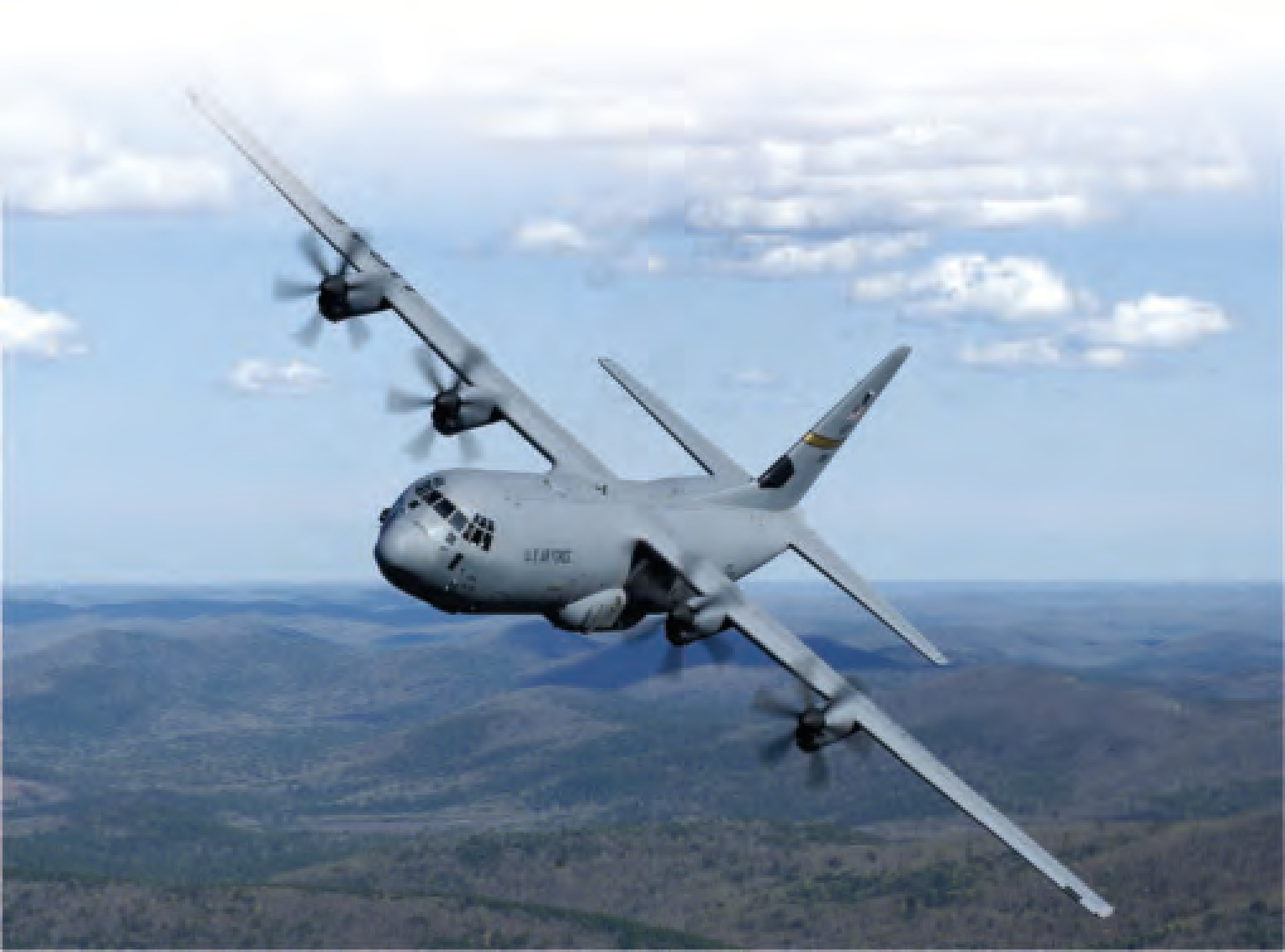
Courtesy of Lockheed Martin
The Lockheed Martin Hercules transport, one of many aircraft to use actuator systems manufactured by Triumph Activation Systems.
Making the systems that keep ‘big birds’ flying straight.
Boeing’s 787 Dreamliner generated positive news in October when its first commercial flight, by All Nippon Airlines, landed in Hong Kong. Inside that 787 was a vast array of high-tech parts and equipment, including linear hydraulic actuators, rotary pumps and rotary motors. These largely unseen, yet indispensable systems and assemblies help keep flights on track and without incident.
Many of these systems for the 787 and other aircraft are made by Triumph Actuations Systems, Clemmons, N.C., a business unit of Triumph Group, Berwyn, Pa. The 130,000-sq.-ft. Clemmons facility opened in 1989 and employs 230. The main product lines are linear hydraulic actuators, solenoid and manually operated hydraulic valves, hydraulic systems, rotary pumps and motors and variable- and fixed-displacement axial piston pumps and motors.
“When I joined Triumph in 1990, we were all about hydraulic systems and linear hydraulic actuators, rotary pumps and motors,” said G. William Burke III, CNC programmer manufacturing engineer. “Then we acquired a line of hydraulic pumps and motors from Honeywell in 2001.This was entirely new work for us and required a steep learning curve, a manufacturing capacity increase, new technology and additional personnel.”
Before the Honeywell acquisition, Triumph Actuation Systems’ aerospace work was about 80 percent commercial and 20 percent military. Today, the balance is 50/50.
Courtesy of Triumph Actuation Systems
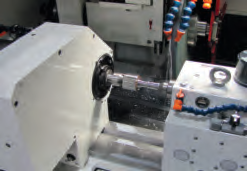
A rotor fixtured on a Studer S33 CNC at Triumph.
Courtesy of Triumph Actuation Systems
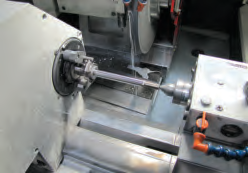
A piston rod setup on a Studer S33.
Triumph’s actuators open and close various aircraft doors, including ones for engine compartments and cargo holds, and also raise and lower nose and landing gears and open and close the doors that house them. Actuator parts include a hydraulic reservoir, an extending and locking piston and a bearing at one end of the actuator that allows the system to pivot as it extends.
“Our actuators are used on planes ranging from the B-1 Bomber and C-130 cargo planes to the Boeing 737 and down to small Piper aircraft,” Burke said. “We also do some Bell helicopter work and systems for the V-22 Osprey. However, the 787 has more Triumph components and systems than any other aircraft.”
U.S. Sourced
Triumph Actuation Systems performs about 10 percent of its parts manufacturing in-house, with the rest outsourced to U.S. companies. Triumph tests every actuator, pump and motor it manufactures, including hydraulic actuator extensions, locking mechanisms and releases.
“We work closely with our customers to achieve design for manufacturability,” Burke said. “Our design team reviews designs with customers with a critical eye on DFM. We try to determine whether or not we are using the most-efficient, cost-effective design and processes. We also look for better ways of making parts and using alternative work materials.”
Triumph Actuation Systems regularly audits its suppliers to see if it can bring their parts directly into its stock system without having to perform incoming inspection. This requires parts to be completely traceable, with verification of all operations performed, equipment used, tolerances and surface finishes held, inspection and verification systems used and process variations recorded.
On the parts it produces, Triumph performs operations including turning, horizontal and vertical milling, internal and external grinding, as well as internal honing, lapping and other secondary operations. After machining, some parts are sent out for anodizing, chrome plating, cadmium plating and nickel plating.
Key Grinding Ops
Grinding is a particularly crucial operation. “We make housings, bearing journals, piston rods and rotors for our hydraulic pumps,” Burke said. “We perform various grinding operations on these parts, including piston-and-sleeve match grinding and some seat grinding. Tolerances are ±0.000050 “, and 2µm Ra to 16µm Ra surface finishes are the norm. Tolerances like these require digital micrometers on the ODs, and electronic gaging and air gages for precision ID work.”
Triumph grinds diameters from 0.125 ” to 4 “, and lengths from 0.250 ” to 13 “. It often grinds multiple diameters and shoulders in one operation.
“Our biggest bearing journal is 3 ” in diameter,” Burke said. “We may grind the body of the rotor, the bearing journal of the rotor and an area for fixturing. We put our own forms and radii on abrasive wheels for parts that require plunge grinding. We do an angular plunge so we can grind the shoulder and the diameter at the same time. We’ll bring the wheel in at an angle, plunge, then traverse to achieve the required finish.”
Grinding cycle times range from 2 to 5 minutes per part. Triumph does not perform high-volume grinding; most parts are produced in lots of 24 or 30. Changeover times for different part styles are from 30 to 90 minutes, part to part, but within a part family changeover typically takes just a few minutes.
Courtesy of Airbus
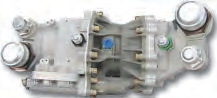
A Triumph rotary pump for the Airbus A320.
“Most of our ground parts, like rotor shafts, we run between centers, with a dead or live center supporting the shaft, and we drive the shaft and grind the OD,” Burke said. “We also use fixtures for part locating and grinding, as well as collets to hold and grind parts.”
Burke added that one 7 “-long rotor shaft goes into a rotary pump-and-motor hydraulic system used in a ground-based auxiliary power unit. “When you’re sitting in a plane on the tarmac, and you can hear the ‘voomp, voomp, voomp’ of a pump working right under your feet, chances are it is a Triumph pump.”
Part Materials
Triumph grinds a range of workpiece materials, including 4340 steel, 15-5 PH (precipitation hardening) stainless, 7075 aluminum, bronze and Toughmet 3. A spinodal bronze, Toughmet 3 machines like 4340 steel but has greater wear resistance and toughness.
“Most of our rotors start out as 4340 steel,” Burke said. “We have developed a bonding process that involves inserting high-lead bronze plugs into rotors, and diffusion bonding the plugs to the 4340 at high temperatures in a furnace. When the rotor is removed from the furnace, the bonded features are machined, revealing the bronze plugs. The plugs are typically wear areas where pistons run inside the cylinder. We ream the ID, leaving a small bronze wall thickness in the piston bore. The bronze material helps maintain free piston movement and facilitates the flow of hydraulic fluid in the cylinder.”
Courtesy of Triumph Actuation Systems
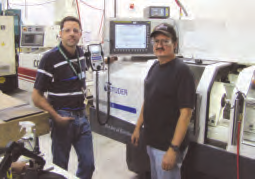
G. William Burke III (left) and Brent Holder, operator, with the shop’s Studer S33 grinder.
Triumph recently purchased a Studer S33 CNC cylindrical grinder from United Grinding Technologies, Miamisburg, Ohio, for OD grinding. Triumph also has an older Studer S20 universal cylindrical grinder, which performs ID and OD grinding.
One of the grinding processes is performed after machined aluminum parts are sent out for anodizing. After the parts are returned, the anodizing is ground off certain areas of the OD, such as the bearing. The part is then sent out for hard coating.
“By exposing the aluminum after anodizing, the hard coat will only attach to the portion of the part that was ground,” Burke said. “Often, we’ll have them build up the coating deeper than we need, then grind the hard coat to size, not taking the coating below the parent aluminum.”
Making the Choice
Triumph chose the Studer S33 over other builders’ machines because of its ability to meet the company’s needs. “Given our extensive experience with a Studer S35 universal cylindrical grinder, we were certain the S33 would allow us to better perform our current grinding applications and move into new applications,” Burke said.
Burke noted that one main advantage of the Studer S33 is that it can store multiple part programs. “With our older machine, we could only program one part at a time—you had to blow the program out after every job, so we were writing a new program every time,” he said. “The Studer S33 allows us to write programs, store them in the control and upload and download them to our computer system. If it’s a repeating part, the operator just calls up the program, sets his grinding limits and pushes the start button.”
Courtesy of Triumph Actuation Systems
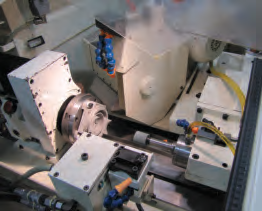
Setup on a Studer S20 ID/OD grinder operated by Triumph.
According to Burke, the machine’s Windows-based StuderWin software is easy to use. He writes the Studer S33 part programs and the operator sets up and grinds the parts. “We’ve built a large inventory of programs,” he said. “When parts come back to our grinding department, unless it’s a new part, we’re off and grinding in a very short time.” The Studer S33 has allowed Triumph to bring in more work due to its ability to enable rapid changeovers and grind features in one setup.
Triumph works closely with United Grinding. “We have a very good relationship with UGT, especially with sales rep Bob Beals, as well as Ray Wyland, a service engineer, and Jim Lennon, an application engineer,” Burke said. United Grinding suggests wheels, assists in applications and helps choose fixtures and part programs.
“Through this process, I’ve learned the importance of selecting not only the latest and best technology—you’ve got to do that to stay ahead of the competition—but also of acquiring that technology though a great partner,” he said. CTE
 About the Author: Robin Yale Bergstrom is principal and editorial director at RYB Communications, Hebron, Ky. He can be reached at (859) 689-9551 or at www.rybcom.com. For more information about United Grinding Technologies Inc., call (937) 847-1253, visit www.grinding.com or enter #350 on the I.S. card.
Glossary terms in this article
Related


Subscribers can use MFGAxis notes, saves and discussion tools with their innoNET account.