

A Pitch for Thread Grinding
When accuracy counts, thread grinding shines. It may not be a new twist, but thread grinding is still one of the most accurate ways to produce internal and external threads.
When accuracy counts, thread grinding shines.
It may not be a new twist, but thread grinding is still one of the most accurate ways to produce internal and external threads. While single- and multiple-point turning tools, taps and dies, milling cutters, whirling rings and thread rollers have their advantages, thread grinding remains a solid choice for tight-tolerance parts.
Thread accuracy is a sum of many elements, including pitch, helical path, helix angle and major, minor and pitch diameters. A thread’s lead, or the distance the helix advances in one full turn of the screw, is the most critical dimension in most cases.

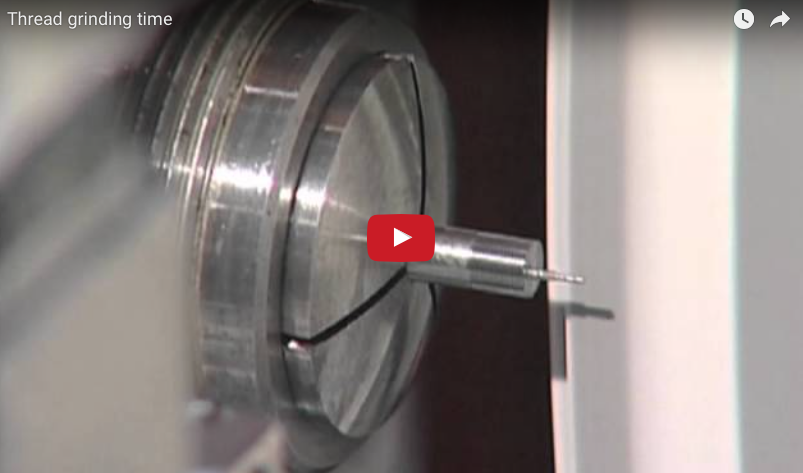
This short video provides some insight into the benefits and time savings afforded by a universal grinding machine. It is presented as supplemental information to Cutting Tool Engineering’s December 2011 cover story, “A Pitch for Thread Grinding.” Video courtesy of United Grinding.
Regarding lead tolerances achieved by different threadmaking methods, Hans Ueltschi, vice president for the cylindrical division of United Grinding Technologies Inc., Miamisburg, Ohio, said, “In thread grinding, we typically talk about tolerances in the lower tenths and millionths, whereas turning thread tolerances are more in the upper tenths and thousandths.” Grinding machines are typically able to achieve tolerances of about 0.0002 ” or tighter.
Consistency is another advantage of thread grinding. “You can dress the grinding wheel extremely precisely, and, once you have that form in the wheel, the wheel generally doesn’t wear as rapidly as does a single-point tool,” Ueltschi said.
Thread grinding can also enhance production flexibility. In a job shop environment, a wheel can be redressed quickly to produce a different thread, while other methods may require different cutting tools.
Jim Vosmik, president of Drake Manufacturing Services Co. Inc., Warren, Ohio, cited production of positioning worms for automotive electronic power steering systems as a typical thread grinding application. A low-quality, threaded worm can produce unwanted noise in the passenger compartment. “Key considerations are surface finish, waviness and accuracy of the thread lead—not in overall length, but in each revolution,” he said.
Inaccuracy—known as drunkenness or wobble—produces “variations in torque, and the feel of the steering will change. For automotive steering components, customers are looking for a surface finish finer than 0.2µm Ra, form compliance on the thread track around 5µm and lead variation in one revolution below 3µm,” Vosmik said. “These tolerances are more typical of the highest-quality positioning ballscrews and indexing worms.”
Universal Grinding
Machines engineered to grind threads can be grouped into two broad categories: universal cylindrical grinders with thread grinding capability and dedicated thread grinders. The machine styles differ in the way they apply the wheel, how the wheel interacts with the part and the number of setups required to produce a part.
In a universal grinding machine fitted for thread grinding, the grinding wheel typically is not tilted to produce the thread’s helix angle. “We call it axis parallel thread grinding,” Ueltschi said. “The wheel spindle axis is parallel to the workpiece axis. The thread form dressing is adjusted to compensate for not tilting the wheel; we actually dress it wrong so it comes out right. If we dressed the wheel with the normal thread form and then cut the thread with the wheel parallel, the thread would have an error.” The machine’s grinding software controls dressing.
Images courtesy of Drake Manufacturing Services
The work zone of a GS:TEM-LM (Mini) grinder (inset) from Drake is used for production-level thread grinding of parts from 0.5mm to 10mm in diameter and up to 100mm long.
There are, however, limits to the helix angles that can be produced via axis parallel thread grinding. For ODs, the limit is generally 6°, according to Ueltschi. Grinding ID threads on a universal machine is further limited because fitting the grinding wheel and quill into the ID bore creates additional issues. “Therefore, on ID threads you would have to go to a tilting A-axis arbor more quickly than you would on the OD side,” Ueltschi said, noting that the limit is about 3° before having to go to a tilting wheel arbor.
United Grinding’s Studer Thread software calculates potential error and compensates in the dressing subroutine. After a user enters thread specifications into the menu-driven software, the program determines whether or not the thread can be produced on the machine, what compensation is required and dressing and cycle times. A variety of grinding cycles enable a thread to be cut in different ways, depending on the type and geometry of thread, including plunging the thread or chasing it with single- or multiple-rib wheels.
Universal cylindrical machines for thread grinding typically feature turret heads with multiple OD and ID wheels. According to Ueltschi, the main advantage of using a universal machine is its ability to produce an entire part in one setup. “For example, we take a gear shaft for a helicopter gearbox, grind the journals and faces and IDs, index the turret to another wheel and grind a precise thread. The old method would have involved putting the part through one or several OD grinders, followed by a thread grinder.
“In thread grinding, there is a lot more involved than in turning, but, in the end, if everything is done right, you definitely get a better product,” Ueltschi continued. “However, grinding—with longer cycle times—may be a more expensive process. So if you can get away with turning the thread, that is the way to go.”
Universal Appeal
Complete Grinding Solutions, Springboro, Ohio, employs universal cylindrical grinding machines for many conventional applications as well as niche jobs, such as grinding Formula 1 steering racks and camshafts for NASCAR teams. Beat Maurer, CGS’ co-founder, said about 10 percent of the company’s work involves thread grinding.
“A lot of it is development work and prototypes, like ball nut threads for aircraft and GO/NO-GO gages for engine blocks,” he said.
In addition to part accuracy, thread grinding provides the fine surface finishes required for critical-application parts. Single-point inserts and milling cutters produce larger chips than grinding wheels and the cutting process may induce stress into a part. As a result, Maurer said, “For parts such as aircraft pistons, we use low-stress thread grinding to avoid generating heat in the part.”
While hard turning may be a threadmaking alternative for less-than-premium-quality parts, tool costs can favor grinding. “A wheel is very cheap compared to changing inserts every 3 hours,” Maurer said. He added that grinding can also be effective when interrupted threading, where gaps in the toolpath could break an insert.
CGS’s performs most of its thread grinding on a Studer S40 universal. “Many times,” Maurer said, “when we do thread grinding it is a combination of complete machining, meaning we do all the part features and then grind a thread as well.” He acknowledged that a universal machine sometimes is limited in the helix angles it can produce. “You have to design the process and optimize it.”
An example of an optimized thread grinding operation is threading automotive engine block GO/NO-GO gages in D-2 and M-2 tool steel to a tolerance of ±1µm, Maurer noted.
Dedicated Operation
Dedicated thread grinding machines have enabled Mechanitron Corp., Roselle, N.J., to serve a customer base that has continually changed over 5 decades. The shop has moved from threading cores for the plastic molding industry, to grinding components for defense and aerospace manufacturers, to producing actuator screws for medical diagnostic equipment. The shop uses venerable non-CNC J&L thread grinding machines which, according to Dave Newman, president of Mechanitron, can hold lead tolerances within 0.0001 ” while handling parts from 0.040 ” to 12 ” in diameter and 2 ” to 105 ” long. Tilting wheel arbors permit grinding helix angles up to 31°.
Changing the lead of a thread on the J&L thread grinders involves changing the gears that control the lead. Switching gears is routine, said longtime Mechanitron grinder Louis Sayte, and occurs several times daily. “The pitch will be whatever gear I put in,” he said.
Some customers have unusual requests. “People come in with a very strange lead, and then I have to calculate that lead for the gears we have,” Sayte said. “That is the reason people come to us—to give them these oddball leads and still hold them within 0.0001 “.”
Review the print ads from this magazine to continue
This quick advertiser review unlocks the rest of the article and keeps the full-screen reader focused on the ads instead of the page chrome.
Advertisers included in this article experience
Print placements connected to this article
Time to think about grinding in-house.
How would you sharpen these tools?
We send them out O.K.…But how much time do you spend? for resharpening Lost production while waiting for tools? Manual tool grinder How do you keep up? Quality? Training? Maybe it’s time to think about a WALTER CNC? WALTER POWER That’s what most people check – over 7,000 shipped! Super fast for short cycle times. Fastest setup – On the.
How would you sharpen these tools? We send them out O.K.…But how much time do you spend? for resharpening Lost production while waiting for tools? Time to think about grinding in-house. Manual tool grinder How do you keep up? Quality? Training? Maybe it’s time to think about a WALTER CNC? WALTER POWER That’s what most people check – over 7,000 shipped! Super fast for short cycle times. Fastest setup – On the machine or off-line so machine stays productive. Most versatile. Simplest and most reliable autoloaders –
Visit Time to think about grinding in-house. View this placement in the issue recordPrint ads from this magazine
We send them out O.K.…But how much time do you spend? for resharpening Lost production while waiting for tools? Manual tool grinder How do you keep up? Quality? Training? Maybe it’s time to think about a WALTER CNC? WALTER POWER That’s what most people check – over 7,000 shipped! Super fast for short cycle times. Fastest setup – On the.
How would you sharpen these tools? We send them out O.K.…But how much time do you spend? for resharpening Lost production while waiting for tools? Time to think about grinding in-house. Manual tool grinder How do you keep up? Quality? Training? Maybe it’s time to think about a WALTER CNC? WALTER POWER That’s what most people check – over 7,000 shipped! Super fast for short cycle times. Fastest setup – On the machine or off-line so machine stays productive. Most versatile. Simplest and most reliable autoloaders –
Continue reading
December 2011
Sayte pointed out that the J&L thread grinding machines run automatically using electromechanical switches and cams. Wheel speed, work speed and lead are independent of each other. The machines can be set up to perform a fast return between grinding passes or to cut on the forward and return passes. Dressing, also set independently, can be performed on the return pass, after every pass or after a specified number of passes. The machines compensate mechanically for material removed in each dressing pass.
The J&L machines can “cut fractional threads, decimal pitches, anything you want,” Sayte said. That capability is useful for mold and die jobs. A finished molded part may have a standard-size thread, but the mold’s thread form dimensions must be adjusted to compensate for shrinkage that occurs during molding. “The customer specifies the shrinkage and we give them a longer or shorter lead to compensate,” Sayte said. “The plastic shrinks, but they still want the proper pitch when the part cools off.”
High Tech, High Demand
According to Drake’s Vosmik, some dedicated CNC thread grinders are riding a wave of high-tech demand. The company’s GS:TEM -Mini thread grinders for production-level thread grinding of parts from 0.5mm to 10mm in diameter and up to 100mm long are “flying out the door,” he said. Most of the machines are going to Asia for making miniature electronic devices.
Vosmik explained that those electronic products typically are held together with fasteners 3mm in diameter and smaller, and manufacturers don’t want chips when threading holes for the fasteners. “So they are using forming taps, which are essentially rotary progressive dies.” Drake machines are used to grind the threads in the taps.
In a forming tap, the thread starts at the minor diameter with no height and grows within a few revolutions to reach the full major diameter, displacing the metal instead of cutting it. Like a fluted tap, the forming tap features a relief that facilitates the cutting action, but, unlike a fluted tool, the relief of a form tap is continuously contoured. “It looks like a screw, with no flutes,” Vosmik said, “but the thread is not the same diameter all the way around.”
Drake software engineers Stig Mowatt-Larssen and Mike Hughes wrote the software code that enables the tiny, complex forming taps to be ground accurately. “The real value in the machine is our software and process development,” Vosmik said.
The forming taps are as small as M0.5×1.25 (metric tap 0.5mm nominal OD × 0.125mm pitch and lead. In inches, 0.020×200 or 200 tpi). Vosmik said advances in grinding wheel technology are key to production of the taps (see sidebar on page 32).
“The wheels are driving us,” he said. “The wheel manufacturers are pushing ahead and advancing the capabilities of the thread grinding machines. We are going to see lots of new order-of-magnitude breakthroughs in cycle times and quality.”
Vosmik said the unanticipated demand for specialized thread grinding machines demonstrates that manufacturers must be open to nontraditional opportunities. The Mini machine concept began as a retrofit of another machine for a Drake customer and was later developed into a new machine. “We kind of married this need for smaller tools with features such as linear motors that permit relieving a cutting edge—reversing X-axis motion—very quickly,” Vosmik said. CTE
About the Author: Bill Kennedy, based in Latrobe, Pa., is a contributing editor for CTE. He has an extensive background as a technical writer. Contact him at (724) 537-6182 or billk@jwr.com.
This traverse disc from Saint-Gobain with a 0.002 ” corner radius dresses aluminum-oxide grinding wheels employed to grind microthreads on HSS taps. Images above and below courtesy of Saint-Gobain Abrasives.
This 200× micrograph shows the edge of a grinding wheel dressed to generate a 0.001 ” tip radius in a HSS forming tap.
Wheel life adventures in thread grinding
When thread grinding jobs get really small, it’s sometimes not enough just to dress the abrasive wheel. Individual abrasive grains in the wheel must also be dressed when that’s the case.
Mike Hitchiner, OEM technology manager for grinding wheel supplier Saint-Gobain Abrasives, Worcester, Mass., noted that demand for precisely ground products like fine-pitch miniature taps makes innovative solutions such as this essential.
To reach the bottom of a 200-tpi thread form, the tip radius of the grinding wheel must be 20µm to 25µm (0.0008 ” to 0.001 “) wide. “In the past, people would always ask us to help them grind threads under a 0.005 ” tip radius, and we’d all duck and hide,” Hitchiner said. “There just wasn’t a good answer. A lot of it was because of grinding machines with vibration issues.”
Machines that are more rigid have solved the vibration issues, he said, and wheel suppliers understand how to properly dress the wheel.
Previously, superfine threads were ground with fine-grain conventional wheels. “You needed a grain size that fit into the radius of the thread,” Hitchiner said. However, standard fine-grain abrasives are from 220 to 400 mesh, 40µm to 50µm in size. Wheels employing such fine grains were unable to remove material quickly due to excessive wear, insufficient chip room and high tool pressure.
The solution was dressing the abrasive grains themselves to size. When dressing wheels to grind fine threads in HSS, Saint-Gobain found that a dresser could be applied to the two sides of the wheel that taper to form the grinding point. At the wheel tip, the dresser would cleave a coarse grain to produce the small tip radius required for a fine thread. The result was a large grain with the small radius ground into its tip. “Most recently, we’ve done things to the grain of Saint-Gobain’s SG ceramic-alumina material that basically make it much easier to fracture it in this form,” Hitchiner said.
A collateral issue is that dressing such a fine-tip radius requires a very sharp diamond-tipped dresser. “The contact width of the dresser is critical,” he said. “The larger it is, the more pressure it puts on the wheel tip. You get to a certain point with the pressure, and it just snaps the tip off.”
The challenge now, according to Hitchiner, is maximizing dresser life because a sharp dresser wears quickly. He noted that the process works well, but a more repeatable, sustainable dressing method would be welcome.
The diamond wheels applied to grind carbide forming taps added another challenge. “You have a wheel that is going to wear a diamond dresser 20 times faster,” Hitchiner said. He described a new Saint-Gobain diamond wheel bond technology, a proprietary nonvitrified hybrid material called Paradigm, which permits the use of an essentially flat CVD-diamond-based disc dresser to generate a 25µm tip radius in a diamond wheel.
Compared to a diamond-tipped dresser, the disc dresser wears in a predictable fashion and enables high-speed dressing, which reduces cycle time for tap production by up to about two thirds. “While grinding quality is essential, parts per hour is the key,” Hitchiner said.
—B. Kennedy
Contributors
Complete Grinding Solutions
(937) 746-7888
www.completegrindingsolutions.com
Drake Manufacturing Services Co. Inc.
(330) 847-7291
www.drakemfg.com
Mechanitron Corp.
(908) 620-1001
www.mechanitron.com
Saint-Gobain Abrasives
(254) 918-2313
www.nortonindustrial.com
United Grinding Technologies Inc.
(937) 859-1975
www.grinding.com
Glossary terms in this article
Related



 MFGAxis Discussion
Be part of the shop-floor conversation
Like, save, or comment on this CTE story.
MFGAxis Discussion
Be part of the shop-floor conversation
Like, save, or comment on this CTE story.


MFGAxis Discussion