



Binderless diamond: Turning Performance
Molds for making plastic lenses can be effectively machined with conventional polycrystalline and single-crystal diamond tools because the molds are made of relatively soft materials, such as electroless nickel. However, molds for making high-performance glass lenses, such as for digital cameras and sensors, are often made of hard cemented carbide.
Molds for making plastic lenses can be effectively machined with conventional polycrystalline and single-crystal diamond tools because the molds are made of relatively soft materials, such as electroless nickel. However, molds for making high-performance glass lenses, such as for digital cameras and sensors, are often made of hard cemented carbide.
In those applications, natural and synthetic single-crystal diamonds tend to split, or cleave, in one direction because of the nature of the crystalline structure. While sintered, PCD tools don’t cleave, they have problems consistently achieving the required accuracy and suffer from short tool life, in part because their metallic binder makes them not as hard as single-crystal diamond tools.
Those cutting tool drawbacks mean moldmakers require diamond grinding wheels to produce hard molds. This also creates challenges because the need to true wheels makes it difficult to achieve submicron-level form accuracy and nanometer-level surface roughness. Also, grinding small concave molds with small-diameter wheels means only a small number of abrasive particles inefficiently remove material.
Courtesy of A.L.M.T.
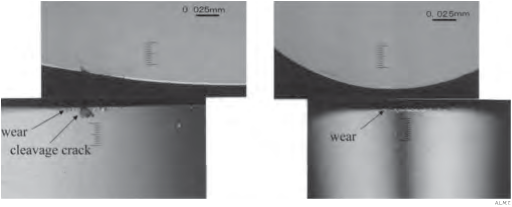
A comparison of the cutting edges of a monocrystalline diamond tool (left) and a nano-polycrystalline diamond tool after machining tungsten carbide on a CNC lathe using elliptical vibration cutting.
To overcome these obstacles, Sumitomo Electric Industries Ltd., which has head offices in Tokyo and Osaka, Japan, developed SumiDIA Binderless nano-polycrystalline diamond. Sumitomo Electric offers ballnose endmills and turning inserts tipped with the material, while Tokyo-based A.L.M.T. Corp., a Sumitomo Electric company, offers BL-UPC series tools, including aspherical surfacing tools, grooving tools and ball endmills.
The diamond material has a single-phase body synthesized by firmly and directly bonding diamond grains that are several tens of nanometers in diameter, the company reports. Sumitomo Electric produces the material under higher temperature and pressure conditions than when creating synthetic, single-crystal diamonds. The binderless, single-phase, nano-PCD material reportedly does not cleave and is harder than conventional PCD and single-crystal diamond material.
When applied on a CNC lathe using elliptical vibration machining, where a cutting tool is attached to a cylindrical support body vibrated by at least two piezoelectric drive elements, a BL-UPC tool with a -20° rake angle imparted a 7.4nm Ra surface finish, according to the company. The DOC was 2µm and the feed was 5 µm/rev. The workpiece was tungsten carbide containing 12 percent cobalt.
In addition to cemented carbide, suitable workpieces include hardened steel, glass and silicon carbide.
For more information about Sumitomo Electric Carbide Inc., Mt. Prospect, Ill., call (800) 950-5202 or visit www.sumicarbide.com.
Glossary terms in this article
Related



Subscribers can use MFGAxis notes, saves and discussion tools with their innoNET account.


