

Leveraging modern CNC capabilities: Drilling Performance
The NC post-processor is an often overlooked piece of the chain between the CAM system and the machine's CNC, according to the Get With The Program column in the May 2012 issue of Cutting Tool Engineering.
You’ve just received the latest release of your favorite CAM software and loaded it on a new PC. As a result, your shiny, new machine tool with a state-of-the-art controller awaits its next challenge. Yet you’ve still got the same nagging problems once everything is up and running. The G code isn’t quite right and still requires manual tweaking. The files are overly large and hard for the operator to interpret. And the machine doesn’t “sing” the way it should.
That’s caused by an outdated NC post-processor, an often-overlooked piece of the chain between the CAM system and the machine’s CNC. Everyone must have an NC post-processor but no one wants to think much about it—if it just works and stays completely in the background, so much the better.
But CNCs have various new features that an updated post-processor can leverage. The right post can also adapt to take full advantage of the machine’s characteristics, based on toolpath data. This column explores how to get the most out of a post-processor.
The capability to define an arbitrary orientation for machining operations and treat them as if you were doing normal 3-axis machining is a powerful feature of today’s controllers. Commonly called “working plane,” or “tilted working plane” in Fanuc vernacular, and “frames” according to Siemens, this capability allows the use of canned drilling cycles and cutter compensation for contouring in “3+2 machining” or “5-axis positioning.”
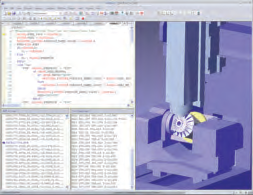
Courtesy of IMS Software
In this screen shot, IMSpost shows the machine model, the automatically programmed tool from the CAM software and the resulting G code.
For example, when 5-axis drilling, instead of a series of G0/G1 moves with a defined working plane, a user can employ a standard G81 canned cycle. Profile contouring in planes other than the standard X-Y, Y-Z and X-Z can use the controller’s built-in cutter-compensation functions.
An effective post-processor, such as IMSpost from IMS Software Inc., defines the working plane based on a variety of different inputs from the CAM system and outputs the correct code based on the specifications of the CNC. The result of using IMSpost to support working planes is easy-to-read, concise G code that leverages the controller features for efficient operation.
Review the print ads from this magazine to continue
This quick advertiser review unlocks the rest of the article and keeps the full-screen reader focused on the ads instead of the page chrome.
Advertisers included in this article experience
Print placements connected to this article
Iscarmetals
200% MORE
PRODUCTIVITY Milling Intelligently Weldon Shank Shell Mill Modular of Extended Flute P M K N S H HELITANG T490 Cutters ISCAR is introducing modular extended flute P M K N S H assemblies of 1.968 and 2.48" diameters. The assemblies carry T490 LN…T 13 inserts, P M K N S H comprising a shell base unit and one or two extensions
200% MORE PRODUCTIVITY Milling Intelligently Weldon Shank Shell Mill Modular of Extended Flute P M K N S H HELITANG T490 Cutters ISCAR is introducing modular extended flute
Visit Iscarmetals View this placement in the issue recordPrint ads from this magazine
PRODUCTIVITY Milling Intelligently Weldon Shank Shell Mill Modular of Extended Flute P M K N S H HELITANG T490 Cutters ISCAR is introducing modular extended flute P M K N S H assemblies of 1.968 and 2.48" diameters. The assemblies carry T490 LN…T 13 inserts, P M K N S H comprising a shell base unit and one or two extensions
200% MORE PRODUCTIVITY Milling Intelligently Weldon Shank Shell Mill Modular of Extended Flute P M K N S H HELITANG T490 Cutters ISCAR is introducing modular extended flute
Continue reading
May 2012
The output from a CAM system is often point-to-point motion, when, in reality, the feature to be machined is an arc, circle, spiral or helix. Controllers often support spiral and helical milling in addition to traditional arcs and circles and, moreover, can support all these in any plane.
Combined with working-plane capability, IMSpost converts point-to-point motion into optimized circular, helical and spiral codes that reduce program complexity, decrease machining time and improve surface finish.
Having a true kinematic model of the CNC machine in the post-processor increases optimization. For example, on a machine with a rotary table, you could drill a circular bolt-hole pattern by positioning the machine in the X-axis and Y-axis before each hole. But a more optimized solution might involve positioning once and then locking the Y-axis and enabling the C-axis to perform what would normally be a linear motion. The result is a simple, precise C-axis rotation to position the drill for the remaining holes.
This type of flexibility allows choosing the optimal motion based on the machine characteristics and the part features being machined.
IMSpost allows this type of dynamic reconfiguration of machine kinematics at any point in the program. It also prioritizes one axis over another in the motion solution (e.g., “always try to move C first, then B”).
With this type of capability, IMSpost can read ahead during processing and pre- position the machine to avoid travel limits and unnecessary retraction and repositioning.
When integrating the latest capabilities and technologies, whether it’s programming with an upgraded CAM system or deploying a new multiaxis CNC machine, always review each link in the chain. Orchestrate your operations by choosing an effective post-processor and then listen to your machines sing. CTE
 About the Author: Inge Lund is responsible for North American sales for IMS Software Inc., Haverhill, Mass. She is a mechanical engineer with a background in manufacturing. She has worked for General Motors and Unisys and was co-owner of a CNC machining house for more than 12 years. For more information, call (978) 556-0077 or visit www.ims-software.com.
Glossary terms in this article
Related

 MFGAxis Discussion
Be part of the shop-floor conversation
Like, save, or comment on this CTE story.
MFGAxis Discussion
Be part of the shop-floor conversation
Like, save, or comment on this CTE story.


MFGAxis Discussion