

Workholding for nonround parts: Turning Performance
When it comes to workholding, one size definitely does not fit all. For example, workholding setups for round parts have similarities to setups used for all other prismatic (nonround) parts, but the latter has unique challenges.
When it comes to workholding, one size definitely does not fit all. For example, workholding setups for round parts have similarities to setups used for all other prismatic (nonround) parts, but the latter has unique challenges.
The following basic rules of workholding apply to all parts.
- Use a locating scheme that places all the work inside the locators.
- Use clamping that allows tool access to areas to be machined.
- Stock edges, such as bar stock flats or formed flats, can be used for locating and clamping.
- Workholding is for accommodating part cutting requirements, not just for holding a part.
- For workholding, one must consider machine characteristics, including size and capacities, cutting capabilities and options for maximizing throughput.
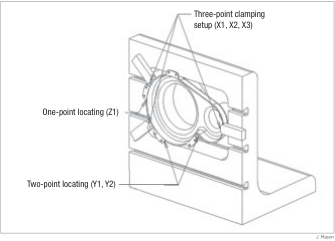
A nonround part fixtured for horizontal machining of the front and back in one setup. Image courtesy J. Mason.
For the nonround parts discussed in this column, I am assuming workholding for either horizontal or vertical milling.
Clamps should be placed directly above part locators because that minimizes the effect of cutting forces on a part. It is not good practice to clamp over voids and open bores that require finishing because that can limit tool access and, more importantly, damage the part by bending or otherwise distorting it. Metal has a tendency to move when you least expect it.
When roughing, use no more than three clamps on the fixture unless it is a very large part. A three-point locator and clamp setup is the first choice. Larger parts may require work supports in other unsupported areas to dampen machining forces. Also, roughing and finishing toolpaths must not interfere with clamp locations.
A fixture must be robust enough to handle the nonround part’s cutting requirements. For example, if a facemill requires a 15-hp cut with 200 lbs. of side load force, the fixture must be able to absorb those cutting forces.
Workholding is all about minimizing vibration. Many horizontal machines with pallet changers use tombstone-type workholding, with parts set on rest pads and side locators and hydraulically or manually clamped. This provides stability and helps minimize vibration.
Workholding can be hydraulic, pneumatic or manual. Hydraulic automatic clamping generates higher clamping forces than pneumatic or manual workholding. Hydraulics should be used for high-volume nonround parts; large, heavy parts made of steel or iron; parts requiring large amounts of material removal; and parts requiring very high clamping forces.
For hydraulic and pneumatic fixtures requiring lines for hydraulic fluid or air, internal lines are the best choice. Using manifold plates can aid placement of internal lines in the fixture. If necessary, leave space between the part and the back of the workholding for chip shedding.
Review the print ads from this magazine to continue
This quick advertiser review unlocks the rest of the article and keeps the full-screen reader focused on the ads instead of the page chrome.
Advertisers included in this article experience
Print placements connected to this article
info.star-su.com/solid-carbide-gundrills
Solid Carbide Gundrills
System technology from one source • Ideally suited for drilling small diameter holes, including stainless steel or titanium • Hold very tight TIR tolerances from start to finish • Engineering solutions for Design and Build • Technical services available • Competitive lead-times.
Solid Carbide Gundrills System technology from one source • Ideally suited for drilling small diameter holes, including stainless steel or titanium • Hold very tight TIR tolerances from start to finish • Engineering solutions for Design and Build • Technical services available • Competitive lead-times 248-474-8200 info.star-su.com/solid-carbide-gundrills
Visit info.star-su.com/solid-carbide-gundrills View this placement in the issue recordPrint ads from this magazine
System technology from one source • Ideally suited for drilling small diameter holes, including stainless steel or titanium • Hold very tight TIR tolerances from start to finish • Engineering solutions for Design and Build • Technical services available • Competitive lead-times.
Solid Carbide Gundrills System technology from one source • Ideally suited for drilling small diameter holes, including stainless steel or titanium • Hold very tight TIR tolerances from start to finish • Engineering solutions for Design and Build • Technical services available • Competitive lead-times 248-474-8200 info.star-su.com/solid-carbide-gundrills
Continue reading
June 2012
Pneumatic workholding is an alternative to manual workholding. Clamping forces are about the same for both, but pneumatics can speed up clamp and unclamp times. Pneumatics are a good choice for vertical machines where load/unload is part of cycle time.
Manual workholding is the least costly option and ideal for low-volume or one-off nonround parts. Unlike powered workholding, manual setups require the operator to apply force to secure the part. Torque wrenches should be used that can consistently apply the same pressure.
The type of workholding for nonround parts is directly related to a shop’s tooling budget. If a more-expensive hydraulic fixture can be cost justified, that’s the route to go. If not, then less costly pneumatic or manual alternatives must be used.
Vertical machining centers lend themselves to single-part workholding systems. In these machines, vises and fixture plates with predefined locators are often used for workholding. Both can be cost-effective, but dedicated workholding systems are a better option when part volume reaches 500 and above.
Also, chip control is a workholding concern because chips collect and interfere with locators and clamps. Fixtures must be designed to be effectively cleared with air or coolant.
Compared to VMCs, horizontals are better suited to medium- and high-volume production and unattended machining using automatic pallet changers. However, fixture costs tend to be higher as multiples fixtures are required.
Whether it is used for a VMC or an HMC, all workholding must accommodate roughing and finishing. A key question is whether or not the part can be machined complete in one setup. Parts with large, flat areas requiring fine finishes and tight flatness tolerances may need additional work supports to neutralize cutter vibration during finishing. Generally, it is better to finish a part in one clamping because tolerance error between operations can be limited to machine positioning and not be affected by the workholding.
In addition to basic workholding setups for nonround parts, milling workholder options include:
- Fixture plates for 4th- and 5th-axis positioning and contouring are used for parts that can be prequalified with a precision locator and mounted to the machine’s rotary axis.
- Turn/mill machine workholding that allows the turning chuck to be used as a static fixture for milling with a spindle or live tool.
- Magnetic and vacuum workholding systems, typically used for grinding, have advantages in milling operations for parts with light finish cuts and large surface areas. Additional clamps and work supports are not required.
Milling fixtures are unique to each part and its manufacturing process. An effective part process and workholding design can help make the part making process faster, more accurate and, ultimately, more profitable. CTE
About the Author: Joe Mason is cost estimator and process engineer for United Machining Inc., Sterling Heights, Mich., a supplier of high-heat manifold, turbine and exhaust components, and a division of Wescast Industries Inc. He has worked in the metalworking industry since 1978, starting as a machinist. Contact him at cncgcode@earthlink.net.
Related
 MFGAxis Discussion
Be part of the shop-floor conversation
Like, save, or comment on this CTE story.
MFGAxis Discussion
Be part of the shop-floor conversation
Like, save, or comment on this CTE story.


MFGAxis Discussion