

Bombarding ceramics: General Industry Coverage
Having to discard thin ceramic parts when they become distorted during manufacturing is wasteful in more ways than one. Not only is a significant amount of energy consumed during the material's sintering process, but a parts manufacturer then has to spend time machining—typically slowly grinding with a diamond wheel—the ceramic workpiece to its specified dimensions.
Having to discard thin ceramic parts when they become distorted during manufacturing is wasteful in more ways than one. Not only is a significant amount of energy consumed during the material’s sintering process, but a parts manufacturer then has to spend time machining—typically slowly grinding with a diamond wheel—the ceramic workpiece to its specified dimensions.
“A ceramic component at the end of the production process is more expensive than a metal component of the same geometry,” said Dr. Wulf Pfeiffer, head of the process and material assessment business unit at Fraunhofer Institute for Mechanics of Materials IWM, Freiburg, Germany. Depending on the component, he estimated that manufacturers discard 5 to 50 percent of ceramic parts with wall thicknesses 2mm and thinner because of warpage.
Still, high-strength ceramic parts are often required in corrosive, high-temperature environments where the properties of metals become compromised.
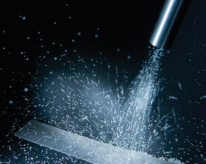
Shot is fired from a blasting gun at a ceramic leaf spring to correct its distorted shape or cause specific warping as desired. Image courtesy Fraunhofer IWM, Felicitas Gemetz.
Review the print ads from this magazine to continue
This quick advertiser review unlocks the rest of the article and keeps the full-screen reader focused on the ads instead of the page chrome.
Advertisers included in this article experience
Print placements connected to this article
800.521.9520 | mscmetalworking.com
MSC March_CTE_Layout 1 2/4/11 3:14 PM Page 1
Available exclusively at MSC Industrial Supply Co.®.
MSC March_CTE_Layout 1 2/4/11 3:14 PM Page 1 Available exclusively at MSC Industrial Supply Co.® 800.521.9520 | mscmetalworking.com
Visit 800.521.9520 | mscmetalworking.com View this placement in the issue recordPrint ads from this magazine
Available exclusively at MSC Industrial Supply Co.®.
MSC March_CTE_Layout 1 2/4/11 3:14 PM Page 1 Available exclusively at MSC Industrial Supply Co.® 800.521.9520 | mscmetalworking.com
Continue reading
June 2012
To reshape the surfaces of warped ceramic parts, researchers at Fraunhofer IWM and Production Systems and Design Technology IPK, Berlin, developed a method for straightening warped ceramics with shot peening. This involves shooting round tungsten-carbide pellets smaller than 1mm in diameter from a blasting gun at the component’s surface, Pfeiffer explained. The pellets typically travel a distance of 100mm to 200mm at a speed of 20 to 80 m/sec. and, to achieve the highest impact, travel perpendicular to the surface, he added.
Pfeiffer noted the entire workpiece surface can be targeted or just a malformed section to generate a flat surface. In addition, shot peening can be applied to create a curvature that would otherwise require a complex and expensive machining process.
Besides controlling part geometry, shot peening introduces compressive residual stresses into a ceramic part to strengthen it. “In the case of medical implants, the main advantage is strength,” he said. “Also, shot peening creates a surface texture that might reduce slippage between implant and bone by improving adhesion.”
Although workers often manually shot peen, the long-term idea is to have a robot perform the task after a computer calculates where to direct the pellets to remove distortion or create the desired geometry, according to Pfeiffer. He added that the equipment needed to shot peen thin ceramic components is the same for metal applications, but the technique the researchers developed is not. “You have to learn how to handle the special needs of ceramic components because they’re quite different than metal ones.”
For more information, contact Fraunhofer Institute for Mechanics of Materials IWM, at +49 761 5142-0 or www.en.iwm.fraunhofer.de.
Glossary terms in this article
Related



Subscribers can use MFGAxis notes, saves and discussion tools with their innoNET account.


