


Advancing cellular manufacturing: Turning Performance
END USER: Kennametal Inc., (800) 446-7738, www.kennametal.com. CHALLENGE: Reduce lead times, manufacturing footprint and costs when making toolholders. SOLUTION: Work cells employing advanced multitask machine tools.
————–
END USER: Kennametal Inc., (800) 446-7738, www.kennametal.com. CHALLENGE: Reduce lead times, manufacturing footprint and costs when making toolholders. SOLUTION: Work cells employing advanced multitask machine tools. SOLUTION PROVIDER: Methods Machine Tools Inc., (877) 668-4262, www.methodsmachine.com
—————
Many manufacturers are struggling to reduce inventory, increase customer service levels and decrease lead times—all while remaining profitable. However, addressing one goal often contradicts another.
Manufacturers often employ cellular manufacturing to address those goals by minimizing work in process, decreasing setup times and removing waste from the machining system. Typically, dedicated work cells efficiently produce a family of parts, but they may not have the flexibility to quickly respond to customer needs and market changes. Latrobe, Pa.-based Kennametal Inc., a manufacturer of tooling, engineered components and advanced materials, faced this conundrum at its toolholder production facility in Solon, Ohio.
Recently, a challenge came from Kennametal management to create a work flow that decreased lead times, reduced costs and increased customer service levels across a large offering of products. In addition, management wanted to reduce the manufacturing footprint and procure a system that delivered value. “These were very demanding goals,” said Jim Stanko, engineering manager at Kennametal. “We started by challenging our machine tool partners to propose a solution that would allow us to achieve these goals.”
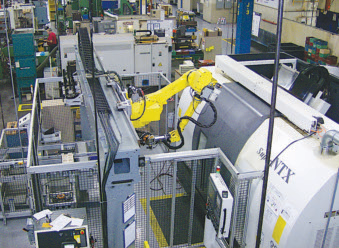
Courtesy of Methods Machine Tools
Kennametal uses Nakamura-Tome Super NTX mill/turn machines with robotic material handling from Methods Machine Tools to produce toolholder blanks at its Solon, Ohio, facility.
Kennametal’s original plan entailed purchasing six to eight mill/turn machines. The first set of four mill/turn machines would produce a semifinished product called a “blank.” Stanko said, “A blank is typically a club of metal with either a KM, HSK or steep-taper back end. We planned to manufacture them in economical lot sizes with at least 50 to 100 pieces per run.”
The finished blanks would then be stored in a “supermarket” by blank style, with each blank style servicing approximately 30 to 40 different line items in the company’s catalog.
The second set of mill/turn machines would primarily serve to create the front-end features of the part, such as a TG/ER collect chuck, endmill adapter or shell mill adapter. The operator would simply pull the required number of blanks from the supermarket for the order, which might range from one piece to 20 pieces. The machine would then be set up to produce the required items and quickly changed to run the next job.
Machine tool supplier Methods Machine Tools Inc., Sudbury, Mass., challenged the original plan. “Methods proposed using just four mill/turn systems instead of the six or eight mill/turn systems we had originally planned to buy. The proposal was highly productive and economical,” Stanko said.
Methods recommended producing the blanks with Nakamura Tome Super NTX mill/turn machines with robotic material handling. The machine has its tool spindle on the upper side and two turrets on the lower side. With its B-axis automatic toolchanger capability, including the unique configuration of two lower turrets, the Super NTX allows three tools to cut simultaneously. By using the two lower turrets during the tool change, idle time is reduced.
The Super NTX also has an integrated recipe management system. This allows the operator to program and save a new style of blank by specifying the diameter, length and end connection for the blank so it can be recalled later.
Once the systems are set up, they run minimally attended. Through the use of a vision system and laser measurement, the robotic material handling system ensures the proper raw materials are being presented to the machine. One operator services two systems, performing quality audits, feeding materials and removing finished blanks.
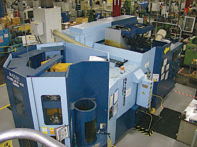
Courtesy of Methods Machine Tools
Matsuura Cublex-42 and Cublex-25 mill/turn machines from Methods Machine Tools produce the front ends on Kennametal’s toolholder blanks.
Kennametal then uses a Matsuura Cublex-42 mill/turn machine and a Cublex-25 mill/turn machine to make the finished blanks into parts. The Cublex multiprocess technology provides 5-axis milling, vertical and horizontal turning and optional grinding.
Each of Kennametal’s Cublex machines has an attached pallet hive and at least 180 tools in the tool chain. Within the pallet hive is a series of fixtures, which allow the operator to set up orders for KM, HSK and steep-taper products.
“It’s been a big time saver. While one order is being run, multiple other orders are loaded, queued and scheduled to run,” Stanko said. “The only time the machine shuts down is to change pallets.” By having a large tool chain along with the pallet hives, the setup time between orders is externalized and does not create additional downtime.
Stanko said: “We call the entire system from Methods Machine Tools our ‘advanced manufacturing cell.’ It has allowed us to decrease lead times for operations prior to heat treat from up to 14 days to a matter of hours. Many times we have been contacted by one of our customers experiencing an emergency need. We can now literally walk over to the supermarket, pull a blank, set the blank in a fixture, schedule the part to run next and have the part ready for heat treat in less than 1 hour.” This would have been impossible in the past, he noted.
The advanced manufacturing cell also significantly reduced Kennametal’s cost. Prior to implementing it, Kennametal had 14 operators and 12 machine tools. Now, Kennametal only needs one operator per shift and uses four mill/turn machines, while more than doubling the production rate.
“It was a matter of Methods knowing which technology would work best for our operation,” Stanko said. He added that the advanced manufacturing cell Methods developed allows the plant to remain competitive on toolholders, maintain high service levels, greatly reduce lead times and thrive in a high-mix, low-volume environment.
Glossary terms in this article
Related


Subscribers can use MFGAxis notes, saves and discussion tools with their innoNET account.