



Get groning: General Industry Coverage
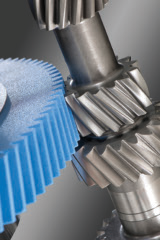
This Look Ahead item features a CNC gear honing machine that uses a honing wheel with external teeth and reduces the number of process stages.
What do you get when fusing grinding and honing? “Groning,” according to Italian machine tool builder Stabilimento Industriale Costruzione Macchinario Attrezzature Torino SpA. “Our philosophy is to use a cutting speed, whenever possible, between that of grinding and honing,” said SICMAT’s Technical Director Alberto Miletto Petrazzini. “The speed is lower than that used for grinding to avoid surface burns and cracks and higher than that used for honing to reduce the contact pressure between the workpiece and the wheel, so the structure is less stressed and the wheel works at a more favorable speed.”
He added that the ideal cutting speed for groning is from 14 to 22 m/sec., compared to a typical speed of 8 m/sec. for honing and at least 30 m/sec. for grinding.
To achieve that capability, SICMAT developed the Grono 250 CNC gear honing machine and conducted research in collaboration with the engineering faculty at Turin Polytechnic University to prove the machine tool’s practicality. The machine applies a unique honing wheel with external teeth to increase cutting speed while reducing costs, according to Petrazzini. (Traditionally, gear honing is performed using wheels with internal teeth, which are reportedly expensive and time-consuming to set up.)
Courtesy of NUM
SICMAT’s Grono 250 CNC gear honing machine uses a unique honing wheel with external teeth.
“We can increase the cross-axis angle between the workpiece and the wheel up to 60° thanks to the external teeth versus 20° maximum for wheels with internal teeth,” he said. If that’s not possible, users can boost the cutting speed by increasing workpiece spindle speed to 7,000 rpm, with 10,000 rpm planned for the future, Petrazzini added.
In contrast to the conventional shaving process, which is a way to produce a gear-tooth finish close to or equal to the finish imparted when grinding, the company reports the groning wheel cuts gears after the workpiece has been heat treated to achieve a hardness of 58 to 61 HRC, eliminating the need for shaving prior to heat treatment or grinding afterwards. Petrazzini explained that shaving must always be performed before heat treatment because the cutter’s HSS serrated flanks have a hardness of 64 HRC and, therefore, are unable to cut a workpiece with a similar hardness.
By eliminating grinding, groning boosts throughput. For example, when producing a 2.3-module gear with 47 teeth, a 19mm face width, a 30° helix and removing 0.05mm of stock per flank, groning consumes about 0.60 minutes shop floor to shop floor while grinding takes 0.70 minutes, Petrazzini noted. Although shaving that gear takes about 0.50 minutes, groning achieves the desired accuracy at the final stage, minimizing rejected parts, he added.
The machine has eight motion axes, plus another three on an associated robotic loader, all of which are controlled by a Flexium CNC from NUM Corp., Naperville, Ill. The 3-axis portal loader provides horizontal, vertical and wrist motions for picking up parts from a flat-belt conveyor.
In addition, all axis motors are driven by NUMDrive C servodrives, and the overall system is equipped with two NUM MDLL 3050 regulated power suppliers.
For more information about SICMAT SpA, Pianezza, Italy, call +39-011-966-7348 or visit www.sicmat.com. The company is represented in the U.S. and Canada by Star SU LLC, Hoffman Estates, Ill., (847) 649-1450; www.star-su.com.
Glossary terms in this article
Related




Subscribers can use MFGAxis notes, saves and discussion tools with their innoNET account.


