



Extreme tools for an extreme sport
END USER: David Buchberger, (585) 208-7382, www.hispeedcorp.com. CHALLENGE: Efficiently machine lightweight components for an "extreme" racecar. SOLUTION: High-performance cutting tools, including a drill and endmill.
—————
END USER: David Buchberger, (585) 208-7382, www.hispeedcorp.com. CHALLENGE: Efficiently machine lightweight components for an “extreme” racecar. SOLUTION: High-performance cutting tools, including a drill and endmill. SOLUTION PROVIDER: WIDIA Products Group and Services, (724) 539-5000, www.widia.com
—————
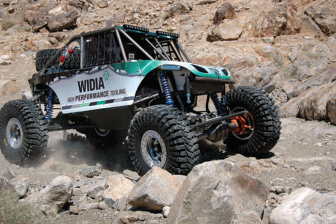
Baseball is called “America’s favorite pastime” but extreme sports are quickly gaining ground. One such sport is Ultra4 unlimited-class racing, which combines off-road desert and rock trail racing. It started in 2008 when 13 teams competed at a nonspectator invitational race in Johnson Valley, Calif., dubbed “King of the Hammers” in reference to the state’s “hammer” rock trails. At KOH 2012, 135 teams participated.
“It’s the fastest-growing motor sport today, bar none,” said David Buchberger, vice president of Hi-Speed Corp., Thousand Oaks, Calif., a manufacturer’s representative for WIDIA-brand products and services. By day, that is. By night, Buchberger can often be found making parts and maintaining his Ultra4-class racecar, which WIDIA is sponsoring for the 2012-13 season.
The defining characteristic of Ultra4 is all cars must be capable of 4-wheel drive. Beyond that, the class is unlimited, meaning all cars are custom-fabricated and come in all shapes and sizes. The fastest cars can exceed 100 mph on desert sections, while traveling 15 to 20 mph through the rocks is “flying,” Buchberger noted. Gear ratios are as low as 100:1 for technical rock crawling.
“It’s challenging because if you build a vehicle that excels in one area, it usually does worse in the other,” he said, noting that heavy and swift is best for the desert and light and nimble helps on the rocks. “People always try to find creative ways to make it go faster in the desert but not too lousy in the rocks and vice versa.”
After the first two cars he built for competition proved not competitive enough, Buchberger started building another one when Bernie McConnell, vice president of WIDIA Products Group and Services, Latrobe, Pa., caught wind of the project. “Bernie and I were talking about how he had heard about KOH and what I would think of WIDIA sponsoring the car,” Buchberger said. “My first thought was this is an unbelievable opportunity. I give a lot of credit to Bernie for taking a big risk on me when I just had a frame, an engine and a transmission sitting in my garage.”
In addition to not having a functioning racecar, Buchberger didn’t—and doesn’t—have a machine shop, but was able to use one after hours with the help of his friend Jonathan Pfaff. That required highly productive cutting tools that allowed him to complete jobs within his limited window of opportunity.
Work on the car included removing “unsprung weight” from the suspension, axles and wheels. (Unsprung weight is mass that moves when the wheels move.) “Typically, the lighter you can make the running gear portion of the car, the higher performing the car will be in the desert,” Buchberger said.
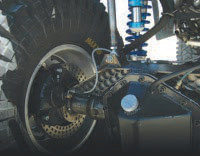
One job required drilling a total of 660 holes into four brake rotors to reduce each rotor’s weight by 9 lbs. “It also keeps the brakes a little cooler,” Buchberger added.
Courtesy of WIDI
Courtesy of WIDIA
Courtesy of David Buchberger
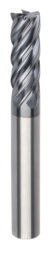
When building his Ultra4-class racecar, David Buchberger applied ½ ” and 3/16 ” VariMill II endmills from WIDIA to mill a 0.040 “-thick honeycomb pattern in 1018 steel and maximize reinforcement while minimizing weight.
He selected a 3⁄8 “-dia. WIDIA Vari-Drill. The drill has a “marginless” design, which reduces edge chipping and stabilizes cutting forces, according to the company. “It has no primary or secondary margin,” Buchberger said. “It’s what we call a full eccentric relief.” According to Buchberger, the design significantly extends tool life.
Before applying the tool, however, he had to write a CNC program for the drilling operation so the tool avoided the unevenly spaced veins that held the two sides of an internally vented rotor together. That rotor design meant the drill had to enter and exit the workpiece twice to produce each hole. Buchberger described the cast parts as porous and abrasive and indicated the drill is suitable for all metals up to 55 HRC.
He started drilling at 35 ipm but was able to increase it, “punching through at 50 ipm.” According to Buchberger, more impressive than the drilling speed was how well the tool held up. “Six hundred and sixty holes and the drill almost looked brand new,” he said.
WIDIA’s endmills also proved beneficial, such as when building frame components. Where most fabricators weld different material thicknesses together to balance lightness and strength, Buchberger was able to take bars of cold-rolled 1018 steel, a grade known for having a good balance of strength and ductility, and mill truss components to create a 0.040 “-thick honeycomb. This resulted in a strong, yet lightweight, component.
“That kind of work can really eat up hours, but with the WIDIA-Hanita VariMill II endmills, I was able to ramp into the material at 40 ipm, roughing it with a ½ ” endmill and finishing the pockets and carving the edges with a 3⁄16 ” one,” Buchberger said. WIDIA tools were also used to mill the front winch plate, the winch fairlead, many of the reinforcement plates and the front and rear trusses.
“I’m really proud of the car, how competitive it is and how outside the box it is,” Buchberger said. “It’s certainly capable of winning.”
Related




Subscribers can use MFGAxis notes, saves and discussion tools with their innoNET account.


