


Trending to turning
Holding a few tenths tolerance on a piece of 60-HRC steel was once the domain of expensive grinding equipment. Today, it's no big deal.
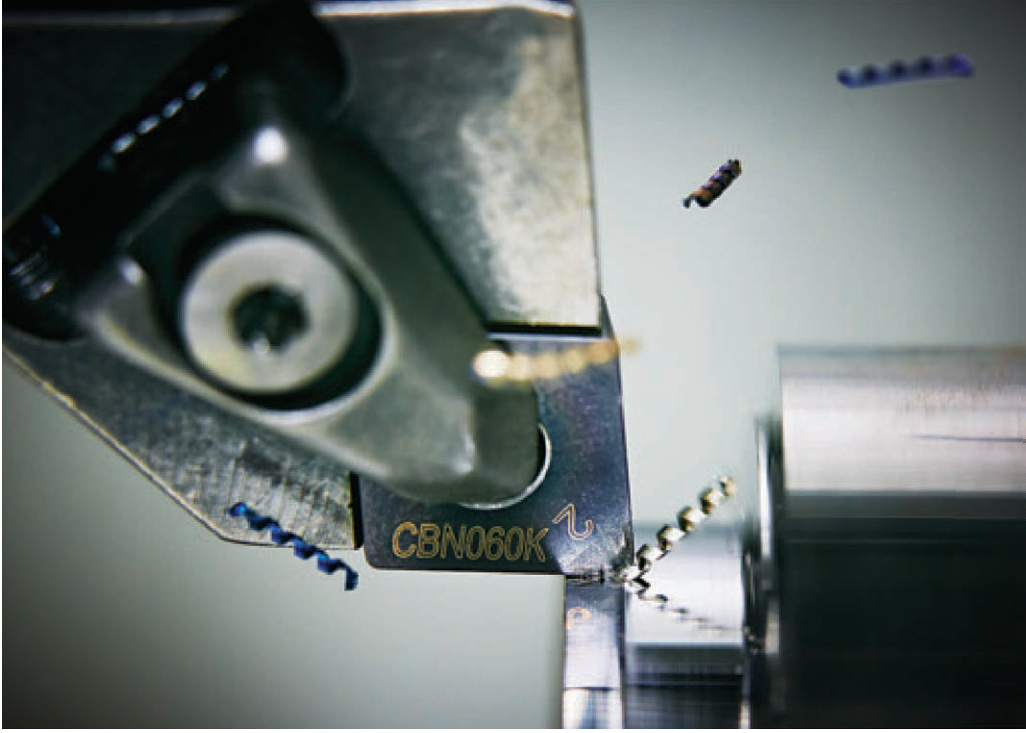
Courtesy of Seco Tools
Turning hardened steel with a CBN060K insert from Seco Tools.
The ability to hard turn is a good reason to trade in your old grinder for a lathe.
Holding a few tenths tolerance on a piece of 60-HRC steel was once the domain of expensive grinding equipment. Today, it’s no big deal.
A growing number of machine shops are shoving their OD grinders into the corner and replacing them with relatively inexpensive lathes. The ability to inexpensively, accurately and quickly cut hardened steel on commodity turning centers is opening doors for part manufacturers and job shops looking to reduce costs and increase throughput.
A Hard Turn
Can a Plain Jane CNC lathe really eliminate a high-precision grinder and hold a few tenths tolerance on a piece of 60-HRC steel? Blake Bailey thinks so. He’s the senior manufacturing engineer at Bronson (Mich.) Precision Products, a division of Royal Oak Industries Inc. Bailey explained how his shop turns 60- to 62-HRC 8620 steel driveline components for Harley-Davidson, as well as 4130 casehardened parts with similar hardnesses for Caterpillar. “We hold 0.0003 ” to 0.0004 ” and 16 µin. Ra all day long on 15-year-old Wasinos, no problem,” he said.
Back up the truck! Using gang-style lathes bought during the Clinton administration to turn hardened-steel motorcycle components? “When you’re only removing 0.010 ” [of material], you don’t need a super rigid machine,” Bailey said. “We use an old linear-way machine that might have cost $50,000 back in the day, compared to a grinder that cost 10 times as much.”
Better yet, it’s faster to hard turn. A typical grinding operation might remove 0.007 ” to 0.010 ” and take 45 seconds. “We can hard turn the same thing in 25 to 30 seconds and get a minimum of 100 parts between tool changes. It works pretty dog-gone good,” Bailey said.
According to Rich Parenteau, director of applications development at Methods Machine Tools Inc., Sudbury, Mass., Bronson Precision could improve tool life 20 to 30 percent with a box-way machine. “In my mind, it’s almost mandatory that you use a box-way machine for hard turning,” he said. “From a machining aspect, hard turning separates the men from the boys, and everything from tooling performance to size control and surface finish becomes a factor when you’re comparing box way to linear way. Linear rollers are pretty sturdy, but when you’re buying inserts that cost $50 and up, tool life is important.”
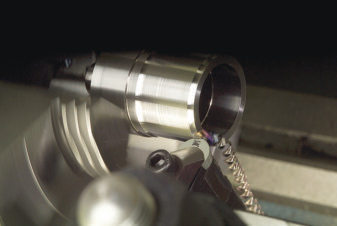
Courtesy of Greenleaf
The WG-300 whisker-reinforced ceramic insert from Greenleaf is effective for turning hardened steel.
Parenteau pointed out one more consideration when shopping for a machine to perform hard turning. “I’m a firm believer in not using an integral spindle for hard turning,” he said. “There’s a fine line between the heat generated by the spindle and the preload on the bearings.” This is because higher spindle heat can cause bearings and their housing to expand.
The additional clearance induced by bearing expansion can make it more difficult to make a round part. “You’re always better off with a spindle that has the motor to the side of the spindle,” Parenteau said. “This gives you a rigid platform across six bearings, and, when it comes to roundness, that means you’re as close to zero as you can get.”
Hard vs. Hard
Another company successfully hard turning is Reliance Tool & Manufacturing Co., Elgin, Ill., which has more than 15 years of experience with the process. Jeff Staes, director of technical services, said: “We do both short-run and production turning, and 99 percent of it is heat treated—A-2 and D-2 tool steels and 400-series stainless steels. We try to stay away from grinding as much as possible because it’s more expensive.
“Sometimes you have to grind, such as small internal diameters, where you can’t get in with a boring bar, or journals, where you can’t chuck the part and turn it at the same time. But if we can reach the part with the right cutting tool, we’re going to hard turn every time.”
A range of cutting tool materials can be applied when hard turning steel and other materials. According to Staes, even carbide tools are effective. “Carbide works as well as some of the original ceramic and CBN grades, which have traditionally been the standard for hard turning,” Staes said. “For example, Seco has new carbide grades (TH 1500 and PH 1000) that are especially good for interrupted cuts, which have always been a problem for hard turning. We’ve had great success with them.”
Chad Miller, advanced materials product manager for Seco Tools Inc., Troy, Mich., agreed that carbide can be an effective tool material choice. “It depends on the workpiece material, but as a rule we can use carbide to cut 62-HRC materials at starting speeds of 350 sfm and achieve reasonable performance.”
Miller noted carbide tools aren’t for everyone. “Smaller job shops or other operations doing limited batch sizes can get away with using carbide, but if you’re looking at a production situation—automotive components, for example, where you’re making thousands of parts a day—you’ll definitely want to go with CBN [because of its longer tool life].”
Miller said much of Seco’s PCBN, or CBN, tool sales come from auto parts makers, which typically turn 1018, 1024, 4340 and 8620 casehardened steel. “Look at a typical differential,” he said. “You’ll have a hardened axle shaft, pinion, ring and spur gears—all of those are being hard turned with CBN.”
However, chip control is a common problem when turning casehardened parts. Miller said: “On many of these components, a majority of the turning is in the 55-plus HRC range, but then you’ll hit an area of the workpiece that’s soft, say, 30 HRC. This happens a lot with induction-hardened parts or when you cut a groove through the case hardening. That’s where you can get into problems with chip control. To counter this, we’ve developed a chipbreaker for our CBN inserts. We use a laser to cut a groove with some bumps, for lack of a better word, on the tip of the insert.”
Rich Maton, engineering manager at toolmaker Sumitomo Electric Carbide Inc., Mt. Prospect, Ill., agreed that chip control is a common problem for casehardened parts. For example, the middle sections of a transmission shaft are kept soft so they remain tough, while outer sections are hardened for wear purposes. After the part is casehardened, the hardened area is removed via hard turning from some areas.
This presents challenges not only with chip control, but also with grade selection. “Let’s say you’re setting up a job for 50-HRC casehardened material,” Maton said. “You have to pick the correct CBN grade and dial in the cutting parameters accordingly. But that setup might not work on the softer parts of the shaft. So you have to adjust [feeds, speeds and DOCs] on the fly and try to generate more heat in the cut. If not, the softer material tends to adhere to the insert, and you can tear off big chunks of the CBN. Sometimes the entire tip will come off.”
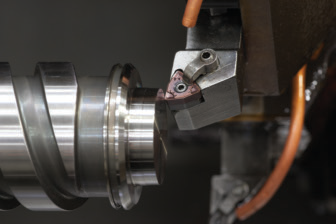
Courtesy of Seco Tools
OD turning, with interrupted cuts, and facing operations for a 54-HRC 420 stainless injection mold component using a WNMG 432 insert from Seco Tools with a MF 1 chipbreaker and made from TH 1000 carbide.
Despite this dire possibility, Maton cited a couple reasons why part manufacturers are moving from grinding to hard turning. “A CNC grinder can easily cost five times as much as a decent CNC lathe, and the operating costs are higher. Because of the high torque requirements and long cycle times, grinders consume at least 50 percent more power.”
The versatility of a lathe is another reason to consider hard turning, Maton noted. “Now you can rough and finish on the same machine, you can do ID or OD work—it doesn’t matter,” he said. “With the grinder, you have to set it up specifically for the application, preparing the grinding wheel to match the part profile, whereas with turning you can pretty much do whatever you need in one shot. This is especially important for job shops, which need a lot of flexibility. And, of course, you can hard turn most parts in a third or even a fifth of the time it would take to grind them.”
Sticker Shock
Rick Crabtree, product and application specialist for advanced cutting tools at Sandvik Coromant Co., Fair Lawn, N.J., is another believer in hard turning. “In a traditional process, the manufacturer used to blank the parts to a rough shape, heat treat and then do multiple grinding operations, dressing the wheel between each one,” he said. “It took a lot of time. With hard turning, you can usually turn everything in one operation.”
Hold on, though. This isn’t all sunshine and daisies. PCBN is brittle and expensive. Like its polycrystalline sister PCD, PCBN inserts can run up to $100 a pop. You can’t just mount one and hit cycle start. Machining strategy is critical.
“It’s important to securely hold the workpiece,” Crabtree said. “Don’t use a 3-jaw chuck; otherwise, lobing or vibration can be problems. It’s better to go with a collet or an air chuck and pie jaws, so you can clamp at least 70 percent of the circumference.”
He also recommends ramping in and out of the part to avoid shock. Holes or keyways should be chamfered ahead of time. “And if you need to hold close tolerances, anything under a few tenths, you might look at a two-cut strategy, where you semifinish within a couple thousandths before the final pass,” Crabtree said.
Does that mean you now have to purchase two $100 inserts? Maybe. But quite often, job shops are turning to less costly ceramic tools for roughing and semifinishing, and pulling out the PCBN big guns for the final pass.
Good Choices
Several toolmakers that focus on hard turning offer PCBN and ceramic inserts. The cutting tool division of Kyocera Industrial Ceramics Corp., Hendersonville, N.C., is one. Bill Shaw, advanced cutting tool specialist at Kyocera, typically recommends ceramic.
“When a customer calls you for help, they want the least expensive approach possible,” he said. “Ceramic, being a solid material, always means you’re going to get multiple edges, and if there is no shock and interruption, ceramic is a very applicable way to go. It’s certainly more cost-effective than CBN.”
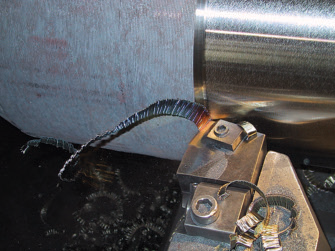
Courtesy of Greenleaf
Hard turning a heat-treated forged steel roll with an LNGN6688 WG-600 ceramic insert from Greenleaf.
Besides the cost, ceramic tools can take a deeper DOC and are more versatile, according to Shaw. “CBN inserts are usually tipped, limiting them to finishing cuts,” he said. “Ceramic has no such limitation. And while CBN is pretty workable above 55 HRC, it won’t be as reliable [when cutting materials in] the low 50s and high 40s, especially if you have inconsistency from your heat treat. Ceramic, on the other hand, will tolerate greater fluctuations in hardness.”
Someone who knows a lot about ceramics is Dale Hill, applications engineer for Greenleaf Corp., Saegertown, Pa. He sees extensive use of ceramic cutting tools in roll manufacturing for the steel industry. “The rolls are made out of either forged steels or high-chrome iron,” he said. “After initial machining, they are hardened above 50 HRC, but there’s still a tremendous amount of material to be removed. The parts are extremely large—4 ‘ or 5 ‘ in diameter and 15 ‘ long, weighing 30 tons. This is where ceramics really shine.”
Another sweet spot for ceramics is in making toolholders. “We manufacture machine spindle adapters, CAT-50 shanks, for example.” Hill said. “In many cases, the part that holds the tool shank is at a modest hardness, maybe 35 to 39 HRC, whereas the taper itself is significantly harder for wear purposes. We’ll machine the whole thing in the softer state, then caseharden the taper before final machining. Most of the time, we hard turn that part with ceramic.”
Greater Staying Power
PCBN, or CBN, however, is sometimes the only way to go. According to Brian Sawicki, turning products manager for Tungaloy America Inc., Arlington Heights, Ill., PCBN outperforms ceramic when interrupted cutting, tight tolerances are required and in production situations.
“CBN has a higher breaking strength than ceramic,” he said. “Also, CBN is best when you have to achieve a fine surface finish. This goes hand in hand with the tight size control required on most hard turned parts. CBN delivers both of these.”
Sawicki also recommends coated PCBN where applicable. “It all boils down to cost per corner,” he said. “Uncoated CBN is generally a few dollars per corner cheaper, but when it comes to high production scenarios, coated CBN gives you from 20 to 30 percent better tool life. It also provides better size control over the long haul. CBN, as a rule, doesn’t need to run long before the insert is stabilized. It may take one or two turns of messing with speed and feeds, but then it’s set. And, for a few bucks per corner more, coated CBN allows for more time in the cut and speeds up to 150 sfm greater than plain CBN. In short, you can run it faster and longer than an uncoated tool, which means greater productivity.”
Does this mean your old grinder is just going to gather dust from now on? It depends. Hard turning is a complex subject, with many variables. Perhaps the best response would be to call your cutting tool distributor and have them send some test inserts so you can give it a try. Hard turning might not be so hard after all. CTE
Contributors
Bronson Precision Products
(517) 369-7361
www.roi-1.com
Greenleaf Corp.
(800) 458-1850
www.greenleafcorporation.com
Kyocera Industrial Ceramics Corp.
(800) 823-7284
www.kyocera.com/cuttingtools
Methods Machine Tools Inc.
(877) 668-4262
www.methodsmachine.com
Reliance Tool & Manufacturing Co.
(847) 695-1234
www.reliancetool.com
Sandvik Coromant Co.
(800) 726-3845
www.coromant.sandvik.com/us
Seco Tools Inc.
(248) 528-5200
www.secotools.com
Sumitomo Electric Carbide Inc.
(800) 950-5202
www.sumicarbide.com
Tungaloy America Inc.
(888) 554-8394
www.tungaloyamerica.com
Glossary terms in this article
Related


Subscribers can use MFGAxis notes, saves and discussion tools with their innoNET account.