Shop wrangles runout challenge: General Industry Coverage
END USER: Homeyer Precision Manufacturing, (636) 433-2244, www.homeyertool.com. SOLUTION PROVIDER: BIG Kaiser Precision Tooling Inc., (888) 866-5776, www.bigkaiser.com. CHALLENGE: Minimize endmill runout to extend tool life when producing aluminum-based forceps. SOLUTION: A collet chuck that provides minimal runout.
 In their 26 years, Homeyer Precision Manufacturing has taken on some of the most demanding industries and jobs. Perhaps the most precise yet is among today’s production lineup at the company’s 63,000 sq. ft., Marthasville, Mo., shop—bipolar, aluminum-based forceps used by neurosurgeons performing brain surgeries.
The forceps must meet exacting standards, and the machining setup had to maintain consistent precision through production runs in the thousands.
As the product gained popularity, demand from the customer grew, and so did the strain on Homeyer’s production. The setup at the time required increased monitoring after about the first 1,800 parts were produced. Because of runout, the endmill would lose its integrity and produce junk parts from part 2,200 to part 2,400, which required frequent tool changes by the operator and hampered productivity.
This wasn’t sustainable. The customer’s previous manufacturing process couldn’t keep up with demand, driving them to switch to Homeyer in the first place, and the shop wasn’t about to fall victim to a similar move.

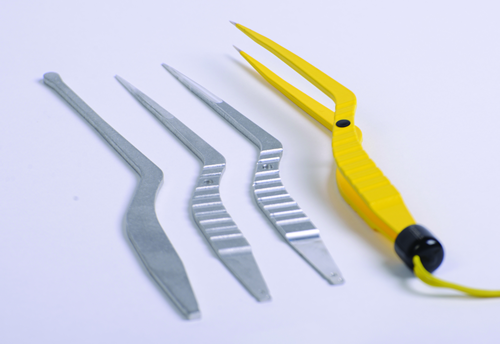
Forceps shown, from left to right, in raw form to finished final product. All images courtesy BIG Kaiser.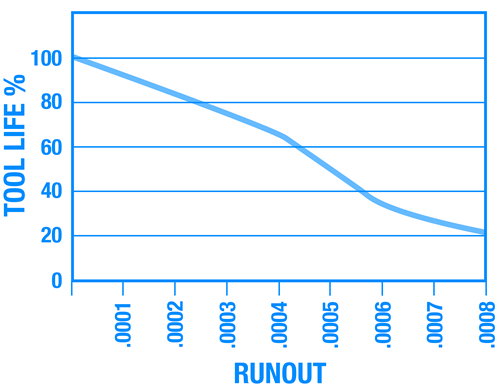
Chart shows tool life compared to runout.
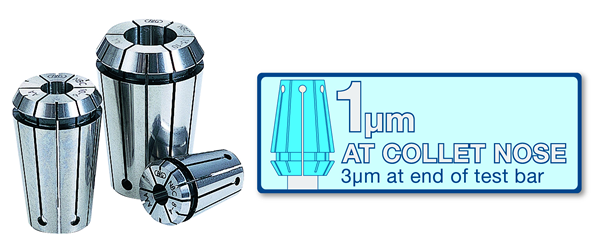
Mega New Baby Chucks from BIG Kaiser. Click here for a video showing the chucks in action.
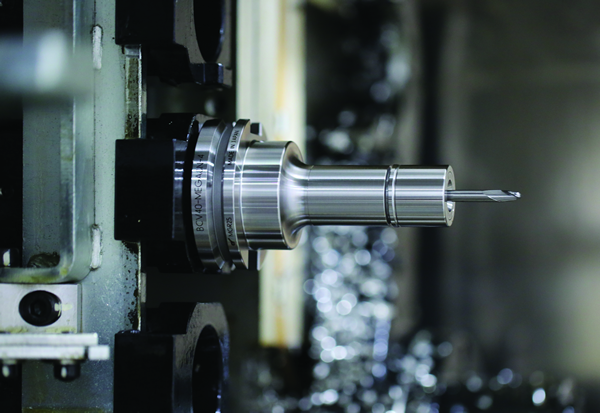
The tool holder in the magazine.
One of Homeyer’s guiding principles is to take advantage of the latest and greatest technology, but the idea for improving this process came to them in a rather unconventional way.
Herb Homeyer, who founded the shop in 1990, is chairman of the National Tooling and Machining Association (NTMA), which afforded him the opportunity to go on the organization’s European Tech Tour in February 2015. Two of the stops in Switzerland were tooling manufacturer BIG Kaiser and coolant producer Blaser Swisslube. The twin visits got Homeyer thinking about how new tooling combined with a different coolant could improve productivity.
When he returned home, Homeyer invited Blaser Swisslube and BIG Kaiser’s U.S.-based vice president of sales and engineering, Jack Burley, to the Homeyer shop to discuss the medical cell that produces the forceps. After examining the setups, Burley immediately thought of his BIG Daishowa product line and the new Mega New Baby collet chuck.
What he found was the setup on the Okuma Space Center MB-5000H horizontal machining center was sound, and a Blaser coolant tailored to Homeyer’s needs. Burley was confident the holder’s BIG-PLUS dual-contact system and AA-grade New Baby collet with guaranteed TIR of less than 3µm at 4 times the diameter would improve performance of the 1/8” solid-carbide, 2-flute endmill used to machine most of the critical features on the forceps and boost productivity, economic efficiency and machining quality.
They ran a few tests with the new setup and the results were dramatic. The new holder and coolant improved tool life by 300 percent, allowing production to go unmonitored without interruption for a much longer period of time. Instead of having to keep an eye on the job at part 1,800, there was no deterioration in finish until after more than 7,000 parts were produced.
“Not only do the tools last longer, but the end product is even better,” said Tim Wetzel, general manager at Homeyer. “The holder is highly precise and accurate. The gains we’ve achieved will ensure this product stays manufactured at Homeyer, no matter how much demand grows or how quickly.”
Wetzel and the team have been so pleased with the tooling change that they’ve made the decision to use more of it in other operations. “We’ll be changing more tooling to BIG Kaiser, starting with the highest usage tools first,” he said.
“We feel once all the tooling is replaced we will be able to substantially increase our feed rates,” Wetzel said. “But, in order to maximize the potential, we need to improve our fixture and workholding. Once that’s done, we expect about a 30 percent gain in efficiency across the board.”