

The madness of wheel trials
Dear Doc: I sell grinding wheels and frequently find myself pulling my hair out when recommending wheels to customers. One customer achieved great success with a resin-bond, 400-mesh diamond wheel when grinding ¾"-dia. carbide endmills.
Dear Doc: I sell grinding wheels and frequently find myself pulling my hair out when recommending wheels to customers. One customer achieved great success with a resin-bond, 400-mesh diamond wheel when grinding ¾”-dia. carbide endmills. It performed like a “superwheel.” I then took that same wheel to a customer who also grinds ¾” carbide endmills on the same machine model with the same coolant and it’s a disaster. Why?
The Doc Replies: All grinding wheels have a sweet spot, based on speeds and feeds, where they produce chips of an optimal thickness. Run a wheel so the chip thickness is too thin and you’ll glaze the wheel. Too thick and you’ll rip grits from the bond material.

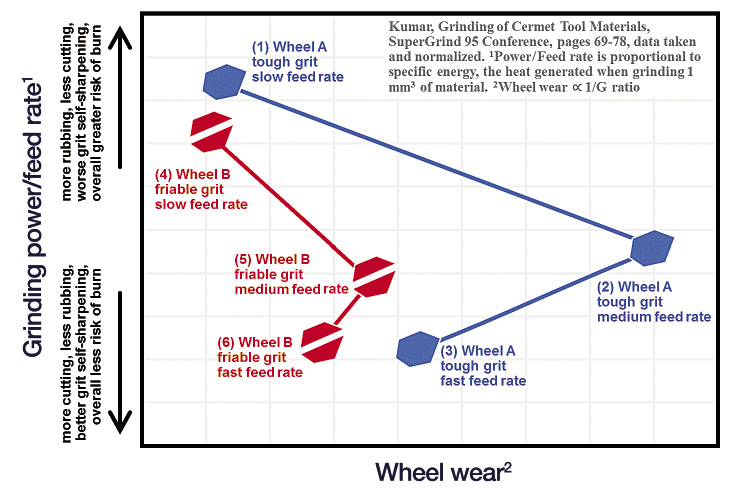
Figure 1. Data from a test of two wheels grinding cermets at three different feed rates. Chart
courtesy J.Badger.
Let’s examine the company where the superwheel failed. For years, operators have likely been fine-tuning parameters for their current wheel and eventually found the sweet spot—for that wheel. Then, which parameters do they run when trying your superwheel? Probably the ones that work for their current wheel. Your superwheel might be great for their application, but not at their established parameters.
The figure shows data from a test of two wheels grinding cermets at three different feed rates. Which wheel and feed worked best? It depends. If you want a long-lasting wheel, go with wheel B at a slow feed rate (4). If you don’t want burn, go with wheel A at a fast feed rate (3) or wheel B at a fast feed rate (6). If you want some combination of long wheel life, low burn and short cycle time, go with (6), (5) or (3).
It’s safe to say that, overall, B is the better wheel. But run it at a slow feed and you’re going to get burn. I’d take wheel A applied at a high feed (3) instead of either wheel B, option (5) or (4).
If you have some influence over testing parameters, first calculate the superwheel’s aggressiveness number for the customer who experienced success. Here is the equation for determining an aggressiveness number:

Your superwheel wants to be run at something close to this aggressiveness number.
Then, when you visit customers, tell them to run any DOC and feed rate they like, but run at the wheel speed that gives the aggressiveness number you calculated.
I can’t guarantee it will always work, because there are other factors involved, such as coolant application, carbide grade and coolant-additive chemistries. But if you start with this aggressiveness number for the superwheel, you’ll increase the chances of it succeeding.