

Getting a grip: Drilling Performance
There are numerous advantages to rigidly holding a workpiece: feed rates can be increased and cutting times reduced, cutters last longer and impart finer surface finishes, and more-accurate parts are produced. At trade shows where vendors offer demonstrations, you rarely see flimsy, difficult-to-hold parts being machined.
There are numerous advantages to rigidly holding a workpiece: feed rates can be increased and cutting times reduced, cutters last longer and impart finer surface finishes, and more-accurate parts are produced.
At trade shows where vendors offer demonstrations, you rarely see flimsy, difficult-to-hold parts being machined. In the real world, however, such parts are common. Holding parts for secondary operations, such as drilling holes on an edge, can also be challenging.

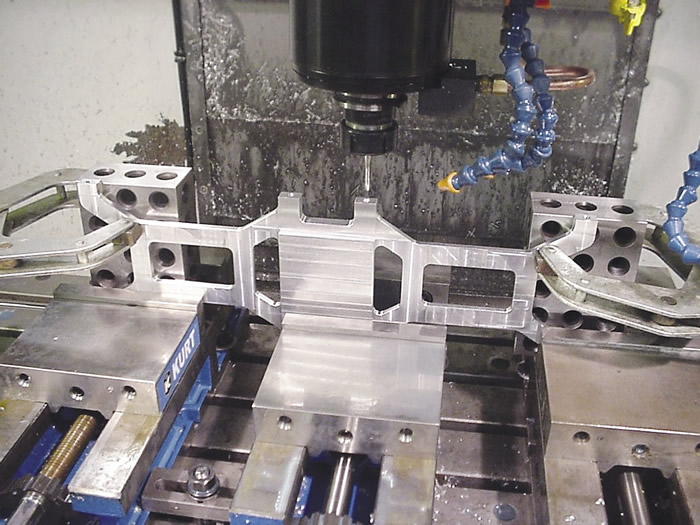
This part is held for edge drilling with the aid of 2-4-6 blocks. All images courtesy J. Harvey.
When presented with a part that is difficult to hold, your ingenuity will be put to the test. However, don’t spend time constructing complex fixtures when you don’t have to. When a standard vise won’t do the job, one option is conventional shop tooling, such as 1-2-3 blocks, 2-4-6 blocks, long parallels, grinding vises, angle plates and V-blocks. These items can effectively provide the added support you need.
Nonetheless, I’ve found that when I finally decide to build a custom fixture, I’m almost always glad I did. Often a fixture is needed to hold parts for perimeter cutting if the material is already at the correct thickness. In these cases, you can’t use excess stock to hold the part.
The following is a simple but effective trick for making fixtures you can bolt parts to. Suppose you are making a part that has no excess material to hold for cutting the perimeter, but has through-holes that can be used for clamping. When you are done drilling, manually tap the fixture through the holes in the part. After that, simply screw the part to the fixture. You are now ready to cut the perimeter. The beauty of this method is you never have to move the part.
Most fixtures can be constructed of aluminum. Our shop has a couple drawers full of simple fixtures that machinists have constructed for various jobs. One of our biggest problems with these fixtures is we don’t have enough room to store them, so they get scattered about, making them difficult to find.
Review the print ads from this magazine to continue
This quick advertiser review unlocks the rest of the article and keeps the full-screen reader focused on the ads instead of the page chrome.
Advertisers included in this article experience
Print placements connected to this article
Supermill.
We bring it!
When it’s a matter of machining difficult materials, achieving maximum productivity, creating geometries and coatings designed for your applications, the choice is clear. Top of the line for 25 years. New catalog. New website. New tool styles. Breadth. Depth. Precision crafted products. Superior end mill performance. We bring it!
We bring it! When it’s a matter of machining difficult materials, achieving maximum productivity, creating geometries and coatings designed for your applications, the choice is clear. SUPERMILL. Top of the line for 25 years. New catalog. New website. New tool styles. Breadth. Depth. Precision crafted products. Superior end mill performance. We bring it! Tomcat Best for HSM Steel
Visit Supermill. View this placement in the issue recordPrint ads from this magazine
When it’s a matter of machining difficult materials, achieving maximum productivity, creating geometries and coatings designed for your applications, the choice is clear. Top of the line for 25 years. New catalog. New website. New tool styles. Breadth. Depth. Precision crafted products. Superior end mill performance. We bring it!
We bring it! When it’s a matter of machining difficult materials, achieving maximum productivity, creating geometries and coatings designed for your applications, the choice is clear. SUPERMILL. Top of the line for 25 years. New catalog. New website. New tool styles. Breadth. Depth. Precision crafted products. Superior end mill performance. We bring it! Tomcat Best for HSM Steel
Continue reading
April 2016
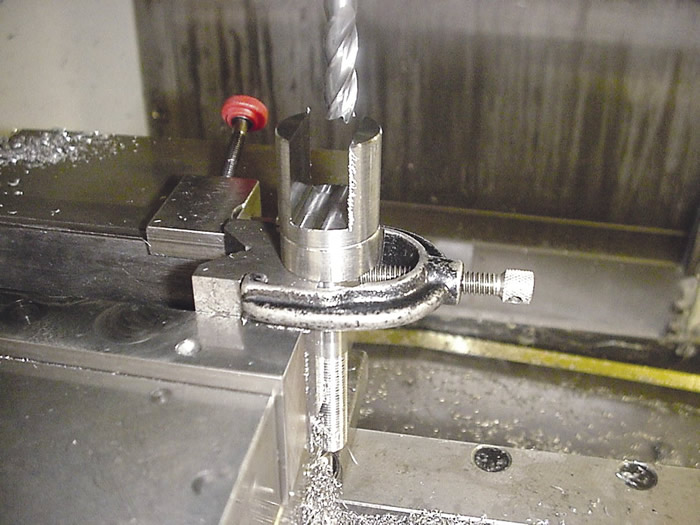
V-blocks provide a quick way to hold cylindrical parts for further machining.
We made the mistake some years ago of buying two cheap, low-quality milling machine vises. Our thinking was, “All the vise has to do is clamp the part. How difficult can that be?” We suffered with these vises for about a year before we upgraded to high-quality vises. With a loose-tolerance milling vise constructed of low-quality metal, we constantly struggled to hold parts securely against parallels, and the vise had a lot of sharp edges and burrs. In addition, there was a “spongy” feel when you started to clamp a part. You were never quite sure how much to tighten the vise, which resulted in inconsistent clamping pressure and part location. Even the handles didn’t fit properly. A milling machine vise is used nearly every day, which compounds the importance of having a good one.
One rule I always try to follow is don’t work blind if you don’t have to. Being able to see the cut allows you to keep an eye on cutters for anomalies—chip packing, chatter, improper coolant coverage, poor surface finish, cutter flex, gouging and jamming—before they become an issue. An added benefit is machined features will likely be easier to inspect.
Theoretically, you have stability when pressure applied anywhere perpendicular to an unclamped part doesn’t move the part. Having stability is more important when machining a flimsy part—the strength of the material may not provide enough rigidity to make a cut.
There are a few items to keep in mind when using V-blocks to hold parts. First, V-blocks don’t apply clamping pressure over a large surface area. The clamping pressure is applied to tangent lines on the part circumference. If you squeeze down too hard on a part held with a V-block, you may dent the part and throw the centerline of the part off location.
If you use two V-blocks to hold round parts, theoretically, you get four lines of clamping contact. If cutting pressures will be light, I often use just one V-block and a vise jaw to apply clamping pressure. In addition, placing soft material between the vise jaw and part prevents denting the part.
If the diameter of a cylindrical part is not precise and consistent, using a V-block to hold the part may cause it to tilt or throw the centerline off location. That’s one reason you shouldn’t always take advantage of wide-open tolerances. Tight tolerances, although not necessarily needed for the part to function, may be needed to accurately locate and hold workpieces for further
machining.
Perishable jaw vises can effectively hold parts, but should be considered a last resort. This is because it’s often difficult to find a set that hasn’t been cut up. You can always make new vise blanks, but if you leave them out, they’ll likely get used quickly. Also, the appropriate nests have to be machined into them, which consumes time.
Glossary terms in this article
Related




Subscribers can use MFGAxis notes, saves and discussion tools with their innoNET account.


