

A Machine Tool for Industry 4.0
Are visitors to a bearing manufacturing facility in Hoechstadt, Germany, getting an early glimpse of what Industry 4.0 looks like? That's the hope of Schaeffler Group, which owns the facility. The plant houses a machine tool meant to show how digitalization works—not in a laboratory, but in an actual manufacturing environment.
Are visitors to a bearing manufacturing facility in Hoechstadt, Germany, getting an early glimpse of what Industry 4.0 looks like?
That’s the hope of Schaeffler Group, which owns the facility. The plant houses a machine tool meant to show how digitalization works—not in a laboratory, but in an actual manufacturing environment. The machine is equipped with more than 60 extra sensors that bring data from the real world into the digital realm, where it can be used to visualize, analyze and predict machine conditions, explained Joerg-Oliver Hestermann, Schaeffler’s strategic applications engineer for production machinery.

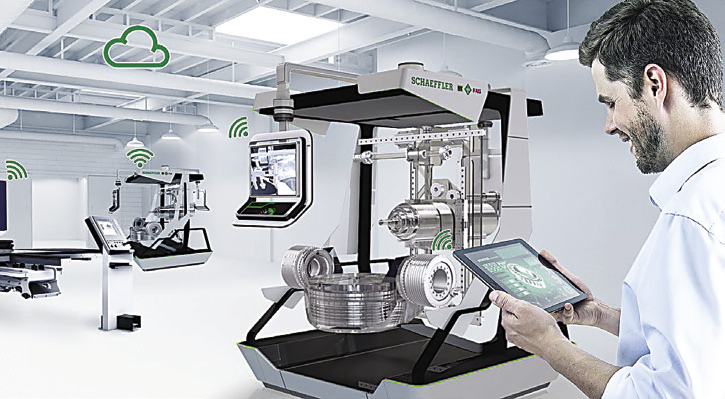
Machine Tool 4.0 data is evaluated both locally in the machine and in the cloud. Image courtesy Schaeffler Group.
The machine was developed in conjunction with Deckel Maho Pfronten (Germany) GmbH, a subsidiary of DMG Mori, as part of a joint effort known as Machine Tool 4.0. Based on DMG Mori’s fourth-generation DMC 80 FD duoBLOCK machining center, the milling machine is used in volume production of rolling bearings.
The additional sensors collect huge amounts of data about the machine’s condition. The sensors—which measure vibrations, forces, temperatures and pressures—are mainly integrated into components that Schaeffler supplies, such as bearings and linear guidance systems. These are located where components move in the machine.
Data generated at these key points is saved and processed locally in the machine, as well as in the cloud, where evaluations that require more computing power are made using specially developed algorithms. These evaluations help users gauge the probability of various process and production faults. When necessary, measures can be taken to prevent such faults, reducing unplanned machine downtime.
Review the print ads from this magazine to continue
This quick advertiser review unlocks the rest of the article and keeps the full-screen reader focused on the ads instead of the page chrome.
Advertisers included in this article experience
Print placements connected to this article
Kyoceraprecisiontools
HIGH VOLUME?
NO PROBLEM. We provide engineered, custom micro tooling solutions for high volume factories specializing in medical and aerospace manufacturing. Our specialized micro tooling team will guarantee improved yields and productivity by working closely with your manufacturing and engineering staff. By providing you with logistic and inventory solutions, we are able to create secure.
HIGH VOLUME? NO PROBLEM. We provide engineered, custom micro tooling solutions for high volume factories specializing in medical and aerospace manufacturing. Our specialized micro tooling team will guarantee improved yields and productivity by working closely with your manufacturing and engineering staff. By providing you with logistic and inventory solutions, we are able to create secure delivery chains that will keep your production on track and your company profitable. Engineered in the U.S.A / Made in the U.S.A KYOCERA Precision Tools, Inc. 1.888.848.8449
Visit Kyoceraprecisiontools View this placement in the issue record[email protected]
847.888.8110
PVD Hard Coating TiN, TiCN, AlCrN, and more Repeatable Product Reliable Delivery Fast Turnaround Expert Handling High Quality Medical, Aerospace, Energy, and Manufacturing Industry Coatings No Minimum Charges YMW High Performance Taps Zelx SS NI TI AL YMW Out Performing the Competition Since 1991 YMW TAPS USA.
847.888.8110 [email protected] www.chicagocoating.com PVD Hard Coating TiN, TiCN, AlCrN, and more Repeatable Product Reliable Delivery Fast Turnaround Expert Handling High Quality Medical, Aerospace, Energy, and
Visit [email protected] View this placement in the issue recordPrint ads from this magazine
NO PROBLEM. We provide engineered, custom micro tooling solutions for high volume factories specializing in medical and aerospace manufacturing. Our specialized micro tooling team will guarantee improved yields and productivity by working closely with your manufacturing and engineering staff. By providing you with logistic and inventory solutions, we are able to create secure.
HIGH VOLUME? NO PROBLEM. We provide engineered, custom micro tooling solutions for high volume factories specializing in medical and aerospace manufacturing. Our specialized micro tooling team will guarantee improved yields and productivity by working closely with your manufacturing and engineering staff. By providing you with logistic and inventory solutions, we are able to create secure delivery chains that will keep your production on track and your company profitable. Engineered in the U.S.A / Made in the U.S.A KYOCERA Precision Tools, Inc. 1.888.848.8449
Continue reading
January 2016
In addition to machine users, machine builders and even component suppliers like Schaeffler can access and analyze cloud-based data from machine tools like the one in Hoechstadt.
“We can detect that a bearing in the field is reaching the end of its life, then start producing a replacement,” said Craig Hooker, director of Schaeffler’s North American production machinery business unit. “So rather than waiting for the bearing to fail and then going through the whole production process, we can ship the new bearing to the customer when it’s needed.”
Each part the Hoechstadt machine produces receives a unique ID: a data matrix code applied by laser. This allows all data generated during the machining of a component to be assigned to that component. The idea is that by comparing data for individual components, Schaeffler will be able to quickly recognize and correct deviations in the manufacturing process.
Other possible benefits of the enhanced data collection and analysis made possible by Machine Tool 4.0 include:
- Greater machining precision.
- Process optimization, where sensor feedback from the cutting edge can trigger process changes that, for example, extend tool life or lower energy consumption.
- Improved maintenance, so rather than lubricating—and often over-lubricating—a machine at regular intervals based on a preventive maintenance schedule, plant personnel can monitor the actual machine condition to determine when and how much lubrication is required.
Although the Hoechstadt machine has been up and running since early October, it’s too soon for Schaeffler to draw any conclusions about its performance. “It will take years to complete the test phase,” Hestermann said. “But in a year, I hope we get the first results that will help us figure out how to proceed.”
One challenge is determining which of the machine’s many additional sensors are essential. While all of the machine and process information being gathered has some value, Hooker said the key question is: What data can improve machine performance “in a way that is valuable in dollars and cents to the person who owns the machine?”
About the Author: William Leventon is a contributing editor for CTE. Contact him at (609) 926-6447 or wleventon@gmail.com.
Glossary terms in this article
Related




Subscribers can use MFGAxis notes, saves and discussion tools with their innoNET account.


