

The virtual machine tool
The benefits of creating and using a virtual machine tool. At trade shows and elsewhere, people on the cutting edge of manufacturing are touting the benefits of digitalizing the machine tool environment, where technologies are employed that make use of digital data. It's at the heart of the much-discussed drive toward Industry 4.0.
At trade shows and elsewhere, people on the cutting edge of manufacturing are touting the benefits of digitalizing the machine tool environment, where technologies are employed that make use of digital data. It’s at the heart of the much-discussed drive toward Industry 4.0.
One key digitalization technology is software that allows the creation and use of a “virtual machine.” Germany-based Siemens AG, for example, sells virtual machine software to help both machine builders and operators.
For machine builders, a virtual machine represents a paradigm shift, according to Sascha Fischer, manager of Siemens’ U.S. machine tool business. Fischer described conventional machine development as a time-consuming process that involves building and testing physical prototypes based on data collected from paper documentation. In these cases, testing is only possible after assembly of a prototype or finished machine, delaying the discovery of design errors and making corrective actions more difficult and expensive.

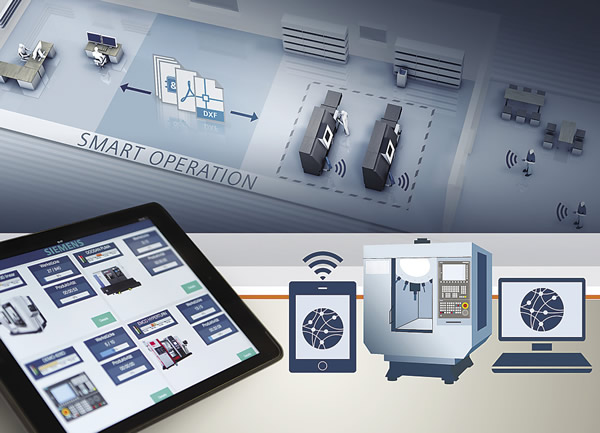
Digitalizing the machine tool environment is at the heart of the much-discussed drive toward Industry 4.0. All images courtesy Siemens.
By contrast, followers of the new paradigm build a virtual machine before making a physical one. Based on digital design data, this virtual machine can be tested by hooking it up to physical, real-life controller technology. During a 3D simulation, the virtual machine is checked under real-life conditions and a large amount of data is collected about its behavior.
If a design error is spotted and a machine feature needs to be altered, the virtual machine can easily be changed and retested. And again, no physical prototype is required.
How accurate are these digital simulations? According to Fischer, they’re almost exact approximations of how a real machine operates.
Use of accurate digital simulations can significantly shorten the machine-development process, Fischer noted, slashing costs and time-to-market. “You can easily save one-third of the production time,” he said.
Review the print ads from this magazine to continue
This quick advertiser review unlocks the rest of the article and keeps the full-screen reader focused on the ads instead of the page chrome.
Advertisers included in this article experience
Print placements connected to this article
Fax +1 817 258 3221, [email protected]
ISCAR's Winning Edge
Grooving Innovations Jet Coolant Directed to the Cutting Edge for Better Chip Control with Superior Productivity Turning Grooving Parting ISCAR METALS INC
ISCAR's Winning Edge Grooving Innovations Jet Coolant Directed to the Cutting Edge for Better Chip Control with Superior Productivity Turning Grooving Parting ISCAR METALS INC. Tel +1 817 258 3200, Tech Tel 1-877-BY-ISCAR Fax +1 817 258 3221, [email protected] www.iscarmetals.com
Visit Fax +1 817 258 3221, [email protected] View this placement in the issue recordShapemastertool
Producing premium custom diamond and PCBN cutting tools since 1976
All ANSI & ISO Boring Bars Grooving Customer Inserts Tools Specials SHEDDING LIGHT ON THE FUTURE OF THE CUTTING TOOL INDUSTRY PhotoCredit Photo Photo Credit: Credit: EWAGAG EWAG EWAG AG Ph: (888) PCD-PCBN.
Producing premium custom diamond and PCBN cutting tools since 1976 All ANSI & ISO Boring Bars Grooving Customer Inserts Tools Specials SHEDDING LIGHT ON THE FUTURE OF THE CUTTING TOOL INDUSTRY PhotoCredit Photo Photo Credit: Credit: EWAGAG EWAG EWAG AG
Visit Shapemastertool View this placement in the issue recordPrint ads from this magazine
Grooving Innovations Jet Coolant Directed to the Cutting Edge for Better Chip Control with Superior Productivity Turning Grooving Parting ISCAR METALS INC
ISCAR's Winning Edge Grooving Innovations Jet Coolant Directed to the Cutting Edge for Better Chip Control with Superior Productivity Turning Grooving Parting ISCAR METALS INC. Tel +1 817 258 3200, Tech Tel 1-877-BY-ISCAR Fax +1 817 258 3221, [email protected] www.iscarmetals.com
Continue reading
December 2015
Once a real machine has been assembled, a builder can sell it along with its virtual twin to plan and optimize machining processes. By running a process on a virtual machine, for example, operators can determine the cycle time and check throughput. They can also ensure an NC program is collision-free and has the correct syntax.
What’s more, all this can be done while the real machine remains available for other tasks. By reducing downtime for production planning, Fischer said, the virtual machine can help make the investment in a new machine profitable.
The cost of acquiring a virtual twin along with a real machine is typically about 5 to 20 percent of the cost of a new machine, Fischer said. Sometimes, he added, machine OEMs will reduce the price of the real machine if a customer also takes the virtual twin.
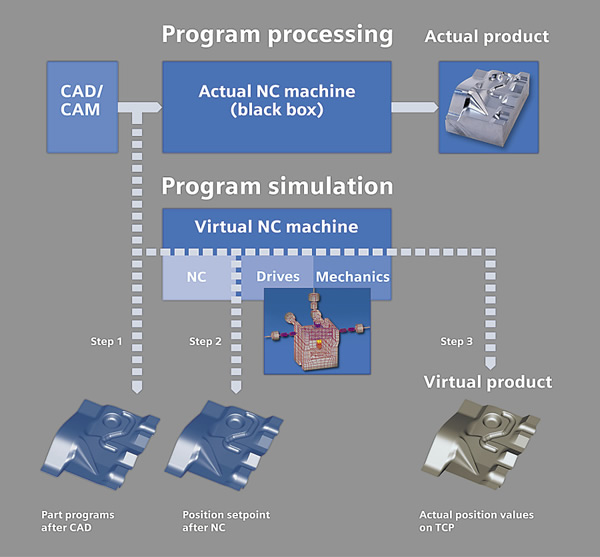
A virtual twin of a real machine can help operators plan and optimize machining processes.
However, not everyone in the machine tool industry is sold on virtual machines. “You need to be open to the process,” Fischer said. “But a lot of machine tool builders say, ‘We know everything about machine tooling.’ So they are a little reluctant to accept knowledge from us about how to design a machine.”
In addition, digital tools like virtual machines tend to be less popular among small companies, which have smaller investment budgets and less in-house IT expertise than their larger counterparts. “Basically, big companies are driving the [digitalization] story,” Fischer said.
But that’s not to say there’s no interest among smaller firms. “There are some small companies that say, ‘We can only grow if we understand these tools,'” Fischer said, adding that digital machining solutions “will come into this market step by step. The tools exist and they can help small companies as much as larger ones, so it’s just a question of time.”
About the Author: William Leventon is a contributing editor to CTE. Contact him at (609) 926-6447 or wleventon@gmail.com.
Related




Subscribers can use MFGAxis notes, saves and discussion tools with their innoNET account.


