



Private equity funds, venture capitalists partner with precision parts manufacturers poised for growth
Running a successful machine shop takes more than having advanced machine tools, high-performance cutting tools and machinists that boost productivity. A manufacturer of precision metal parts might also need a strategic partner that has the network, expertise and — last but not least — capital to penetrate new markets, overcome capacity constraints and make investments to help the business grow.
Running a successful machine shop takes more than having advanced machine tools, high-performance cutting tools and machinists that boost productivity. A manufacturer of precision metal parts might also need a strategic partner that has the network, expertise and—last but not least—capital to penetrate new markets, overcome capacity constraints and make investments to help the business grow.
Technicut Tool Inc. is one example of a machine shop that followed this path. The Windsor, Ontario-based company employs 80 people and specializes in machining complex, precision parts for the oil and gas industry, as well as for aerospace customers, at its 44,000-sq.-ft. manufacturing facility. CEO Dino Civiero explained that his partner was looking to retire while he wanted to remain and grow the business. “I was looking for somebody who has the capital and connections to help us do that.”
He turned to Capital Assist (Valuation) Inc., a Windsor-based capital advisory firm, and NewPoint Capital Partners Inc., a Toronto-based investment banking firm, to serve as financial advisers. Capital Assist President Federica Nazzani said the process for securing a financial investor begins by examining an organization’s structure, products and management team while looking at the customers and industries it serves, as well as the direction, opportunities and challenges that exist for the company. From there, an adviser prepares a document called a confidential investment memorandum, which is provided to potential investors as they start to evaluate opportunities, and determine its interest in investing.
“We work closely with management to assess future growth projections,” Nazzani said. “We then look at potential sources of capital required to meet that growth.”
Enter the Equity Fund
After shortlisting those sources, Nazzani noted White Wolf Capital LLC, Miami, was ultimately selected as the most appropriate partner for Technicut. “They have tremendous depth in terms of their technical and financial expertise, as well as their knowledge of the U.S. market, a key target market for Technicut,” Nazzani said.
“From a growth standpoint, they seem to be the best fit,” Civiero added, noting White Wolf is aligned with manufacturers that machine similar types of parts. “They have a lot of connections in the oil and gas industry.”
Civiero said he was also attracted to White Wolf’s focus on long-term investing with a strategy that keeps the administration of a machine shop intact. “They are looking for companies with a strong management team, which is what we have. It’s pretty much business as usual for us.”

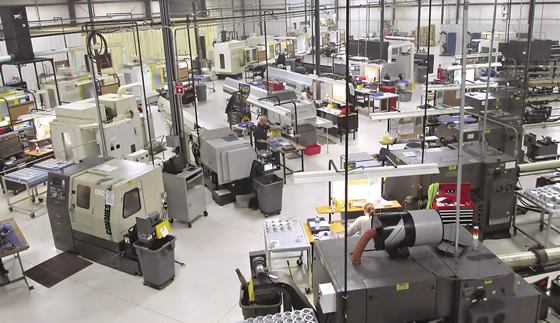
A machine shop can be attractive as an investment opportunity, particularly for those in the banking community, because of its high-value, tangible assets. Image courtesy Natoma Corp.
Elie Azar, managing director for White Wolf, noted the equity firm focuses on lower- to mid-market companies with revenues up to $100 million and EBITDA (earnings before interest, taxes, depreciation and amortization) up to $10 million. White Wolf typically looks to acquire 60 to 75 percent of those companies. “We are only interested in situations where we can partner with an existing team,” he said. “We look for situations where the management team has grown the company to maybe $15 million to $30 million in revenue and are looking to take it to the next level, take some chips off the table and take a second bite of the apple—hopefully, a much larger apple—5 to 7 years down the road.”
As a partner, an equity firm isn’t going to recommend what cutting tool to apply when deep-hole drilling or the speeds and feeds for roughing a block of Inconel, but rather it helps in areas such as business development, financing and mergers and acquisitions. “Maybe the business needs a CFO, making investments in strategic IT like ERP (enterprise resource planning) or CRM (customer relationship management),” Azar said. “A lot of times these growing companies have been financed by the owner, so they typically are more conservative. We see an opportunity to seek out strategic acquisitions for the company, expanding lines of credit and investing working capital to help grow the business.”
That conservative nature can translate to owners not wanting to accept 100 percent of the risk when growing a manufacturing operation. “So they take on an investor to help share the risk,” Nazzani said. “That could be a reflection of age or just their own internal resources and what they are prepared to continually invest. In the case of Technicut, it’s not just about providing money to help them grow, but they are really looking for expertise and network.”
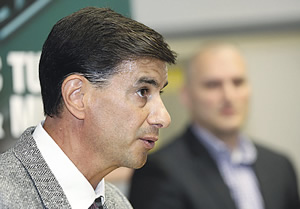 Dino Civiero, CEO of Technicut Tool Inc.
Because many founders of private equity groups have an industrial background, their personal relationships can be quite valuable when targeting new markets, according to Nazzani.
Although diversifying a manufacturer’s customer base usually involves serving industries it had not previously, that’s not always the case. “There is an incredible amount of promise in the oil and gas industry, and just diversifying in that industry alone is huge,” Technicut’s Civiero said, adding that the company plans to target other industries as well.
Consolidation Crunch
Strategic investors often seek to consolidate companies in a highly fragmented marketplace, and, with at least 20,000-plus machine shops in the U.S., precision parts manufacturing certainly qualifies, noted Elijah Crotzer, president and CEO of ARCH Global Precision, Livonia, Mich. The company was formed in 2011 with the goal to acquire manufacturers that specialized in producing machined components and cutting tools.
 Federica Nazzani,president of Capital Assist (Valuation) Inc.
He explained that large consumers of parts, such as numerous Fortune 500 companies, want to dramatically reduce their supply base. Therefore, a parts manufacturer becomes a more attractive supplier by acquiring additional machining capabilities. “We have different capabilities, from Swiss-style screw machining of very small parts all the way to machining castings and forgings that weigh several thousand pounds—and everything in between,” Crotzer said. “We become a one-stop shop for our customer base.”
Nazzani concurred that it’s an optimal time to consolidate within the parts manufacturing sector. This is because, depending on the industries they serve, machine shops are seeing increased business activity and face several constraints when increasing capacity. These include financial constraints to growth, such as physical, where a facility doesn’t have the space to deploy additional machine tools, people, where even if a facility has the space for new equipment it’s challenged to find a skilled person to operate it, and expertise, because besides machinists, qualified production managers, manufacturing engineers and logistics personnel are also in limited supply.
“All of those things are important,” she said, “and the ability to share those resources through consolidation leads to greater economies of scale and helps with those constraints.”
Nonetheless, the consolidation of parts manufacturing may be more anecdotal than a real trend for now. “For whatever reason, a lot of private equity has not ventured into this space as much as I would have anticipated,” Crotzer said. “But I would be surprised if we don’t start to see more and more folks at private equity firms getting into this space.”
Crotzer pointed out that ARCH Global Precision purchases 100 percent of a company’s equity or assets, depending on how the deal is structured. Typically with ARCH Global, the previous owners remain to continue their day-to-day roles of running the business, or, when owners want to transition out, the owners create a second layer of management to handle operations. “We help with purchasing and benefits and put in a little bit of accounting structure,” he said.
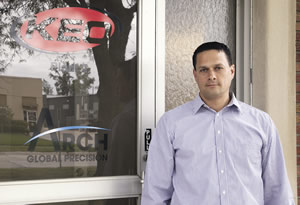 Elijah Crotzer, president and CEO of ARCH Global Precision
To help ensure that the profitable manufacturers it acquires stay profitable and avoid losing sales to producers in low-labor-cost regions, Crotzer said ARCH targets companies that manufacture high-value-added, difficult-to-machine parts. “It’s not commodity stuff.”
In addition to profitability, diversification is critical. “We don’t want all of our eggs in one basket,” Crotzer said. “We want ARCH Global to be a precision machining company serving as many markets as possible, so as one industry cycles down, another one is presumably doing well or at least holding its own.”
And after the company makes an acquisition, Crotzer emphasized that ARCH intends to hold onto it while continuing to operate the business with its legacy name, at least for now. “One of the ways we differentiate ourselves is we are not the traditional, ruthless private equity firm that is just trying to squeeze the business for cash and leave a disaster,” he said. “We are very actively reinvesting in the businesses and are focused on growth.”
Distress Signal
Some strategic investors are also interested in growing companies, but start with calamities. One investment banking firm that specializes in this space is Heritage Equity Partners, Easton, Md. “We live in a small niche in the investment banking world,” said Managing Director Fred Cross. “For the past 27 years, we’ve worked with troubled companies, either finding them new money, joint venture relationships or entirety sales.”
In addition to troubled companies, Heritage conducts single-asset sales, including what once was the largest barge crane. “We’ve sold just about everything, but the common thread is some sort of distress, either in Chapter 11, having financial troubles or experiencing partnership disputes,” Cross said.
The majority of owners of troubled companies stay on board, frequently as part of the ownership group, unless they caused the problems, he noted. The goal is to turn the businesses around by eliminating the financial distress and taking it to the next level.
One manufacturer that recently retained Heritage is TT and D Inc., a 12-employee shop in Tupelo, Miss., that makes precision dies and tooling. “There is significant opportunity to not only expand business with the company’s existing customer base, but also utilize their excess capacity to make new components in any number of different industries,” Cross stated. “We took the project on in late June, and we are finalizing documents with a going-concern buyer now in August. These project don’t need a great deal of time to reach a positive outcome for all those involved.”
Some projects, however, require a resurrection rather than a turnaround, because the business is no longer a going concern. When a company has a padlock on its door, Cross said Heritage looks for a buyer to open the business again by hiring personnel and resuming operations. “We’re not scared of situations like that. The niche we’re in is to try and help people who have seemingly gotten too far along in the fall, so to speak, and then provide a solution that brings them back from death’s door.”
Cross added that nearly all of its clients come to Heritage via hundreds of bankruptcy attorneys across the U.S. and the workout departments at banks where bad loans go. Then, through negotiations with bankers, buyers, sellers and company personnel, Heritage works to awaken a troubled company from its nightmare, he said. “In many cases, the family’s name is in the company’s name, they have a staff of 50 to 100 people on the floor and they’re like family. We understand that and want to do right by all of those people.”
 Fred Cross, managing director, Heritage Equity Partners
Regardless of the scenario that causes a parts manufacturer to seek an investor, having a positive chemistry between the buyer and seller is critical. “How comfortable do each of the parties feel working together?” Capital Assist’s Nazzani asked. “Because you suddenly are introducing two strangers and telling them that if this deal goes through, they are now going to be partners and aligned to grow this business together.”
ARCH Global Precision’s Crotzer added cultural alignment to the list of marriage requirements. “We have a set of values and beliefs that are pretty core to our identity,” he said, “and we want people who are like-minded and share the same vision and value system.”
Those values, for example, include treating all constituents as you would want to be treated, being passionate about what you do every day and striving to create and maintain a workplace that is fun and enjoyable. Who wouldn’t buy into that?

Contributors
ARCH Global Precision
(734) 266-6944
www.archglobalprecision.com
Capital Assist (Valuation) Inc.
(226) 347-8100
www.capitalassist.ca
Heritage Equity Partners
(866) 969-1115
www.equitypartnershg.com
Technicut Tool Inc.
(519) 969-4048
www.technicuttool.com
White Wolf Capital LLC
(786) 441-8441
www.whitewolfcapital.com
Related




Subscribers can use MFGAxis notes, saves and discussion tools with their innoNET account.


