

Long and short of broaching
Many options are available for removing stock and shaping workpieces. Broaching is one of the most productive, underutilized -- and least understood.
Many options are available for removing stock and shaping workpieces. Broaching is one of the most productive, underutilized—and least understood.
Broaching is similar to shaping in that neither the tool nor the workpiece rotate relative to each other. In most cases, broaching is accomplished by holding the workpiece stationary and moving the broach tool past—and through—the workpiece to initiate the chip-forming process. The most familiar broaching operation is likely for the creation of square keyways in bored holes, where the keyway is produced by pushing a broach through a hole using an alignment bushing.
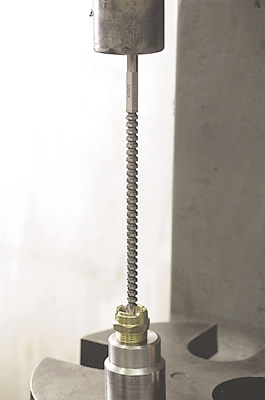
This hexagon-shaped broach it pushed through a drilled hole to produce a hexagon-shaped hole. Each tooth is slightly larger than the previous tooth, and the change in size from tooth to tooth is equal to the DOC per tooth. Image courtesy Hassay Savage.
Broach construction is similar regardless of the application. Broaches can be constructed of various materials, including HSS and carbide, and some even accept carbide inserts. HSS broaches are by far the most common because HSS provides adequate wear resistance and toughness.
No matter what material they are made from, all broaches function according to the same principle. The broach form is a mirror image of the desired form in the part. Broaches are constructed so each tooth is slightly larger than the previous tooth. This staggered effect allows each tooth to remove an incremental amount of material as the broach moves past the workpiece. Typically, each tooth will remove 0.001 ” to 0.003 ” of material, depending on the application and capability of the broaching machine.
Broaching is often used for geometric forms that cannot be produced by other means or economically by other processes, such as internal splines found on the input shaft of a transmission.
Broaching also can be used in place of milling, because it can quickly and accurately remove large amounts of material. This is often called surface or slab broaching.
Because of the relatively light DOC, broaching can create intricate and close-tolerance forms. Maintaining a dimensional tolerance of 0.0005 ” on complex forms is possible with a rigid machine and well-made broaches.
One of the most significant broaching advantages is cost. Broaches and broaching machines can have high acquisition costs, but, because broaching is so efficient, the cost per part is typically low.
When I worked in the automotive industry and made power steering gears, a set of broach tools for the gear rack (rack and pinion steering) cost about $25,000 per set, and a new horizontal broaching machine cost $750,000. However, a set of properly maintained tools could produce 100,000 parts. Good tools paired with a good machine yielded a robust process that produced a gear rack every 40 seconds while maintaining a 0.0005 ” dimensional tolerance on the gear teeth.
Review the print ads from this magazine to continue
This quick advertiser review unlocks the rest of the article and keeps the full-screen reader focused on the ads instead of the page chrome.
Advertisers included in this article experience
Print placements connected to this article
Haas Automation Inc. | 800-331-6746 | www.HaasCNC.com
RELIABILITY. PRICE. REPUTATION.
Haas VF-2SS Super Speed Vertical Machining Center = TOTAL CUSTOMER VALUE. WE KNOW what it’s like. That’s why we’re driven to make sure that every Haas We’re MACHINISTS, too. CNC machine is trustworthy, affordable, and always We CUT METAL every day. backed by the industry’s best after-sale service. Proud sponsor of the Stewart-Haas #41 car.
RELIABILITY. PRICE. REPUTATION. Haas VF-2SS Super Speed Vertical Machining Center = TOTAL CUSTOMER VALUE. WE KNOW what it’s like. That’s why we’re driven to make sure that every Haas We’re MACHINISTS, too. CNC machine is trustworthy, affordable, and always We CUT METAL every day. backed by the industry’s best after-sale service. Haas Automation Inc. | 800-331-6746 | www.HaasCNC.com Proud sponsor of the Stewart-Haas #41 car
Visit Haas Automation Inc. | 800-331-6746 | www.HaasCNC.com View this placement in the issue recordPrint ads from this magazine
Haas VF-2SS Super Speed Vertical Machining Center = TOTAL CUSTOMER VALUE. WE KNOW what it’s like. That’s why we’re driven to make sure that every Haas We’re MACHINISTS, too. CNC machine is trustworthy, affordable, and always We CUT METAL every day. backed by the industry’s best after-sale service. Proud sponsor of the Stewart-Haas #41 car.
RELIABILITY. PRICE. REPUTATION. Haas VF-2SS Super Speed Vertical Machining Center = TOTAL CUSTOMER VALUE. WE KNOW what it’s like. That’s why we’re driven to make sure that every Haas We’re MACHINISTS, too. CNC machine is trustworthy, affordable, and always We CUT METAL every day. backed by the industry’s best after-sale service. Haas Automation Inc. | 800-331-6746 | www.HaasCNC.com Proud sponsor of the Stewart-Haas #41 car
Continue reading
September 2015
Broaching machines are available is many sizes; some are no bigger than a Bridgeport-type knee mill while others are the size of a small house. The size is determined by the power necessary to drive the broach, as well as the length of the broach and workpiece.
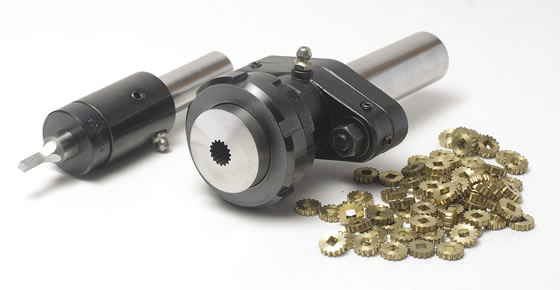
Internal squares and external splines are rotary-broached into small brass parts. Image courtesy Slater Tools.
Broaching machines have a stroke length, or maximum distance they can travel, so the broach must be manufactured accordingly. The necessary stroke for a given job is determined by the length of the broach, which, in turn, is determined by the amount of material to be removed. Each broach tooth removes a fixed amount of stock, which means it is necessary to increase the number of teeth on the broach as the amount of stock increases. As the number of teeth increases, so does the broach’s length.
The power of a broaching machine is given in tons. Therefore, a 40-ton machine is capable of doing more work than a 5-ton machine. Tonnage requirements, like stroke requirements, are determined by the tool and material. Obviously, more power is required to broach high-carbon steel like 4140 than materials like brass or aluminum. The power requirement is determined by the number of teeth engaged in the cut. So a broach that has a single row of teeth requires less power than one that has multiple rows.
Along with the tonnage and the stroke, a specification is provided for cutting speed. Knowing the cutting speed helps to determine if the machine is correct for the application. If the cutting speed is too fast, premature damage to the broach can occur. Cutting speeds that are too slow are less efficient. Like other machining operations, cutting speed will be based on the workpiece material, part geometry, coolant and tool coatings.
Broaching is applicable in high-volume machining where dedicated equipment is justified, including automotive and gun parts. It is also applicable when alternatives are expensive or not capable of supporting the required production rates. It is common for some shops to outsource EDM work on parts that could be broached more efficiently.
Broaching does not have to be performed on a broaching machine. It can be done on milling machines, lathes and other types of equipment. This flexibility would eliminate the secondary operation needed for a part that must be broached and milled, for example. It can also replace milling to reduce cycle times, improve surface finishes and create intricate forms.
A little research—and creativity—may uncover broaching opportunities in your shop. CTE
About the Author: Christopher Tate is engineering manager, combustion shop, for Mitsubishi Hitachi Power Systems Americas, Savannah (Ga.) Machinery Works. Email: chris23tate@gmail.com.
Glossary terms in this article
Related



 MFGAxis Discussion
Be part of the shop-floor conversation
Like, save, or comment on this CTE story.
MFGAxis Discussion
Be part of the shop-floor conversation
Like, save, or comment on this CTE story.


MFGAxis Discussion