

Green lantern: CMM Inspection
Perceptron Inc. has developed a green laser scanner for coordinate measuring machines that works with aluminum and carbon-fiber-composite parts. In the past, integrating 3D scanning software on a CMM or portable CMM was expensive and awkward, according to Song Chung, senior vice president and CTO at Perceptron.
Perceptron Inc. has developed a green laser scanner for coordinate measuring machines that works with aluminum and carbon-fiber-composite parts. In the past, integrating 3D scanning software on a CMM or portable CMM was expensive and awkward, according to Song Chung, senior vice president and CTO at Perceptron.
“With 3D printing and reverse engineering advancing so rapidly, we saw a void in the market for a laser scanning solution,” he said.
The ScanR, which is Perceptron’s sixth-generation laser scanner, provides a wider spectrum within the dynamic range than red or blue lasers and without the reflective noise. This results in a laser scanner that offers improved material coverage, edge detection and accuracy, as well as a better signal-to-noise ratio.
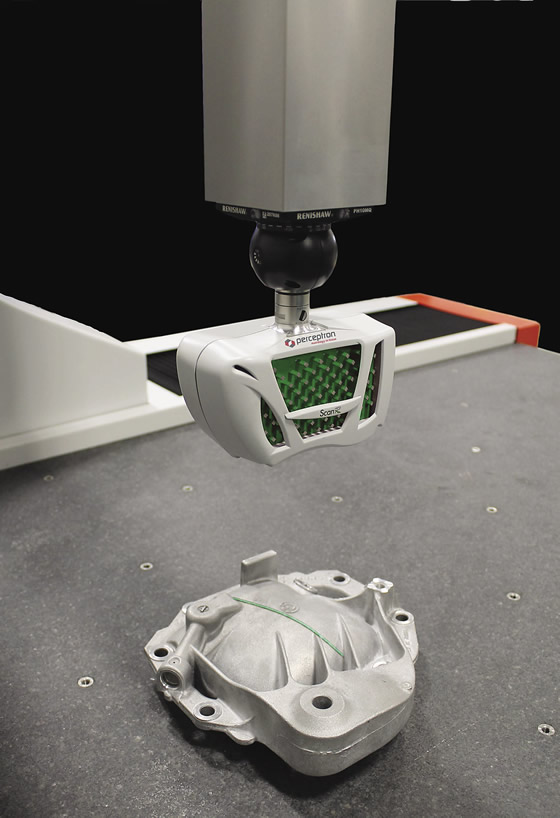
The ScanR universal CMM green laser scanner from Perceptron offers improved material coverage, edge detection and accuracy, as well as a better signal-to-noise ratio. Image courtesy Perceptron.
Chung said the use of green laser was once considered expensive because the wavelength was difficult to achieve. Instead of a single process, it took several additional steps, more optics, more space and more energy to produce. “New technology, however, has solved many of these issues in terms of stability and affordability,” he said. “In our development process, we were able to apply the right set of optics to make good use of the green laser spectrum, optimizing the wavelength over that of red or blue lasers.” (Green lasers have wavelengths from 490nm to 560nm, red lasers from 630nm to 700nm and blue lasers from 360nm to 480nm).
One advantage of using a green laser compared to a red one on a highly reflective carbon-fiber part is end users don’t have to spray the part with a powder coating. “Carbon-fiber surfaces have a clear coating over the fiber texture,” Chung said. “Red lasers will look right through the coating and see the actual fibers, while green and blue lasers will reflect off the clear surface, providing good surface detection.”
Review the print ads from this magazine to continue
This quick advertiser review unlocks the rest of the article and keeps the full-screen reader focused on the ads instead of the page chrome.
Advertisers included in this article experience
Print placements connected to this article
Machinecontroltechnologies
Productive Times
“We chose the Haas UMC-750 to improve the quality and artistic value of our products,” Belyakov added. “This machine meets the quality standards demanded by the motorcycle market and makes it easy to work with a large tool over- hang and quickly generate a lot of chips.” After purchasing the 5-axis ma- chine tool, the company needed.
Productive Times “We chose the Haas UMC-750 to improve the quality and artistic value of our products,” Belyakov added. “This machine meets the quality standards demanded by the motorcycle market and makes it easy to work with a large tool over- hang and quickly generate a lot of chips.”
Visit Machinecontroltechnologies View this placement in the issue recordFreeduratomic
Shops discard inserts with
approximately 20% of their cutting edges unused. Edge Intelligence on Seco’s new Duratomic TP grades makes it easy to identify unused edges and eliminate an expense you may not even know you’re experiencing. Additionally, TP grade inserts’ improved subtrates and coatings offer an average productivity gain of 20%, with some applications.
Shops discard inserts with approximately 20% of their cutting edges unused. Edge Intelligence on Seco’s new Duratomic TP grades makes it easy to identify unused edges and eliminate an expense you may not even know you’re experiencing. Additionally, TP grade
Visit Freeduratomic View this placement in the issue recordPrint ads from this magazine
“We chose the Haas UMC-750 to improve the quality and artistic value of our products,” Belyakov added. “This machine meets the quality standards demanded by the motorcycle market and makes it easy to work with a large tool over- hang and quickly generate a lot of chips.” After purchasing the 5-axis ma- chine tool, the company needed.
Productive Times “We chose the Haas UMC-750 to improve the quality and artistic value of our products,” Belyakov added. “This machine meets the quality standards demanded by the motorcycle market and makes it easy to work with a large tool over- hang and quickly generate a lot of chips.”
Continue reading
September 2015
Another advantage with ScanR is the adjustable data-acquisition rate for high-quality and high-speed operation. This largely depends on the application, part size and shape complexity. “If it’s a small part with a high geometry, you want to slow down acquisition but try to get more resolution,” Chung said. “With large areas like a door or fender, part variation is not too high, so you want a higher speed to reduce data-acquisition time and eliminate unnecessary data that you may ultimately throw away.”
ScanR can be integrated into Perceptron’s TouchDMIS metrology software, which offers a one-touch scanning interface and allows initial user setup via a tactile measuring probe, according to the company. Feature extraction from the generated point cloud allows automatic inspection of part features against nominal feature definitions from CAD.
This laser scanning concept complements 3D printing whenever there is a need to create modify or adjust a digital copy of a critical part—for example, when you have just one original part and want to make it in varying sizes. “Also, you may want to use the scan to compare it with the original part data in order to verify and/or inspect the 3D-printed part,” Chung said.
For more information about Perceptron Inc., Plymouth, Mich., call (734) 414-6100 or visit www.percep tron.com.
About the Author: Matt Jaster is senior editor of CTE. Contact him at (847) 714-0174 or mjaster@jwr.com.
Related




Subscribers can use MFGAxis notes, saves and discussion tools with their innoNET account.


