

Chuck aids retention knob work
Enhance precision and shorten changeover time when machining retention knobs. Quick-change collet chucks.
END USER: JM Performance Products Inc., (800) 322-7750, www.jmperformanceproducts.com.
CHALLENGE: Enhance precision and shorten changeover time when machining retention knobs.
SOLUTION: Quick-change collet chucks.
SOLUTION PROVIDER: Hainbuch America Corp., (800) 281-5734, www.hainbuchamerica.com.
Competitive manufacturers continually seek new and innovative ways to improve product quality while cutting costs, and a logical starting point involves methods to increase tool life.
JM Performance Products Inc., Fairport Harbor, Ohio, offers a retention knob that has quickly gained acceptance as a means of extending tool life and improving tool performance. The company, which started as the job shop J&M Machine in 1966, developed a high-torque retention knob that prevents the toolholder taper from expanding, thereby reducing the harmonics responsible for premature tool failure.
“In conventional milling machine operations, 70 percent of the toolholder taper does not contact the spindle,” explained Andrew Rowley, president of JM Performance Products. “This results in an uneven wear pattern capable of causing tolerance problems, as well as (negatively) impacting the tool. The spindle opens and the expanded toolholder becomes lodged, creating the characteristic ‘thump’ frequently heard during tool change. Our design stops the toolholder from expanding so it does not become lodged.”
Since production of the retention knobs began 5 years ago, the line has grown to encompass about 400 different versions for virtually every type of toolholder. The variety offered continues to expand and currently ranges from ¾ ” (19.05mm) for a 30 taper holder to 2¾ ” (69.85mm) for a 60 taper holder, with a maximum length of 45⁄8 ” (117.48mm) for the 60 taper holder, machined from 2¾ “-dia. stock.
The knobs are made from 9310 tool steel or 8620 steel. Plant Manager Craig Fischer noted that 9310 has a higher chromium content and is about 40 percent stronger than 8620. “Everything will eventually be made out of 9310,” he said. The knobs are heat treated and shot peened to enhance rigidity, and most are equipped with coolant holes.
As the number of configurations grew, so did the need for faster changeover times and improved manufacturing capability to maintain precision when cutting materials with a hardness up to 225 HB. This led to a search for better workholding methods.
The company was using 3-jaw chucks with soft jaws, but the workpieces would cause the jaws to wear and reboring the jaws took up about 20 minutes every day—sometimes every 12 hours, Fischer said. “And that’s if you got it right. It took a good setup guy to get the jaws bored right.”
In addition, the company experienced pushback, where the bar stock slides in the collet during machining, when running at the toolmaker’s recommended speeds and feeds. “I couldn’t compensate because sometimes it would slide back 0.050 ” and sometimes it would slide back 0.100 “. I don’t have that type of tolerancing in my parts,” Fischer said.
Review the print ads from this magazine to continue
This quick advertiser review unlocks the rest of the article and keeps the full-screen reader focused on the ads instead of the page chrome.
Advertisers included in this article experience
Print placements connected to this article
Star SU
Perhaps it’s time to take another path
Discover Star tool grinders with linear motor technology and say goodbye to ball screws - Tool manufacturing and resharpening - Gear tool reconditioning - Mineral cast base for increased damping and thermal stability - Industry leading NUMROTO software - Automated loading options - Built and serviced in the U.S.A. PTG-6L NTG-4L.
Perhaps it’s time to take another path Discover Star tool grinders with linear motor technology and say goodbye to ball screws - Tool manufacturing and resharpening - Gear tool reconditioning - Mineral cast base for increased damping and thermal stability - Industry leading NUMROTO software - Automated loading options - Built and serviced in the U.S.A. PTG-6L NTG-4L
Visit Star SU View this placement in the issue recordPrint ads from this magazine
Discover Star tool grinders with linear motor technology and say goodbye to ball screws - Tool manufacturing and resharpening - Gear tool reconditioning - Mineral cast base for increased damping and thermal stability - Industry leading NUMROTO software - Automated loading options - Built and serviced in the U.S.A. PTG-6L NTG-4L.
Perhaps it’s time to take another path Discover Star tool grinders with linear motor technology and say goodbye to ball screws - Tool manufacturing and resharpening - Gear tool reconditioning - Mineral cast base for increased damping and thermal stability - Industry leading NUMROTO software - Automated loading options - Built and serviced in the U.S.A. PTG-6L NTG-4L
Continue reading
April 2015
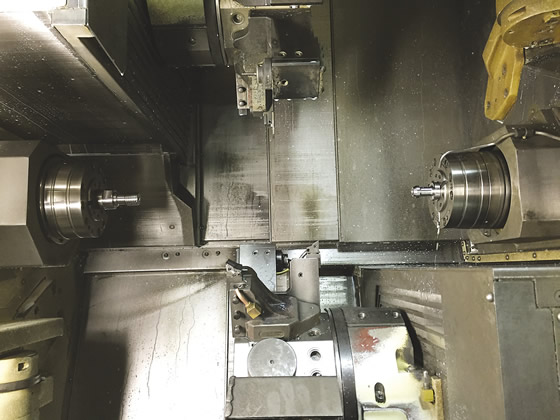
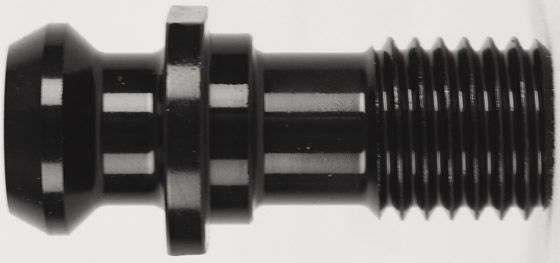
The manufacturing setup at JM Performance Products for a high-torque retention knob (below) involves two opposed Hainbuch chucks mounted in a Mazak turning center, such as this Hyper Quadrex dual-spindle unit. Images courtesy JM Performance Products.
Another issue was a 3:1 ratio on drawback when the diameter varied. “For every 0.001 ” we varied on the part diameter, we got a 0.003 ” change in length,” he said. The answer was found in collet chucks from Hainbuch America Corp., Germantown, Wis.
“What really impressed us with the Hainbuch chucks is their quick-change capability,” Fischer said. “Our changeover time literally went from 20 minutes to 30 seconds.” He added that it previously took up to 10 minutes to remove the soft jaws to clean the chuck and another 10 to put the jaws back in. With the Hainbuch collet chucks, it takes only 5 seconds each to pull a collet out and replace it, and clearing the fine chips takes a couple minutes.
“Our workholding is now a lot truer in every respect,” Rowley said. “Thanks to the hardened chuck jaws, we’ve reduced wear and runout and have gone from 0.001 ” to 0.0004 ” tolerances. Also, the Hainbuch collet design results in better gripping and the elimination of pushback.” He added that quick changeover is exceptionally important to JM in that most of its products require 12 operations, four to five of which are machining processes.
Of those machining operations, Fischer noted three—blanking the parts, a secondary operation for producing the heads, and hard turning the knobs—consume the majority of machining time and require use of the collet chucks.
Although Hainbuch offers serrated and rough-surface collet pads as an option, Hainbuch indicated JM Performance Products wouldn’t need them. “We tested it in a Mazak Hyper Quadrex machine with two spindle heads and that bar did not budge when we were running with regular, smooth-surface collet pads,” Fischer said.
Larry McMillan, Great Lakes area regional manager for Hainbuch America, said Hainbuch converted all but two of JM’s machines to the new chucks and plans to outfit those last two machines with a larger model in the near future. “What JM Performance Products wanted to do in terms of changeover and accuracy was precisely what these chucks were invented for.”
Fischer added that the workholders not only improve process accuracy but also extend tool life 40 to 50 percent, because holding the bar stock more firmly minimizes vibration detrimental to the carbide cutting edge. “If you get microfracturing on the edge, it’s just gone,” he said, adding that the company can run high-performance carbide tools at the recommended machining parameters to further improve productivity. “It’s a happy coincidence that the Hainbuch chucks that extend tool life through improved gripping in turning are used to manufacture retention knobs that extend tool life in machining.”
“The retention knob may not be the most glamorous piece of equipment in the shop, and, in many cases, it is overlooked,” Rowley said. “The retention knobs we sell, though, help our customers achieve better tolerances, extend tool life and improve overall performance. In machining, as in many other areas, success is in the details.”
Glossary terms in this article
Related




Subscribers can use MFGAxis notes, saves and discussion tools with their innoNET account.


