

Wave control: General Industry Coverage
Elastic and sound waves travel through or at the surface of a material or liquid without causing permanent changes to the substance's makeup. Examples include waves passing through water and shockwaves from an earthquake.
Elastic and sound waves travel through or at the surface of a material or liquid without causing permanent changes to the substance’s makeup. Examples include waves passing through water and shockwaves from an earthquake.
Controlling and manipulating elastic waves as they pass through or at the surface of certain materials may lead to numerous medical, military and commercial applications, but the methods to do that have proven elusive and difficult at the subwavelength scale, according to Guoliang Huang, associate professor of mechanical and aerospace engineering in the College of Engineering at the University of Missouri. Previously, scientists “bent” and controlled these waves using difficult-to-fabricate, multiphase-based metamaterials by combining materials, such as metal and rubber.
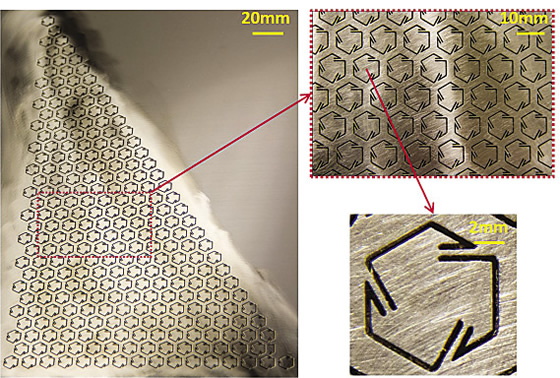
Researchers at the University of Missouri use a CO2 laser to engrave “chiral” pattern, such as these, in stainless steel and produce a metamaterial for controlling elastic and sound waves.
Now, UM researchers have reportedly developed a metamaterial to control subwavelength elastic waves. They use an Amada high-powered CO2 laser to engrave “chiral,” or geometric microstructure patterns, into a 1.5mm-thick (0.059 “) sheet of stainless steel. Huang noted other metals can be used, but the resonant frequency will be different.
Review the print ads from this magazine to continue
This quick advertiser review unlocks the rest of the article and keeps the full-screen reader focused on the ads instead of the page chrome.
Advertisers included in this article experience
Print placements connected to this article
Iscar
Intelligently large diameter drilling with unique insert clamping
Iscar promotes self-centering large-diameter drilling with a clamping mechanism designed for accuracy and longer tool life.
Intelligently large diameter drilling with unique insert clamping Iscar promotes self-centering large-diameter drilling with a clamping mechanism designed for accuracy and longer tool life. Visit iscarmetals.com to learn more.
Visit Iscar View this placement in the issue recordPrint ads from this magazine
Iscar promotes self-centering large-diameter drilling with a clamping mechanism designed for accuracy and longer tool life.
Intelligently large diameter drilling with unique insert clamping Iscar promotes self-centering large-diameter drilling with a clamping mechanism designed for accuracy and longer tool life. Visit iscarmetals.com to learn more.
Continue reading
March 2015
“Our team has developed a material that, if used in the manufacture of new devices, could have the ability to sense sound and elastic waves,” Huang stated in an article from the university. “By manipulating these waves to our advantage, we would have the ability to create materials that could greatly benefit society—from imaging to military enhancements, such as elastic cloaking.”
Although there is no projected time for commercialization, Huang added that the applications for the metamaterial to control elastic waves include energy harvesting, sensors that could achieve a super-resolution of about one-tenth of a wavelength and a “superlens” that could significantly advance imaging.
“In its current state, the metal is a passive material, meaning we need to introduce other elements that will help us control the elastic waves we send to it,” Huang stated. “We’re going to make this material much more active by integrating smart materials, like microchips, that are controllable. This will give us the ability to effectively ‘tune in’ to any elastic sound or elastic wave frequency and generate the responses we’d like.”
For more information about the University of Missouri’s Mechanical and Aerospace Engineering Department, call (573) 884-8610 or visit engineering.missouri.edu/mae. CTE
Glossary terms in this article
Related


Subscribers can use MFGAxis notes, saves and discussion tools with their innoNET account.


