

Creating visibility with the cloud
Most manufacturers have made great strides in optimizing operations. Many have even standardized multiple facilities with the same on-premise software to create consistency across the enterprise. However, no matter how many procedures are put in place, each plant has its own idiosyncrasies, making it nearly impossible for systems to communicate with each other.
Most manufacturers have made great strides in optimizing operations. Many have even standardized multiple facilities with the same on-premise software to create consistency across the enterprise. However, no matter how many procedures are put in place, each plant has its own idiosyncrasies, making it nearly impossible for systems to communicate with each other. This miscommunication means data cannot be aggregated or summarized across the enterprise, limiting visibility across operations.
Consider that an automotive component supplier might make front-axle half shafts in 20 different facilities. During the manufacturing process, operators must measure various part features to ensure the quality of each piece. If the measurements don’t meet specifications, operators make corrective actions or scrap the part, resulting in wasted time, material and money.
To better manage this process, management might want to know, for example, how much scrap has been generated from out-of-spec ID features across all 20 plants. This seems like a simple request, especially if every plant has standardized on the same software. Here’s the problem: Each plant likely has different naming conventions for the same feature. Plant A may use “inside diameter,” Plant B calls it “diameter – inner,” Plant C denotes it as “ID” and so on.
Something as seemingly simple as displaying waste created from out-of-spec IDs across the enterprise is actually quite difficult. This is because every on-premise deployment is different. In addition to different feature-naming conventions, product codes (although identical from one plant to the next) might be named differently. These differences make it challenging to aggregate data.
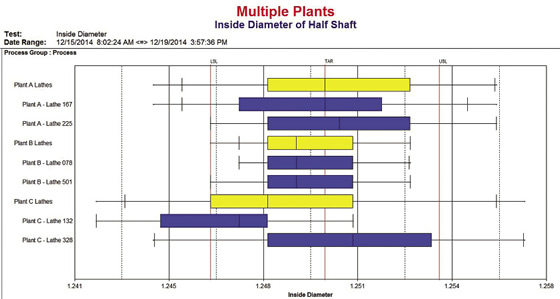
Consistent naming conventions create an environment in which analysis of data from multiple plants or sites becomes simple and meaningful.
Furthermore, if data is housed on-site at each plant, aggregated data must be compiled from 20 different databases and placed in a spreadsheet for management to analyze scrap results. Simply put, it’s a mess.
Review the print ads from this magazine to continue
This quick advertiser review unlocks the rest of the article and keeps the full-screen reader focused on the ads instead of the page chrome.
Advertisers included in this article experience
Print placements connected to this article
Iscar
Intelligently large diameter drilling with unique insert clamping
Iscar promotes self-centering large-diameter drilling with a clamping mechanism designed for accuracy and longer tool life.
Intelligently large diameter drilling with unique insert clamping Iscar promotes self-centering large-diameter drilling with a clamping mechanism designed for accuracy and longer tool life. Visit iscarmetals.com to learn more.
Visit Iscar View this placement in the issue recordPrint ads from this magazine
Iscar promotes self-centering large-diameter drilling with a clamping mechanism designed for accuracy and longer tool life.
Intelligently large diameter drilling with unique insert clamping Iscar promotes self-centering large-diameter drilling with a clamping mechanism designed for accuracy and longer tool life. Visit iscarmetals.com to learn more.
Continue reading
March 2015
Achieving visibility requires standardized naming conventions across an enterprise and centralized storage in a single database. For example, one company standardized on the InfinityQS ProFicient cloud-based manufacturing intelligence platform across more than 140 plants worldwide and now maintains all its critical quality data in one database in the cloud. With this configuration, the company’s management has visibility across the globe regarding their products’ critical characteristics.
With global visibility, the cloud allows organizations to obtain the manufacturing intelligence necessary to reduce costs and defects. But companies shouldn’t stop there. The next step is to evaluate suppliers and vendors for quality improvement opportunities. These third parties can be provided with access to a cloud-based software program, such as InfinityQS ProFicient on Demand, because there’s no application to install or software to purchase—all that’s needed is a browser, Internet connection and log-in credentials. As a result, the manufacturer has quality visibility throughout the supply chain.
But it’s not just about product quality. It’s also about quality at the retail or customer level. Returning to the half-shaft example, say a car is brought back to the dealership because the purchaser complained about the way it drives. At the dealership—whether in Detroit, Daytona or Dublin—the mechanic notices a faulty front half shaft. After he installs replacement parts, he can enter the reason for failure into the OEM quality system using a mobile device. The OEM can then determine which supplier manufactured the shaft and notify them of the issue. This defect information can also be combined with warranty claims and consumer complaints. Doing so allows companies to gather intelligence that helps the manufacturer’s engineering staff and quality personnel identify what issues are causing problems and how to correct them.
The cloud has created extraordinary business opportunities because it is convenient, low cost and easy to access. Data entry is as simple as opening an app on a smartphone. After entry, data can be aggregated and summarized, providing visibility into quality issues—and not just within a plant or across an enterprise. Instead, the cloud provides visibility throughout the entire supply chain, from raw materials to manufacturing to retail outlets.
Using cloud technologies, manufacturers can see what’s causing quality issues, providing insight into improvements needed to mitigate potential issues in the field and reduce the cost of quality. CTE

Related




Subscribers can use MFGAxis notes, saves and discussion tools with their innoNET account.


