

Preloading ball nuts: General Industry Coverage
Translating machine tool axes are often driven by screws attached to the rotor of a motor by a coupling, with the motor attached to the fixed frame of the machine. A nut is attached to the moving element, such as a table or carriage, and is fixed so it cannot rotate.
Translating machine tool axes are often driven by screws attached to the rotor of a motor by a coupling, with the motor attached to the fixed frame of the machine. A nut is attached to the moving element, such as a table or carriage, and is fixed so it cannot rotate. When the screw rotates, the nut and the attached moving element translate along the length of the screw.
In this configuration, the screw is called a lead screw. The screw has a large mechanical advantage, meaning its thrust capacity is high. In designs where more turns of the screw are required for a given linear translation, the mechanical advantage and load capacity are higher. Lead screws are stiff because the thrust load is carried on the large contact area between the threads.
Courtesy of All images: S. Smith
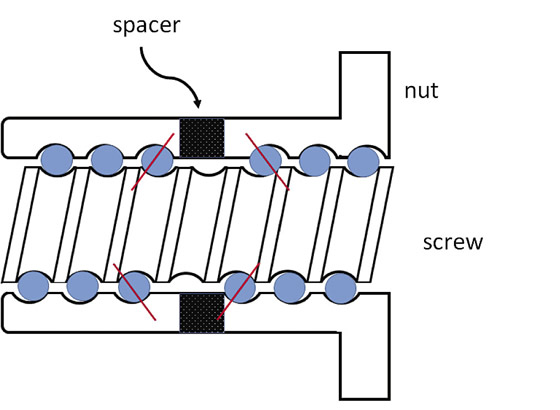
Figure 1. A split-nut, spacer-preloaded ball nut.
However, lead screws in this configuration have two significant limitations:
1. The motor has to overcome a significant amount of friction as the screw and nut slide against each other, and the friction generates heat. This heat, in turn, thermally deforms the screw and machine, reducing accuracy.
2. A clearance must exist between the screw threads and nut threads such that only one side contacts at a time. Typically, the position feedback is on the motor, not the translating slide. As a result, when the screw reverses direction, the slide remains stationary as the screw turns and makes contact with the other side of the nut thread. The controller thinks the slide moved, but the slide remained stationary. This is called backlash. A trade-off always exists between machine accuracy (and stiffness) and cost. Some controllers use backlash compensation, so whenever the axis reverses direction, additional motion is commanded to compensate for the measured backlash.
To reduce friction, balls are often introduced between the screw and nut. When the screw rotates, the balls roll, as in a ball bearing. The balls roll through the nut from one end to the other, then are collected into a tube that transports them back to the start of the nut. This configuration is called a recirculating ballscrew. The balls dramatically reduce friction and heat generation, but they also reduce stiffness. The balls act as springs, but they do not exhibit a linear relationship between force and deflection like coil springs do. Rather, because the contact exists only at small points on opposite sides of the balls, a small deflection only requires a small force. As the deflection increases, the force required to cause the deflection quickly increases, and stiffness goes up.
A preload, which would keep the balls in a compressed condition all the time would increase stiffness and eliminate backlash. So how can it be arranged? There are four basic ways: a split nut with a spacer, a split nut with a spring, a variable thread pitch and oversized balls.
Review the print ads from this magazine to continue
This quick advertiser review unlocks the rest of the article and keeps the full-screen reader focused on the ads instead of the page chrome.
Advertisers included in this article experience
Print placements connected to this article
Fax+1 817 258 3221, [email protected] www.iscarmetals.com
New Generation Strong Tangential Positive Insert
) With 4 Cutting Edges for General Milling on All Material Types Straight Chip Edge Splitter (CS) LNMT 08 LNMT 08-CS LNMT 13 LNMT 13-CS LNMT 16 LNMT 16-CS.
) New Generation Strong Tangential Positive Insert With 4 Cutting Edges for General Milling on All Material Types Straight Chip Edge Splitter (CS) LNMT 08 LNMT 08-CS LNMT 13 LNMT 13-CS LNMT 16 LNMT 16-CS ISCAR METALS INC. Tel + 1 817 258 3200, Tech Tel 1-877-BY-ISCAR, Fax+1 817 258 3221, [email protected] www.iscarmetals.com
Visit Fax+1 817 258 3221, [email protected] www.iscarmetals.com View this placement in the issue recordPrint ads from this magazine
) With 4 Cutting Edges for General Milling on All Material Types Straight Chip Edge Splitter (CS) LNMT 08 LNMT 08-CS LNMT 13 LNMT 13-CS LNMT 16 LNMT 16-CS.
) New Generation Strong Tangential Positive Insert With 4 Cutting Edges for General Milling on All Material Types Straight Chip Edge Splitter (CS) LNMT 08 LNMT 08-CS LNMT 13 LNMT 13-CS LNMT 16 LNMT 16-CS ISCAR METALS INC. Tel + 1 817 258 3200, Tech Tel 1-877-BY-ISCAR, Fax+1 817 258 3221, [email protected] www.iscarmetals.com
Continue reading
October 2014
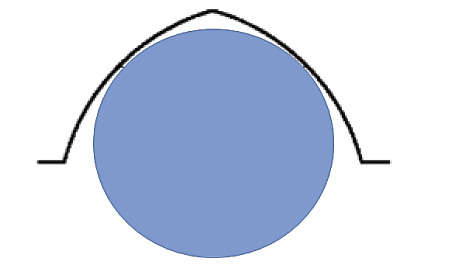
Figure 2. A ball makes contact with two points in a Gothic- arch thread.
Figure 1 shows a cross-section of a split nut with a spacer mounted on the screw. The left and right portions of the nut are separated by a spacer, whose dimension is carefully chosen and controlled to preload the balls on the left of the figure toward the left and preload the balls on the right of the figure toward the right. The red lines in the figure indicate the lines along which the balls are compressed.
This design is inexpensive and robust. However, if the screw does not have a perfect pitch and the balls are not the exact same size, the preload changes and the stiffness of the ballscrew changes as it rotates. Even small errors in the geometry can cause large changes in the stiffness. One way to fix this problem is to replace the spacer with a stiff linear spring (split nut with a spring). The spring keeps the balls compressed with a constant preload, even if there are small errors in the geometry. This design keeps the ballscrew stiffness more constant, but it is more expensive.
Variable thread pitch means the spacing of the threads on the screw and nut are not quite the same. If the difference is too great, the screw could not rotate in the nut. However, if the difference is small, the change in pitch preloads the balls in opposite directions over the length of the nut. This design can be compact, but it is difficult to fabricate, and some balls are preloaded more than others.
When oversized balls are used, they are slightly larger than the gap between the screw and nut. In addition, the threads of the screw and nut are not circular in profile, but are created in the form of a Gothic arch. This means the sides are parts of circles, but the circles have different centers. As a result, an oversize ball makes contact with the thread in two places on the nut and two places on the screw (Figure 2). This design is compact and stiff, but generates higher friction and has shorter life than the others.
The choice of preload mechanism in a modern ballscrew is a compromise that balances friction, heat generation, stiffness, backlash, load capacity and bearing life. CTE
About the Author: Dr. Scott Smith is a professor and chair of the Department of Mechanical Engineering at the William States Lee College of Engineering, University of North Carolina at Charlotte, specializing in machine tool structural dynamics. Contact him via e-mail at kssmith@uncc.edu.
Related


Subscribers can use MFGAxis notes, saves and discussion tools with their innoNET account.


