

Connecting the dots: General Industry Coverage
A system to share real-time data between a lathe's CNC and bar feeder.
Without precise comparative data, the concept of interchangeable parts, as advanced by cotton gin inventor Eli Whitney in the early 1800s, could not have changed the face of manufacturing. Today, collecting, analyzing and applying data to improve productivity and achieve tighter tolerances is central to virtually any manufacturing process.
Taking this concept one step further is the enabling of CNC machine tools and peripherals to share part production data to improve productivity and minimize material waste. For example, the products LNS America Inc. produces, including bar feeders, chip and coolant management systems, vacuum unloaders, workholders and air filtration systems, enable CNC machines to operate more efficiently, according to Randy Lewis, the company’s control manager. “Several years ago we recognized that by making it possible for our various products to communicate with the CNC machine tools they work with, we could improve the customer’s productivity,” he said. “That’s why we developed e-Connect, which is a database and data transfer system.”
Courtesy of LNS America
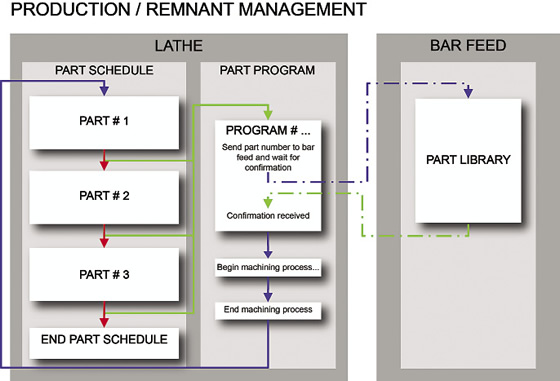
The production/remnant management flow for the e-Connect system from LNS America.
Lewis added that the system can share real-time data between a lathe’s CNC and an LNS bar feeder while using the LNS parts library function. The library can store 500 part programs, each of which has a unique identification number. Through e-Connect, the bar feeder automatically detects the program the lathe is running and loads the correct setup data for that part from the library to changeover—on the fly—without operator intervention, thereby eliminating downtime. This enables running a large family of parts or even a group of unrelated parts with little or no operator involvement after the initial setup.
Review the print ads from this magazine to continue
This quick advertiser review unlocks the rest of the article and keeps the full-screen reader focused on the ads instead of the page chrome.
Advertisers included in this article experience
Print placements connected to this article
toolingu.Com/weCanhelp
Your shop’s most
complex equipment needs training. We can help. For more inFormation. Visit us at IMTS Booth # W-1392 MACHINISTS | ASSEMBLERS | INSPECTORS | WELDERS | MAINTENANCE | ENGINEERS.
Your shop’s most complex equipment needs training. We can help. Call 866.706.8665 or visit toolingu.Com/weCanhelp For more inFormation. Visit us at IMTS Booth # W-1392 MACHINISTS | ASSEMBLERS | INSPECTORS | WELDERS | MAINTENANCE | ENGINEERS
Visit toolingu.Com/weCanhelp View this placement in the issue record1-800-storloc www.storloc.com
the best tool cabinet
you’ll ever buy guaranteed for 55 years 100% made in the usa in every way! Made by aMerican Visit us at IMTS Booth # W-1492.
the best tool cabinet you’ll ever buy guaranteed for 55 years 100% made in the usa in every way! Made by aMerican 1-800-786-7562 craftsMen in the Usa 1-800-storloc www.storloc.com Visit us at IMTS Booth # W-1492
Visit 1-800-storloc www.storloc.com View this placement in the issue recordPrint ads from this magazine
complex equipment needs training. We can help. For more inFormation. Visit us at IMTS Booth # W-1392 MACHINISTS | ASSEMBLERS | INSPECTORS | WELDERS | MAINTENANCE | ENGINEERS.
Your shop’s most complex equipment needs training. We can help. Call 866.706.8665 or visit toolingu.Com/weCanhelp For more inFormation. Visit us at IMTS Booth # W-1392 MACHINISTS | ASSEMBLERS | INSPECTORS | WELDERS | MAINTENANCE | ENGINEERS
Continue reading
August 2014
The system can also reduce material costs through its data transfer function, which enables the bar feeder to continuously tell the lathe how much bar stock is available for machining, Lewis explained. After each part is machined, a CNC lathe’s production-scheduling program checks the remaining parts to be produced and determines if there is adequate bar stock to machine the next scheduled part. If not, the system scans the production list for another part that could be made from the remaining material. Users can even set priorities for each part in the schedule, in which case the system identifies the highest-priority part that can be machined from the remaining stock.
The production-scheduling program then loads the appropriate part program in the lathe. The bar feeder recognizes the new program, recalls the associated part data from the parts library and automatically changes to the new configurations, Lewis added. If the new part requires a change in bar stock diameter or profile, e-Connect can send an e-mail to a remote computer or mobile device, altering the operator that a mechanical adjustment is needed.
If the system determines there is no part in the schedule that can be made from the remaining stock, the remnant is ejected, the system confirms the next part to be made, makes any necessary adjustments and the next bar loads into the bar feeder.
Article by LNS America Inc., Cincinnati. For more information, call (513) 388-5017 or visit www.lns-america.com. CTE
About the Author: Alan Richter is editor of CTE. Contact him at (847) 714-0175 or alanr@jwr.com.
Glossary terms in this article
Related




Subscribers can use MFGAxis notes, saves and discussion tools with their innoNET account.


