

Sharp attack: How needles and other medical sharps are ground
Spend enough time working in a machine shop and you're bound to pay a visit to the emergency room for a cut finger. First comes the sting as the ER physician injects you with a local anesthetic, then the tug of the thread as she drags the suturing needle, a type of surgical needle, through your skin.
Spend enough time working in a machine shop and you’re bound to pay a visit to the emergency room for a cut finger. First comes the sting as the ER physician injects you with a local anesthetic, then the tug of the thread as she drags the suturing needle, a type of surgical needle, through your skin.
This traumatic experience is painful enough, but without the sharp edge imparted to those needles through special machines known as needle-point grinders, those sutures would feel as if the doc were using a darning needle from grandma’s sewing kit.
Rapid-Fire Production
The world is filled with accident-prone machinists—and klutzes of all sorts—making medical needles high-volume products. Despite their supersharp edges, taper-point surgical needles, lancet-tip hypodermics and other medical sharps are often cranked out at the rate of five to 10 per second, according to Herbert Selbach, president of Wilmington, N.C.-based Selbach Machinery LLC.
Selbach, which has designed and built grinding machines for more than 2 decades, offers several machines that produce surgical needles via the cylindrical grinding process. The company also operates a job shop that makes specialty tungsten electrosurgical needles that are as small as 0.002 ” (0.051mm) in diameter.
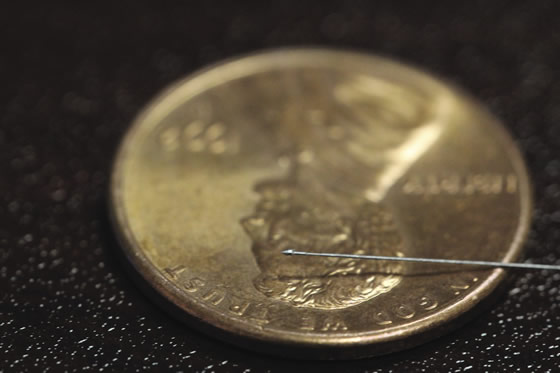
Courtesy of Modern Grinding
A tip ground on the end of a surgical guide wire. The head of the conical shape is 0.010 ” in diameter.
The raw wire used for surgical needles—typically a precipitation-hardening stainless steel—is fed from coil stock, straightened and cut to length before being dropped into a magazine, which in turn feeds the needle blanks into a half-moon-shaped saddle, where they are ground to shape. Next, depending on how the needles will be used, they may go to a bending operation and, finally, to heat treatment and polishing.
Hypodermic needles are made in much the same manner, except the grinding wheel arrangement is similar to that of a surface grinder rather than a cylindrical grinder. Both types of needles are made with a variety of points, all of which are designed to puncture skin with minimal pain.
Selbach explained that the company generally applies a 4 “-dia. (101.6mm) CBN or diamond wheel without coolant to remove a minimal amount of material.
Needles are just a few of the ground instruments that surgeons and other doctors rely on every day. They also use trocars and cannulas, guide wires and scalpels, tweezers and bone cutters. Modern medicine would be in the dark ages without microgrinding.
Jim Boldig, product engineer for Modern Grinding Inc., a medical guide wire, pin and needle manufacturer in Port Washington, Wis., said the company routinely grinds solid wire and hypotube—the tube stock used to make hypodermic needles—down to 0.006 ” (0.152mm) in diameter and to tolerances of ±0.0002 ” (±0.005mm).
The needles’ smallness is one of the big challenges of manufacturing them, Boldig explained. “Most [parts] have to be viewed under a microscope during manufacturing, sometimes to 200× magnification. Proper handling is critical—bending, pulling or even the wrong packaging can cause permanent damage.”
Nobody wants a crooked guide wire snaked into their body, so it’s Boldig’s job to ensure that Modern’s parts are made to print. “Microground parts need very careful processing, often with a trial-and-error approach,” he said. “Sometimes we don’t know how well something will work until we try it, and we keep trying till we get it right.”
Although it also specializes in centerless grinding, the majority of Modern’s work is OD grinding microthreads and complex, often lifesaving, devices. Break your leg in a car accident, for example, and the surgeon might use a trocar to open the damaged area and some Steinmann bone pins to patch you up, both of which require OD microgrinding to generate their Lilliputian profiles.
Another Common Process
As previously noted, centerless grinding is another process commonly used for medical microparts. These machines crank out ground bar stock small enough for paperclips and are great for generating the simple, sharpened-pencil-like tapers found on the ends of guide wires used for catheter and stent placement. “We typically dress the necessary taper directly onto the grinding wheel,” Boldig said. “This helps keep the shape stable over a longer period of time.”
Stability during grinding is becoming more of a challenge as medical device designers increasingly specify products made from Nitinol and titanium because of the materials’ flexibility and strength. Boldig said their abrasiveness causes the work wheel (the roller that drives the workpiece in a centerless grinder) to wear fairly quickly, requiring frequent wheel changes and downtime.
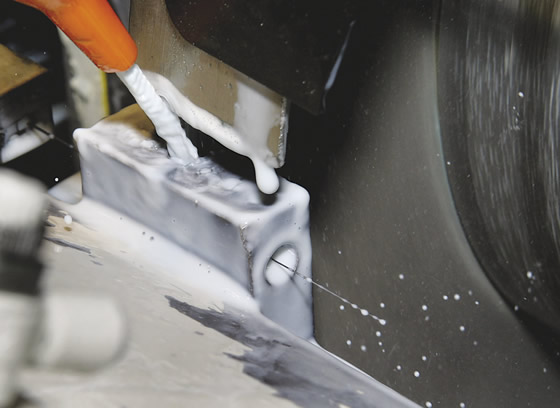
Courtesy of M&S Centerless Grinding
M&S Centerless uses a hybrid Swiss-style grinding process.
Likewise, cutting conditions such as wheel speed, infeed rate and traverse rate must be closely monitored. “A wrong [input] will cause faster wheel wear or a painfully slow process,” Boldig said. “It’s always a tradeoff between the two, and the trick is finding the sweet spot.”
Someone who knows how to find that sweet spot is John Shegda, president of M&S Centerless Grinding Inc., Hatboro, Pa. The company centerless-grinds everything from valve spools and core pins to injector needles and motor shafts.
A unique process at M&S is Swiss-style grinding on a hybrid machine that situates a grinding wheel directly in front of a guide bushing and collet mechanism. “The collet grips the wire and feeds it through the guide bushing,” Shegda explained. “The grinding wheel basically acts as a turning tool, allowing you to interpolate a variety of forms.”
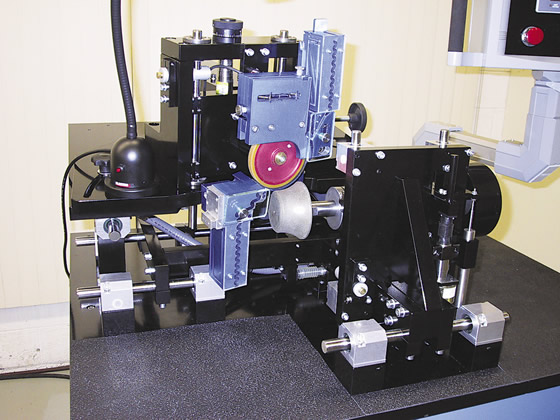
Courtesy of Selbach Machinery
Selbach Machinery’s NG3E machine grinds needles for sutures, tattooing, textiles and other applications, using solid wire already cut to length.
Like Swiss-style turning, this process can produce round parts to ±0.00005 ” (1.27µm) tolerances, as well as generate flats and complex profiles. It can also feed spool stock and bar material.
“We’re running a job with 5,000 meters of 0.018 ” Nitinol wire for angioplasty parts,” Shegda said. “The loader mechanism cuts the stock to the proper length and feeds it into the collet, then the machine grinds some crazy shapes on the end.”
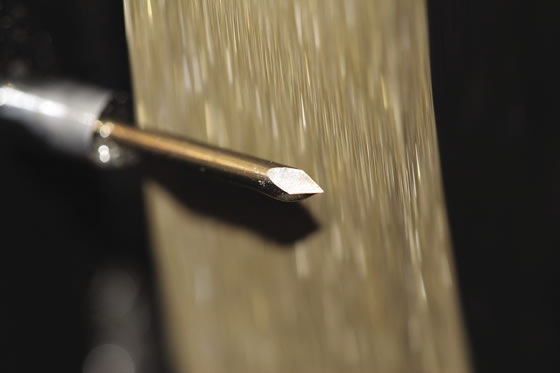
Courtesy of Modern Grinding
In-process grinding of a trocar, used in laparoscopic surgery.
Review the print ads from this magazine to continue
This quick advertiser review unlocks the rest of the article and keeps the full-screen reader focused on the ads instead of the page chrome.
Advertisers included in this article experience
Print placements connected to this article
Iscarmetals
MAX AR
) B Ultimate Insert Clamping Guarantees Supreme Tool Life Jet Pressure with Free Unobstructed Unique Chipbreakers Chip Flow for Ultimate for Ultimate Insert Life Blade Life Parting and Parting and Parting and Parting and Parting and Parting and Parting and Grooving Grooving for Grooving for Grooving for Grooving for Grooving for Grooving for for Cr-Ni Alloys.
) MAX AR B Ultimate Insert Clamping Guarantees Supreme Tool Life Jet Pressure with Free Unobstructed Unique Chipbreakers Chip Flow for Ultimate for Ultimate Insert Life Blade Life Parting and Parting and Parting and Parting and Parting and Parting and Parting and Grooving Grooving for Grooving for Grooving for Grooving for Grooving for Grooving for for Cr-Ni Alloys, Hard Materials Hard Materials Hard Materials Soft Materials Soft Materials Stainless Steel Ductile Materials and
Visit Iscarmetals View this placement in the issue recordPrint ads from this magazine
) B Ultimate Insert Clamping Guarantees Supreme Tool Life Jet Pressure with Free Unobstructed Unique Chipbreakers Chip Flow for Ultimate for Ultimate Insert Life Blade Life Parting and Parting and Parting and Parting and Parting and Parting and Parting and Grooving Grooving for Grooving for Grooving for Grooving for Grooving for Grooving for for Cr-Ni Alloys.
) MAX AR B Ultimate Insert Clamping Guarantees Supreme Tool Life Jet Pressure with Free Unobstructed Unique Chipbreakers Chip Flow for Ultimate for Ultimate Insert Life Blade Life Parting and Parting and Parting and Parting and Parting and Parting and Parting and Grooving Grooving for Grooving for Grooving for Grooving for Grooving for Grooving for for Cr-Ni Alloys, Hard Materials Hard Materials Hard Materials Soft Materials Soft Materials Stainless Steel Ductile Materials and
Continue reading
July 2014
Shegda said the shop has made some “pretty crazy stuff” on these machines, such as a dumbbell-shaped locking pin for a heart valve that measured 0.005 “(0.127mm) in diameter and 0.056 “(1.422mm) long. Another odd application was a 1/8 “-long (3.18mm)cam pin used in pacemakers, with two camshaft journals ground to 0.007 ” (0.178mm)in diameter but offset 0.0028 ” (0.0711mm) from one another. A Nitinol guide wire the size of a human hair was nearly 7 ‘ (2.1m) long, the last 8 ” (203mm) of which was necked down to 0.002 ” (0.051mm) in diameter.
As a rule, grinding is close-tolerance and demanding work, but it’s these kinds of parts that separate the everyday grinding boys from the “micro” men.
The medical industry isn’t the only one calling for ground microparts. Semiconductor probes, gas turbine and fuel-metering components, spools and bearings are only a small sample of the parts that would be impossible to manufacture without microgrinding.
One shop servicing these nonmedical industries is Tessa Precision Products Inc., Painesville, Ohio. Manufacturing Engineer Mark Kawasaki described another microgrinding method: electrochemical grinding. “It’s essentially an electrified surface grinder,” he said.
In electrochemical grinding (ECG), a copper-core grinding wheel made with a binder capable of conducting a current is mounted on a spindle. The wheel is dressed to whatever shape is needed and the machine is filled with a saltwater electrolyte. A current is then passed through the wheel and the sparks fly.
The result is a process that, given the right application, removes material 30 to 40 percent faster than traditional grinding, milling or EDMing, according to Kawasaki. Better yet, burrs are minimal and there’s no heat-affected zone as is the case with abrasive grinding and EDMing.
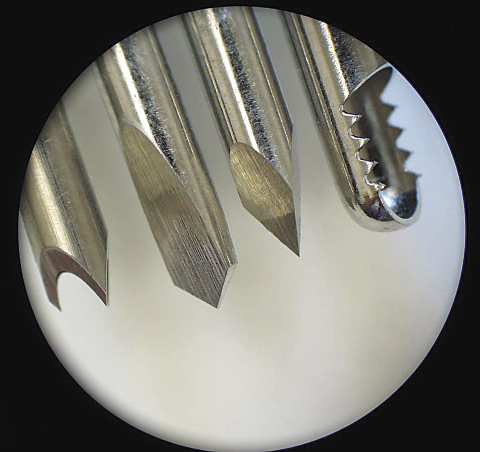
Courtesy of Everite
Parts produced via ECG.
Tessa has found just the right application: grinding a series of 0.017 “- to 0.040 “-wide (0.432mm to 1.016mm)slots out of Inconel for fuel-valve bodies on gas-turbine engines. “Each slot is done in a single pass,” Kawasaki said. “Depending on the part, it might take a minute or so to grind a slot, and we can do at least 100 parts before dressing the wheel. It’s awesome.”
The company responsible for that “awesome” machine is Everite Machine Products Co., Pennsauken, N.J. Everite builds a number of ECG machines used widely in the aerospace and power-generation industries, largely because of ECG’s ability to make burr-free cuts in virtually any electrically conductive material.
“Compared to ECG, abrasive grinding is rather slow,” said Bill Clipsham, ECG global business development manager for Everite. “With abrasive grinding, you have to take relatively light depths of cut—often no more than a few thousandths of an inch—or risk fracturing the material due to heat. You may also experience so much wheel wear that you can’t control size. And burrs can be a big problem with abrasive grinding.”
ECG sounds like the best thing since sliced bread. If it is capable of fast, burr-free grinding in everything from honeycomb-like materials used in gas turbines and aircraft engine components to tiny aspiration vents in cardiopulmonary cannulas, why hasn’t it replaced conventional grinding?
One drawback to ECG is overcut. “Abrasive grinding is much more accurate,” Clipsham said. “With proper wheel dressing, tolerances to 0.000050 ” or better are possible with abrasive grinding. With ECG, you’re dealing with an electrochemical reaction in the boundary layer between the negatively charged wheel and positively charged workpiece.”
Because of this reaction, achieving exact feature size can be somewhat unpredictable. On a 0.100 “-wide (2.54mm)slot, for example, the width might come out to 0.101 ” (0.256mm). This also means longer setup times, because the operator must tweak cutting parameters, wheel size, electrolyte and voltage until the part is within tolerance. Once there, however, the process is very repeatable, Clipsham said.
Variation on Centerless
Tru Tech Systems Inc., Mt. Clemens, Mich., is another machine tool builder serving the microgrinding industry. To support its own grinding needs—Tru Tech is also a job shop—as well as those of its machinery customers, the company has developed a workholding process called Perimetric grinding.
“It’s similar to centerless grinding,” said Steve Smarsh, Tru Tech president. “We use a work blade, regulating roller and a grinding wheel, of course, but we’ve also added a pressure roller, strategically placed to support the workpiece.”
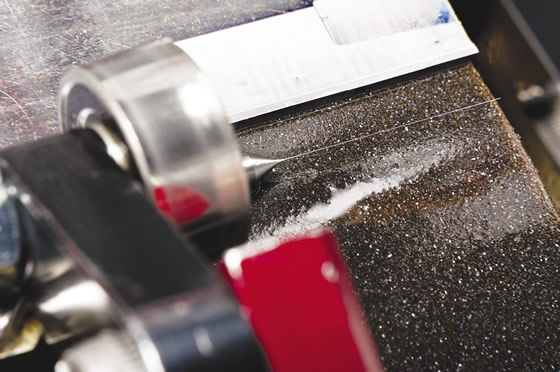
Courtesy of Sheldon Buchler, Tru Tech Systems
A tension roller holds a 3mm shank against the guide blade and regulating roller, holding the part for Perimetric grinding.
Smarsh claimed Perimetric grinding is the most accurate way to hold a workpiece. “We can hold tolerances down into the millionths with virtually none of the triangulation seen with conventional centerless grinding machines,” he said.
He’d be happy to sell you a new machine—an autoloader version capable of both centerless and OD grinding goes for around $219,000—but you can also buy a Perimetric grinding attachment to use on your existing equipment for $9,000. CTE
About the Author: Kip Hanson is a contributing editor to CTE. Telephone: (520) 548-7328. E-Mail: khanson@jwr.com
Contributors
Everite Machine Products Co.
(856) 330-6700
www.everite.com
M&S Centerless Grinding Inc.
(888) 779-2061
www.msgrinding.com
Modern Grinding Inc.
(262) 719-9388
www.moderngrinding.com
Selbach Machinery LLC
(910) 794-9350
www.usneedle.com
Tessa Precision Products Inc.
(440) 392-3470
www.tessaprecision.com
Tru Tech Systems Inc.
(877) 878-8324
www.trutechsystems.com
Glossary terms in this article
Related


 MFGAxis Discussion
Be part of the shop-floor conversation
Like, save, or comment on this CTE story.
MFGAxis Discussion
Be part of the shop-floor conversation
Like, save, or comment on this CTE story.


MFGAxis Discussion