


No room for error: General Industry Coverage
Tap 100 2"-8 blind-holes without breaking the tap or scrapping a part. A tap engineered to effectively produce threads in holes more than ½" in diameter.
END USER: D&N Machining Co., (479) 996-2738, www.dnmachining.com.
CHALLENGE: Tap 100 2″-8 blind-holes without breaking the tap or scrapping a part.
SOLUTION: A tap engineered to effectively produce threads in holes more than ½” in diameter.
SOLUTION PROVIDER: OSG Tap & Die Inc., (800) 837-2223, www.osgtool.com.
A single mistake when tapping large, complex, expensive parts for the energy industry can make a job shop go dark. Finding a tap that can execute the job accurately, efficiently and affordably when threading a difficult-to-tap workpiece only adds to the challenge.
D&N Machining Co., Greenwood, Ark., faced this situation when machining two outer piston ring housings for a customer in the oil field industry. The housings are 4140 steel forgings that weigh up to 5,000 lbs. each, have a hardness of 32 HRC and feature a 30″ bolt circle and 32″ major OD. They required D&N to tap 50 2″-8 blind-holes 3½ ” deep in each housing—100 holes total.
To ensure it had a tap for the job, D&N purchased the one tap the shop could find in stock from a toolmaker. “Purchasing the tap was basically done out of necessity,” said Matt Hankins, owner of D&N.
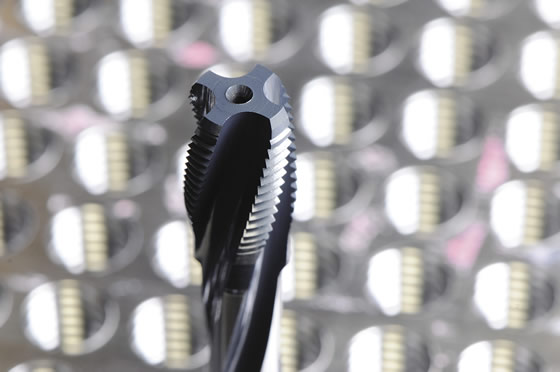
Courtesy of OSG Tap & Die
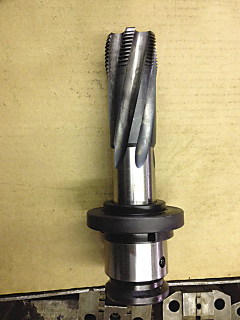
The HY-PRO HXL tap from OSG is for threading difficult-to-cut alloy steels, such as 4140 and 4130. Below: An HY-PRO HXL tap shows little wear after tapping 100 holes in 4140 at D&N Machining.
However, the toolmaker recommended tapping at 10 sfm, which seemed too slow and could possibly cause the tap to break during the cutting-force-intensive threading operation, according to Hankins. Because of the part size, he thought it would be problematic to locate an EDM large enough to remove a broken tap. Also, with multiple machining hours already invested in each expensive workpiece, scrap wasn’t an option. There was no room for error.
When the shop had nearly completed the job but had not yet tapped the holes, Ron Portwine, district manager for OSG Tap & Die Inc., Glendale Heights, Ill., visited D&N. Portwine evaluated the application and informed Hankins that OSG had the needed-size tap. Not only was OSG’s HY-PRO HXL HSS tap suitable for the job, but the toolmaker had 12 of the taps in stock and, at about $1,200 each, was 40 percent less than the competitor’s tool.
In addition, Portwine recommended running the tap at 25 sfm (48 rpm at 6 ipm) and even contacted his colleague Mike Brzezniak to confirm his recommendations based on the application details and Brzezniak’s success with the tap being applied by part manufacturers in the Houston energy market.
D&N purchased two of the taps from OSG and ran them the next day on the shop’s Haas HS-4R horizontal CNC mill, using flood coolant. The parts were held in a fixture D&N produced in-house that has large V blocks with hydraulic chains as the clamps, Hankins noted.
The tap ran in a tension-compression toolholder at the recommended speed and successfully threaded the 100 holes. The machine operator noted the tap provided effective chip control, generating straw-colored chips predominantly shaped like sixes and nines.
After the job, the tap still looked new, according to Hankins, who plans to use it for other applications and possibly for repeats of the initial job. “This was the first run on the part and our customer will dictate the return of the job,” he said.
As for the other tap, D&N promptly returned it.
Glossary terms in this article
Related


Subscribers can use MFGAxis notes, saves and discussion tools with their innoNET account.