

Shop tools that are ‘oldies but goodies’
Christopher Tate, Cutting Tool Engineering's Shop Technology columnist, said he is surprised by the number of engineers and machinists who are not familiar with traditional machining tools and techniques. Many metalworking professionals seem to default to using only sophisticated technology for all aspects of machining without understanding or being able to use more traditional options.
I am surprised by the number of engineers and machinists who are not familiar with traditional machining tools and techniques. Many metalworking professionals seem to default to using only sophisticated technology for all aspects of machining without understanding or being able to use more traditional options. This habit includes using coordinate measuring machines to measure parts that can be measured with hand tools, replacing edge finders and indicators with machine tool probes and relying on CAM and conversational programming instead of manually calculating the coordinates of holes in a bolt circle.
Before becoming a manufacturing engineer, I ran a family-owned machine shop. My first machining experiences were on lathes built in the 1940s and knee mills from the 1960s—none of which had digital readouts, power feeds or any of the other now common time-saving accessories. I learned “old school” machining by running manual machines for several years before being introduced to CNC equipment. The skills I learned on those manual machines have been more beneficial than any other training or education I have received, and I exploit every opportunity to practice them.
Courtesy of All images: C. Tate
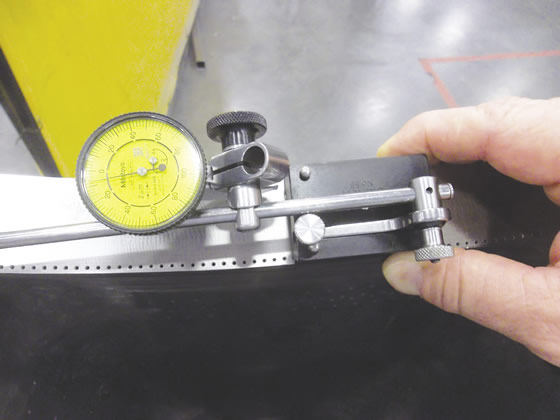
The author uses this surface gage—one of his favorite tools—to inspect a machined face for flatness.
When I’m at work, I keep my dark-walnut Gerstner toolbox by my desk so my tools are readily available. Why? Because those simple tools are invaluable. Every machinist and manufacturing engineer should have a few common tools at every job. The following are some of them.
Machinery’s Handbook from Industrial Press Inc. is so important that many toolbox manufacturers include a drawer specifically designed to house it. The master toolmaker I learned from told me to buy it before anything else. I have three of the 29 editions and the oldest one has pages marked for quick reference. I can find information faster in this book than I can find it online.
The second tool the master toolmaker told me to buy is a surface gage. I don’t often see surface gages in “young guy” toolboxes, which is unfortunate. In the world of CNC and CMM, many machinists and toolmakers no longer perform proper layout, which is the primary function of a surface gage. However, like test indicators, they have limitless uses. I have used them to prove the flatness of machined surfaces and paired one with an indicator to measure part height on a surface grinder chuck. You can hold the V-groove against a shaft and verify concentricity to a bearing race, and, by resting the pins against the edge of a mill table, you can align long parts or vise jaws without having to crank the mill handles. It is also possible to check the alignment of machine ways with a surface gage and an indicator.
A battery-powered calculator (solar ones don’t always work well under shop light) is also indispensable for machining. I have a $15 scientific calculator to access trigonometry functions. One without those functions works, but you will have to open the Machinery’s Handbook to find, for example, the sine of 29° and 15 minutes.
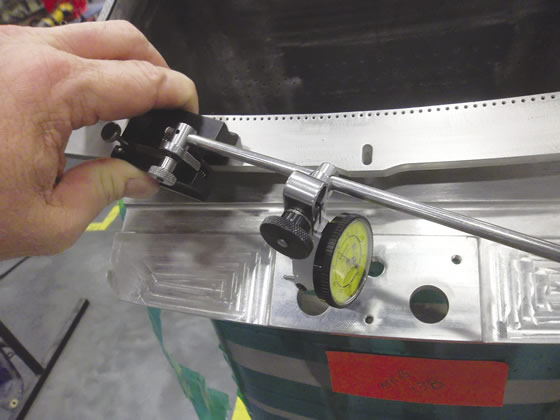
The same surface gage is also suitable for inspecting the parallelism of two machined faces.
Review the print ads from this magazine to continue
This quick advertiser review unlocks the rest of the article and keeps the full-screen reader focused on the ads instead of the page chrome.
Advertisers included in this article experience
Print placements connected to this article
Dmgmori USA
CTX gamma 2000 TC
We’ve got a vision for your part, and it’s something you never imagined. With superior technology, progressive techniques and a little creative problem solving, you can have the speed, accuracy and efficiency to make the competition sweat. It’s possible with the widest breadth and depth of machine technology in the world
CTX gamma 2000 TC We’ve got a vision for your part, and it’s something you never imagined. With superior technology, progressive techniques and a little creative problem solving, you can have the speed, accuracy and efficiency to make the competition sweat. It’s possible with the widest breadth and depth of machine technology in the world. www.dmgmori-usa.com | 855-364-6674
Visit Dmgmori USA View this placement in the issue recordPrint ads from this magazine
We’ve got a vision for your part, and it’s something you never imagined. With superior technology, progressive techniques and a little creative problem solving, you can have the speed, accuracy and efficiency to make the competition sweat. It’s possible with the widest breadth and depth of machine technology in the world
CTX gamma 2000 TC We’ve got a vision for your part, and it’s something you never imagined. With superior technology, progressive techniques and a little creative problem solving, you can have the speed, accuracy and efficiency to make the competition sweat. It’s possible with the widest breadth and depth of machine technology in the world. www.dmgmori-usa.com | 855-364-6674
Continue reading
December 2013
In addition, I always have an edge finder. I prefer the single-ended model with a 0.200 ” diameter because I can put it in more places than the double-ended version. Of course, the tool’s typical function is to find the corner or edge of a part, but it can also find the center of a hole, usually to within 0.001 “. I have also used them, along with DROs, to measure parts on knee mills. They are rugged and never need batteries.
I also recommend a test indicator, which measures small changes in distance, with accessories for attaching to height gages, machine tools and magnetic bases. I have collected several over the years, but I prefer the one that has 0.030 ” of travel and is graduated in thousandths of an inch.
The test indicator should have a medium-sized magnetic base with solid rods. A magnetic base makes the possible uses of a test indicator almost limitless. I prefer not to have fine adjustment on the base, because the fragile nature of the fine-adjustment feature is subject to error from the indicator’s weight when held upside down. Compared to ones with solid rods, newer magnetic bases with flexible necks don’t seem to hold up over time and have moving parts that can disappear.
A matched set of one-two-three blocks (or several sets if you can afford them) is invaluable as well. A one-two-three block has dimensions measuring 1 “, 2 ” and 3 ” long, respectively. Typically, most people use the blocks as parallels on a mill or granite plate—the intended purpose—but they can be combined with a magnetic base and test indicator to make an impromptu surface gage. And by wrapping a piece of Emory paper around one, you have a lapping tool to help restore surface flatness. You can make your own one-two-three blocks and, by drilling holes to match the major diameter of different taps, create a tapping block that helps get a hand tap started straight.
Medium-sized, matched V-blocks are always useful and well worth the money. They are jigs typically used to hold round workpieces for measurement or machining. One of my favorite uses is to put one against a stationary jaw, with the V-groove facing the moving jaw and the side of the V-block on the bottom of the vise. This arrangement forces the shaft parallel and square to the mill spindle, and can be done so the shaft is held horizontally or vertically.
Several other tools, such as micrometers, calipers, scales and squares, are important as well, although they don’t have the same versatility as the previously mentioned tools. Those simple—albeit expensive—tools will always have machining applications. I suspect most “old shop guys” have them and use them regularly.
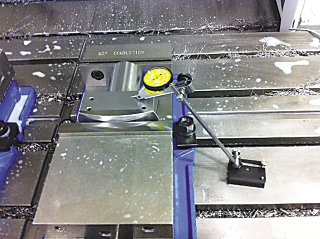
Demonstrating the tool’s versatility, a surface gage can also check the alignment of a part relative to the machine table.
I fully embrace the technology found in the modern metalworking facility and employ it every day. However, there is a growing population of machinists and engineers who struggle with problems that cannot be solved immediately with newer technology. I see problems with CMM measurements and machine setups that can be easily and quickly solved with these “old tools,” but the people who understand how to use them are becoming increasingly rare. Please e-mail me your novel “tips and tricks” for using simple tools. I’d love to include them in a column. CTE
About the Author: Christopher Tate is senior advanced manufacturing manager for Milwaukee Electric Tool Corp., Brookfield, Wis. He is based at the company’s manufacturing plant in Jackson, Miss. Tate has 19 years of experience in the metalworking industry and holds a Master of Science and Bachelor of Science from Mississippi State University. E-mail: chris23state@gmail.com.
Glossary terms in this article
Related




Subscribers can use MFGAxis notes, saves and discussion tools with their innoNET account.


