


Shop has need for speed
Achieve a 24-hour-maximum turnaround time on aluminum prototypes for tablet computers. Endmills designed for maximum metal-removal rate when cutting aluminum.
END USER: Griffin Technology Inc., (800) 208-5996, www.griffintechnology.com.
CHALLENGE: Achieve a 24-hour-maximum turnaround time on aluminum prototypes for tablet computers.
SOLUTION: Endmills designed for maximum metal-removal rate when cutting aluminum.
SOLUTION PROVIDER: OSG Tap & Die Inc., (800) 837-2223, www.osgtool.com.
The digital age has greatly affected the way people conduct personal and commercial business. Founded by Paul Griffin in 1992, Griffin Technology Inc., Nashville, Tenn., understands this digital revolution and creates accessories for smartphones and tablets.
With new technologies being developed daily, Griffin Technology’s R&D department needs to react quickly. Rick Fielder, prototype department manager, said the company’s claim to fame is 24-hour-maximum turnaround time on CNC machined components. When operating at its best, Fielder’s team receives a CAD file, writes a NC program, machines a mold and has a finished plastic or rubber prototype in hand within 8 hours. The prototypes include stands, brackets, housings and cases.
To achieve its turnaround objective, Griffin Technology relies on cutting tools from OSG Tap & Die Inc., Glendale Heights, Ill. For example, OSG’s Exocarb-Aero Blizzard endmill series, which the toolmaker designed for high-speed machining of aluminum, is the mainstay for machining the company’s 6061 aluminum prototype for an iPad wall mount.
Fielder sticks with OSG tools, using ones from 1⁄8 ” to 1 ” in diameter, and has been applying them for some time. “A high material-removal rate is the main thing I am after,” he said. “The Blizzard endmills provide this because of the relief angles they have on the cutting edge. And the material the tools are made from prevents the aluminum from sticking to the cutting edges, which allows for higher feed rates and spindle speeds.”
Because aluminum has a high affinity for cobalt—meaning the soft material tends to gall, or stick to and build up on the tool edge—the Blizzard’s carbide substrate contains a low percentage of cobalt to reduce galling.
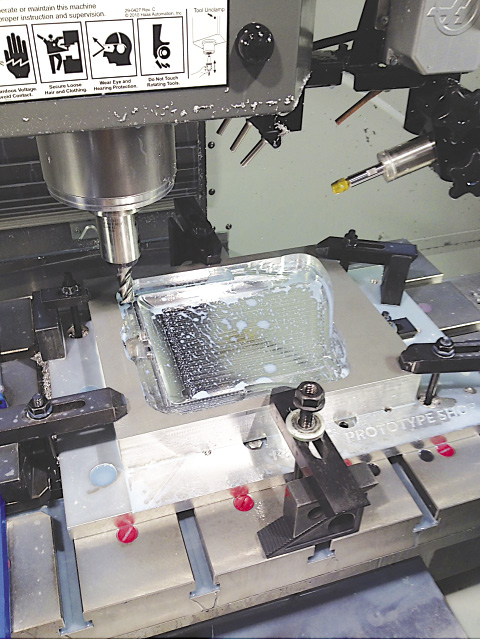
Courtesy of OSG Tap & Die
Griffin Technology applies an Exocarb-Aero Blizzard endmill (inset) from OSG to machine an aluminum prototype for an iPad wall mount.
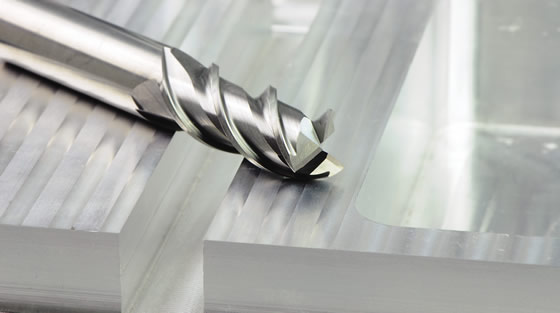
Blizzard tools help provide the fast turnaround times Griffin Technology needs because they can run at the highest speeds and impart the finest surface finishes, according to Fielder. “I’ve used other tools in the past, but they could never reach the speed the Blizzard can, so in the last couple of years I haven’t even tried anything else.”
Designed primarily as roughers, Blizzard endmills have features for maximizing mrr, tool life and part consistency. The special end gash and offset teeth allow for heavy DOCs (up to 0.5 times diameter) at maximum feed per tooth.
Deeper, heavier cuts produce high volumes of large chips, so a strong cutting edge and effective chip evacuation are extremely important, said Pete Gennuso, sales engineering supervisor for OSG. “The geometry of the Blizzard creates a sharp cutting edge to effectively shear and form the chip, enabling smooth chip evacuation.”
He added that highly polished flutes give the endmills a low coefficient of friction to smoothly evacuate chips.
Although designed for roughing, Griffin Technology has been able to reduce cycle times by using the Blizzard endmills for finishing as well, increasing the DOCs for finishing from 2 to 4 times diameter and imparting slick wall finishes.
“Machining deeper DOCs creates more chips and those chips must be evacuated from the flutes so they don’t build up on the cutting edges,” Gennuso said. “Because the Blizzard’s polished flutes enhance chip evacuation, the tool can be run at heavy DOCs and still maintain good chip evacuation and produce smooth surface finishes.”
Cutting data demonstrated that the Blizzard can reach high feed rates when roughing without breakage and spindle overload vs. competitive tools, which ran into severe galling and tool breakage issues, according to OSG.
“We tested and benchmarked the Blizzard endmill against several key competitors’ products,” Gennuso said. “When run at conditions identical to the Blizzard, the competitors’ tools suffered extreme build-up, which led to tool breakage. Each application is different and requires selection of the appropriate cutting conditions, but, for example, a 2-flute, 0.250 ” Blizzard endmill is capable of milling a slot 0.250 ” wide and 0.250 ” deep at 1,000 sfm and 175 ipm in an aluminum alloy.”
Fielder, who is averaging 992 sfm with the endmills, said the Blizzard’s speed, accuracy and life “are incredible. They are the longest lasting tools we’ve ever used.”
Glossary terms in this article
Related


Subscribers can use MFGAxis notes, saves and discussion tools with their innoNET account.