

Keeping it real: New and traditional parts marking technologies help prevent counterfeiting
To the public at large, the word "counterfeit" mostly brings to mind so-called "funny money" or, more recently, low-priced CDs and DVDs that violate copyright laws. What is less widely known, but more threatening to public safety is the counterfeit parts and products that have found their way into the supply chains of critical industries, including aerospace, automotive and medical.
Courtesy of Gravotech
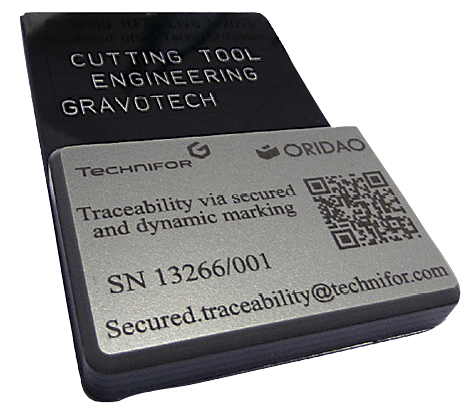
Gravotech and ORIDAO’s interactive marking technology incorporates micropercussion marking and a RFID microchip (lower part of device).
To the public at large, the word “counterfeit” mostly brings to mind so-called “funny money” or, more recently, low-priced CDs and DVDs that violate copyright laws. What is less widely known, but more threatening to public safety is the counterfeit parts and products that have found their way into the supply chains of critical industries, including aerospace, automotive and medical.
One way to curb the use of counterfeit parts is to mark them securely. This includes marks that are difficult to remove and difficult for counterfeiters to read and duplicate. The marking methods involve conventional strategies, such as laser and micropercussion marking, as well as new approaches, such as microlithography and embedded RFID (radio frequency identification) tags.
A Growing Flood
The rise of manufacturing in Asia and other regions has helped produce a growing flood of counterfeit parts—and their impact is significant. A 2010 report from the U.S. Government Accountability Office quoted an FBI estimate that U.S. businesses lose $200 to $250 billion annually on counterfeiting. The Motor and Equipment Manufacturers Association estimates that counterfeiters have cost just the U.S. auto parts industry at least $3 billion annually—a figure that is climbing. Global auto industry losses for 2013 from counterfeiting are $12 billion, according to estimates from the Motor Equipment Manufacturers Association.

Courtesy of Nanotech Security
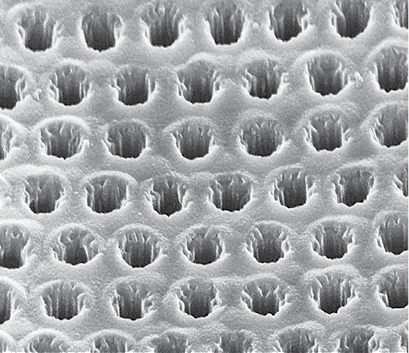
The a. Morpho butterfly (top) creates colors through light-diffracting holes. Nanotech Security’s nanohole arrays (bottom), created via electron-beam lithography, are meant to mimic this effect. This array has nanoholes that measure 250nm in diameter, and the spacing between the holes (center to center) is about 500nm.
According to a United Press International report, the National Highway Traffic Safety Administration estimated, in 2012, that “tens of thousands of counterfeit airbags,” which could rupture or otherwise malfunction in a collision, have been installed in vehicles repaired at independent shops. Further, others are sold online for as little as $50—compared to $700 to $1,000 for the genuine article.
Automotive glass is another sensitive area. Ken Feldman, global brand protection manager for Ford Motor Co., stated online: “Glass manufacturers are able to counterfeit multiple OEMs very easily by simply changing silk screens. Over the last 2 years, authorities in China have conducted 40 raids and seized 200,000 pieces of counterfeit glass across various brands, and made to close 30 arrests, with half of those successfully prosecuted serving jail time.”
Addressing the problem is especially critical in the case of complex machines with long service lives, such as aircraft. Airplane manufacturers must not only police the suppliers and distributors contracted to make OEM parts; the replacement parts market can be a dumping ground for unlicensed components.
To combat counterfeiting, OEMs and part makers must permanently and securely identify their parts. The verification process often starts with raw materials—especially with custom parts for a single customer.
Industrial Forge Inc., Alma, Ga., produces specialized fasteners. “Because of the applications for our products, it’s essential that we verify the raw materials,” said Ted Murray, company president. “We use a Nitron XL2 analyzer that incorporates X-ray fluorescence to define the composition of the alloys before manufacture. That way, we can be sure the products we deliver are exactly to customer specification and that no inferior material makes its way into our process.”
A Graphic Approach
One of the new methods of securely marking manufactured parts is electron beam lithography (EBL). Nanotech Security Corp., Vancouver, B.C., is developing an EBL process to generate complex graphics.
Courtesy of FOBA
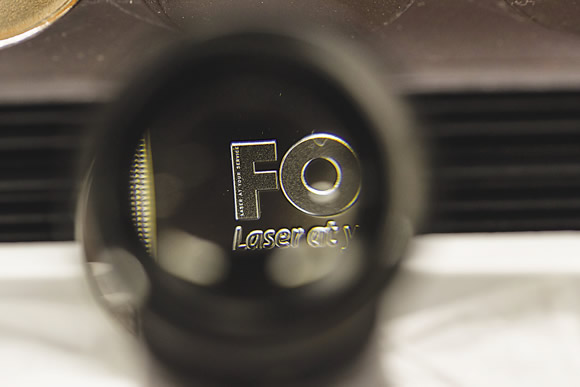
Micromark on a coin applied with a FOBA laser and viewed through a loupe.
According to Clint Landrock, Nanotech’s chief technology officer, “The EBL system patterns a controlled array of holes in a thin-film material, or resist, which is transferred to a master, typically made of quartz. The median hole size for the structures we create is about 100nm in diameter, and the actual structures can have hole sizes anywhere from 50nm to 350nm in diameter, depending on what the optics need to do.”
The array diffracts light and, when viewed from different angles, can create multiple colors. Full-color images are similar to the holograms traditionally found on credit cards and other secure documents but offer more detail and a wider, richer variety of color. The master then replicates the structure onto a secondary nickel master for production. Anticipated resolution is about 250,000 dpi. The graphic device can be applied as a patch or foil and adhered to parts or documents, or it can be directly applied to parts made of metal or other materials.
Courtesy of Miyachi America
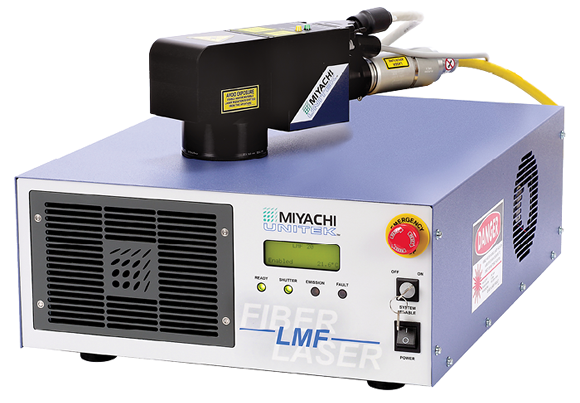
Fiber laser markers, such as this one from Miyachi America, can create pictures, bar codes or specialized codes, as well as alphanumeric sequences.
An advantage of EBL is that it offers three levels of security. In the overt stage, the mark is visible in natural light. The second, or covert, level involves creation of a high-definition microimage that requires magnification. (Both the overt and covert levels are visible within the range of 2,500 to 250,000 dpi. The higher the dpi, the greater the resolution). The third, or forensic, level uses nanoscale imagery that requires specialized equipment for viewing.
The cost of applying these marks will depend on design complexity and volume. “The economics will be excellent in high-volume production,” Landrock said. The process is in its final development stages and is expected to debut in 2014. While it can be used to mark parts, possible primary applications include financial instruments, passports and other official documents, such as for customs and trade documentation.
From Percussion to RFID
The range of methods to securely mark parts has grown thanks to an alliance between Gravotech Group, Rillieux-la-Pape, France, and ORIDAO, Montpellier, France.
Gravotech’s Technifor unit produces marking equipment that applies laser, micropercussion and scribing technologies for permanent traceability and unique identification. For example, the company’s micropercussion machines are used to mark data that includes the vehicle identification or serial numbers.
“Micropercussion displaces metal without removing it,” said Bon Carter, business manager for Gravotech Inc., Duluth, Ga. “The permanent marking, which typically incorporates special fonts for security, literally changes the structure of the part such that grinding or filing cannot erase the identification.” Although the depth of the marks depends on the type and thickness of the material, maximum achievable depth would near 0.3mm (0.01 “).
The Gravotech/ORIDAO venture targets marking applications on high-value parts, including engine components and structural assemblies for aerospace and defense applications and medical implants and appliances. The companies have developed an interactive marking technology (which they call “augmented traceability”) that incorporates conventional marking and RFID microchips.
A readable tag applied to the exterior of a part can include alphanumeric data, such as part description, serial number and date of manufacture, as well as bar codes, QR codes and other markings. Additionally, an RFID microchip can be permanently enclosed in a plate or tag or directly into a part. This is accomplished through a process called “hardening,” whereby the tag is placed in a shell or container suitable for the environment and can be attached, depending on the part, with rivets, industrial adhesives, epoxy or hose clamps. The chip contains relevant information, which can be read by any standard RFID reading device. Over the part’s life cycle, additional information can be encoded into the chip. This could include regularly input data, such as maintenance intervals, or the number of flight hours for an aircraft engine part, according to Carter.
Nicholas Reffe, CEO of ORIDAO, added: “Critical information cannot be erased or corrupted. As a result, the part’s history can be accurately maintained through the supply chain. This information is invaluable in situations where components are rebuilt or parts are salvaged for subsequent reuse.”
The objective of the system is to keep the information compact yet readable, even in hostile working environments. Tags can be hardened to resist temperature and vibration and, in some cases, incorporate composite or ceramic layers to extend life. The process is currently on the market and is being used by the aerospace industry for aircraft components, as well as by the military and oil and gas industries.
Review the print ads from this magazine to continue
This quick advertiser review unlocks the rest of the article and keeps the full-screen reader focused on the ads instead of the page chrome.
Advertisers included in this article experience
Print placements connected to this article
We Asked The Mastercam Community...
Why do you use Mastercam?
Mastercam is the most widely used CAD/CAM software in the world with an unmatched global community to back it up. Join us to find out how the #MastercamFamily can benefit you
We Asked The Mastercam Community... Why do you use Mastercam? Mastercam is the most widely used CAD/CAM software in the world with an unmatched global community to back it up. Join us to find out how the #MastercamFamily can benefit you. 671 Old Post Rd.Tolland, CT USA • 800 228 2877 www.mastercam.com
Visit We Asked The Mastercam Community... View this placement in the issue recordPrint ads from this magazine
Mastercam is the most widely used CAD/CAM software in the world with an unmatched global community to back it up. Join us to find out how the #MastercamFamily can benefit you
We Asked The Mastercam Community... Why do you use Mastercam? Mastercam is the most widely used CAD/CAM software in the world with an unmatched global community to back it up. Join us to find out how the #MastercamFamily can benefit you. 671 Old Post Rd.Tolland, CT USA • 800 228 2877 www.mastercam.com
Continue reading
December 2013
“Certain parts on offshore drilling rigs, for example, require marks that are not only permanent—so as to avoid counterfeiting—but that can record life cycle history,” Carter said.
Also, the U.S. Department of Defense demands permanent marks on every asset worth more than $5,000, and the medical industry is developing regulations to enhance part integrity and traceability, according to Carter.
Micro Laser Engraving
Laser machining’s flexibility and versatility have helped boost its popularity for parts marking. “Laser marking can be so small that it is virtually indistinguishable to the naked eye,” said Ulrich Ofer, vice president of marketing and applications at FOBA Laser Marking + Engraving Solutions/Alltec GmbH, Selmsdorf, Germany, which builds laser marking and engraving machines.
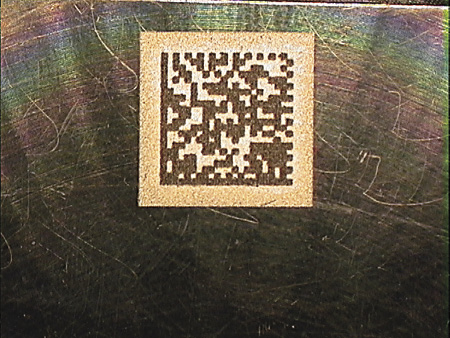
Courtesy of Miyachi America
A 2-D coded matrix applied to a motor top using a laser from Miyachi America.
Alltec has developed laser marking systems for industrial tools and parts. Some of the marks are very small. For example, one 7µm-high mark requires a microscope for viewing. Other applications involve engraving 2-D bar codes and other coding.
“We typically recommend a YAG or a fiber laser for plastic and metal applications,” Ofer said. “We see growth not only in direct marking of high-value parts, but also in securely laser marking accompanying documentation.”
He noted costs can range from $150,000 for a machine capable of creating latent markings to more than $200,000 for specialized micromarking equipment that requires extensive software, tooling and training.
Tailored to Materials
Another laser builder, Miyachi America Corp., recommends different lasers for different marking jobs. “Fiber laser markers can create pictures, bar codes or specialized codes, as well as alphanumeric sequences, on metals, ceramics and some plastics,” said Dr. Mark Boyle, laser product engineer for Monrovia, Calif.-based Miyachi. He noted green vanadate (532nm) and UV (355nm) marking systems are used primarily for high-contrast marking on plastic and specialized marking, such as 2-D matrices, bar codes or other coding, on metals.
Different types of lasers are necessary not only because of the various workpiece materials that are marked, but also to accommodate the way in which markings are applied. For instance, certain high-value parts are marked individually, as they require information specific to the part. Components produced in bulk must be marked in-line for greater production efficiency.
For permanent marking of high- value metal parts, such as titanium and stainless steel ones, the part can be annealed. “Compared to engraving, which requires metal removal, the annealing process uses heat to build oxide layers that cannot be removed,” Boyle said. “With this process, it is also possible to impart certain colors to the markings for further security.”
Many manufacturers are marking parts with 2-D bar codes and other matrices that are nearly indistinguishable to the eye but can be easily read with the appropriate reader.
Another reason for the popularity of laser marking systems is cost. According to Boyle, an ultrafast system capable of marking the widest variety of materials can cost in the area of several hundred thousand dollars, while a basic system can range from $40,000 to $50,000.
A ‘Safe’ Technology
A unique engraving process is used internally by the sealing technologies unit of the Freudenberg Group, Weinheim, Germany, a supplier of dynamic and static seals, gaskets and other elastomeric components. When a customer in the food service industry discovered that non-Freudenberg counterfeit parts had been used in its equipment, the customer asked Freudenberg for a solution to protect its equipment against counterfeiting and ensure component traceability.
Freudenberg developed a laser engraving process incorporating a 24-digit sequence that can be directly applied in standard rectangular fashion on flat parts or rounded for curved parts such as O-rings. “Every component using this identification system is marked with a unique number sequence,” said Christian Geubert, a technical support representative with Freudenberg.
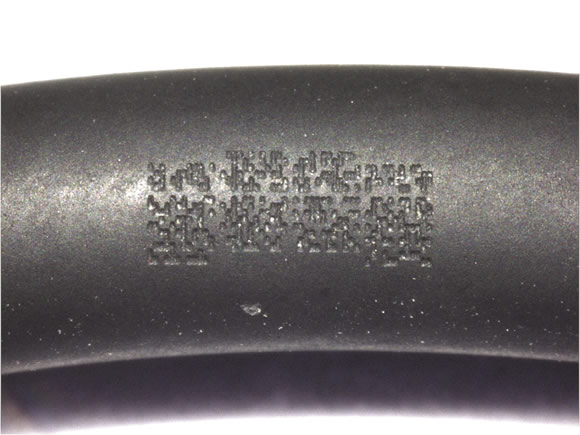
Courtesy of Freudenberg Group
Freudenberg’s “safe” marking applied to an O-ring.
The sequence can be added to over the life of the part to provide additional information. The identification does not need to take the form of a tag, which product pirates may separate from marked originals and attach to their counterfeit products, especially small parts, such as O-rings used in specialized applications.
The fine print is so small that it requires a special magnifier to read it, but the code remains legible even if up to 70 percent of the marking has been worn through or destroyed, Geubert said.
The product, trademarked under the name “safe,” was patented 3 years ago in Europe. The technology is proprietary and used only on Freudenberg products. Application costs range from approximately 0.05 Euros per part for high-volume applications up to 2 to 3 Euros per part for complex component systems in which just a few products are marked.
As new marking technologies emerge, developers will initially seek high-volume applications, including coins, banknotes and secure documents, but also lower-volume but high-value merchandise and parts, where the added cost of secure marking is justified. As these technologies and protocols gain wider acceptance, they will no doubt migrate to midlevel markets. CTE
Contributors
FOBA Laser Marking + Engraving Solutions/Alltec GmbH
(519) 572-8695
www.fobalaser.com
Freudenberg Group
(734) 354-5505
www.freudenberg.us
Gravotech Inc.
(800) 843-7637
www.gravotech.com
Industrial Forge Inc.
(912) 632-9014
www.industrialforgeinc.com
Miyachi America Corp.
(626) 303-5676
www.miyachiamerica.com
Nanotech Security Corp.
(604) 420-0830
www.nanosecurity.ca
ORIDAO
+33 467-130-000
www.oridao.com
Glossary terms in this article
Related
 MFGAxis Discussion
Be part of the shop-floor conversation
Like, save, or comment on this CTE story.
MFGAxis Discussion
Be part of the shop-floor conversation
Like, save, or comment on this CTE story.


MFGAxis Discussion