



Superhard automation
Simultaneously improve product quality and productivity when EDMing PCD and PCBN cutting tools and wear parts. An automation process that incorporates work cells.
END USER: Diamond Innovations Inc., (800) 368-6507, www.diamondinnovations.com.
CHALLENGE: Simultaneously improve product quality and productivity when EDMing PCD and PCBN cutting tools and wear parts.
SOLUTION: An automation process that incorporates work cells.
SOLUTION PROVIDER: Methods Machine Tools Inc., (877) MMT-4CNC (668-4262), www.methodsmachine.com.
In keeping with its name, Diamond Innovations Inc. continuously seeks inventive manufacturing processes to make its PCD and PCBN products, which include more than 3,000 geometries for cutting tools. The Worthington, Ohio, company custom makes about 90 percent of its tools in quantities from one to more than 50,000. The typical order quantity is 200.
EDMing is effective for cutting PCBN and PCD, but Diamond Innovations sought full process automation to optimize the operation. “The quality of the product was not at the optimal level we sought for our demanding customer base,” said Steve Chadwick, operations manager for Diamond Innovations, noting dimensional tolerances can be as tight as ±0.02mm (±0.0008 “). “We determined that two variables in our EDM operation were producing inconsistent results: individual, unique tooling and operator error due to manual part loading.”
Chadwick’s team determined the company could improve product repeatability, accuracy and productivity by incorporating more complete process automation. The company challenged several EDM providers to eliminate the inconsistencies and provide an automated solution that would increase flexibility and capacity without increasing labor costs.
To ensure the company was using the “best” equipment, Diamond Innovations sent the EDM suppliers a test-cut package that included several different grades and shapes of PCD. After inspecting the cut PCD and tabulating the results, Diamond Innovations determined the FANUC RoboCut wire EDM from established partner Methods Machine Tools Inc., Sudbury, Mass., had the fastest cutting speed and produced the highest quality tools.
Effectively automating that equipment, however, was more challenging than obtaining it. Short EDM runs of dissimilar parts are traditionally not considered conducive to full automation. Diamond Innovations cuts tools from master blank discs that range from 0.8mm to 5mm (0.031 ” to 0.197 “) in thickness and 50mm to 70mm (1.97 ” to 2.76 “) in diameter, with diamond particles varying from 1µm to 25µm (0.00004 ” to 0.0010 “). Each blank requires specific EDMing parameters for optimal quality. The PCD or PCBN is typically adhered to a thin tungsten-carbide backing for strength, and pieces are often exceedingly difficult to load, clamp and unload in a precise position.
To overcome the challenges, Methods and Diamond Innovations jointly developed a machine cell to address several variables. The first variable was designing an automated method to load and unload parts (cutting tools and wear parts) so the operator doesn’t have to. This was achieved by incorporating three FANUC RoboCut wire EDMs serviced by one FANUC M20iA robot in one cell. One side of the cell is an operator station, where drawers are located for introducing raw parts into the cell and a rack holds baskets for catching and removing the cut parts. “Now we can load blanks on Friday, leave for the weekend and come in on Monday to finished parts,” Chadwick said.
Another challenge was enabling a pneumatic clamping fixture in each EDM to accept the varying disc sizes and locate the robotically loaded tool. Generally, the blank is manually placed in a fixture, which is mounted on a pallet system that locates the blank precisely in an EDM. Because of the nature of using many different pallets, the fixtures must be manually clamped. Therefore, an operator is needed to manually clamp the disc onto the pallet. To automate the process, an automated clamping method was needed.
“We needed to find a way to grab the smallest edge of a disc in order to fully machine it,” said John Lucier, automation manager at Methods. “In EDM setups, these types of fixtures are uncommon.”
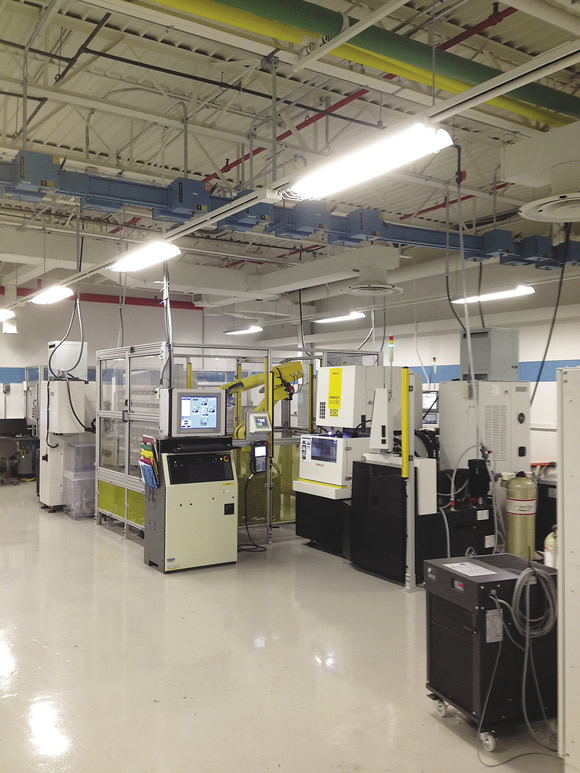
Courtesy of Methods Machine Tools
A work cell at Diamond Innovations that includes three FANUC RoboCut wire EDMs and a FANUC M20iA robot.
This is because wire EDMs traditionally use water during the cutting process and, in many cases, flood and even fill the work area completely with water. As a result, it’s challenging to make a fixture that’s compatible with this environment.
The clamping solution did not require the expensive pallet and custom tooling that Diamond Innovations previously used, which reduced costs. “We started with three cells, which altogether contain 180 blanks of varying sizes,” said Richard Mercurio, advanced manufacturing engineer at Diamond Innovations. “It would be very costly to purchase individual fixtures and pallets designed for each part.”
Instead of manually clamping each disc to a pallet, an operator needs only to place the raw disc in the drawer position, which takes a fraction of the time and facilitates unattended machining.
The clamped disc must be held flat and parallel to the EDM’s axes. Before automating the process, if a disc was not clamped within specification, the operator had to manually unclamp, rotate, reclamp and reinspect the disc, a process that could require several attempts. With automation, a robot-mounted laser displacement sensor measures the flatness of the blank as it is held in the fixture. After the blank is loaded into an EDM, the robot positions the laser over the tool and takes several measurements to ensure the disc is located within tolerance. If the disc location is out of tolerance, the robot repeats the procedure at calculated adjustments until an acceptable result is achieved.
A cell-controlled computer runs MMAC (Methods Manufacturing Automation Control) software, which allows the cell operator to identify and prioritize each of the 60 incoming discs in the cells. When one of the EDMs in a cell becomes available, the software directs the robot to pick up the next tool on the job list and send the proper cutting parameters to the EDM’s control.
Diamond Innovations set a goal of eliminating all cut part mix-ups. Once EDMed, the several grades of PCD tips are difficult to identify, and mix-ups, while not common, can be mistakenly released to customers. The solution was to use custom parts-catching baskets to collect and separate cut parts.
After installing four automated cells, Diamond Innovations reports that it increased productivity 20 percent, operates 40 percent more EDMs with the same production staff and reduced scrap caused by cutting errors to a negligible level, mainly because of the automated fixturing and inspection processes.
“Robots free up people so they can do what is most important,” Chadwick said. “We still have
Glossary terms in this article
Related



Subscribers can use MFGAxis notes, saves and discussion tools with their innoNET account.


