

Coat, don’t plate: General Industry Coverage
A tungsten carbide-based CVD coating that's an environmentally friendly alternative to hard-chrome plating.
Hard-chrome plating (HCP) provides parts, such as ones for the aerospace industry, with a wear- and corrosion-resistant surface but requires the use of hexavalent chromium salts. Those salts are genotoxic carcinogens and pose health and environmental hazards, and, therefore, are restricted in the U.S. by the Occupational Safety and Health Administration and in the European Union by REACH (Registration, Evaluation, Authorization and Restriction of Chemicals).
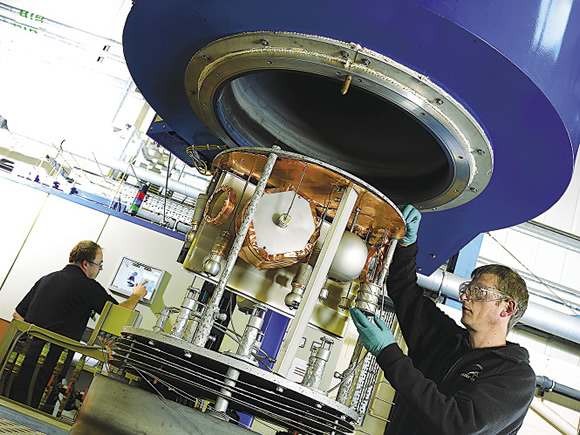
Courtesy of Hardide Coatings
Parts to be coated with Hardide-A are loaded into a CVD coating reactor.
“Hexavalent chromium has been a concern for many years, but the alternatives have always been limited,” said Dan Wilson, business development manager for Hardide Coatings Inc., which offers the Hardide-A coating as an environmentally and worker-friendly alternative to HCP.
Workers applying hexavalent chromium-containing products are exposed the most, particularly when chrome plating because the processing bath produces bubbles, which generate a difficult-to-capture fog, according to Dr. Yuri Zhuk, technical director for U.K.-based Hardide Coatings Ltd.
Hardide-A, on the other hand, is a tungsten carbide-based CVD coating that is applied in a coating reactor, which doesn’t expose workers to environmental hazards. Zhuk added that although spray coatings, such as high-velocity oxy-fuel, are considered the best available alternative to HCP, those are line-of-sight processes that can only be applied to external surfaces because a spray gun can’t fit, for example, into a small bore.
“In the past, hard chrome was often seen as the best option for hardening interior surfaces because spray coatings are difficult or impossible to apply in tight spaces,” Wilson said.
Review the print ads from this magazine to continue
This quick advertiser review unlocks the rest of the article and keeps the full-screen reader focused on the ads instead of the page chrome.
Advertisers included in this article experience
Print placements connected to this article
coolant-through retrofit system from REGO-FIX. Now
2 MINUTES
CHANGES EVERYTHING WHEN THE GAME IS ON THE LINE, you don’t get a new team, you make it happen. Convert your existing live tooling to coolant-through with the ease and simplicity of reCool®, the revolutionary new reCool® Coolant Supply you can have cost-effective, low-maintenance internal cooling in as little as two minutes. It’s the winning play.
2 MINUTES CHANGES EVERYTHING WHEN THE GAME IS ON THE LINE, you don’t get a new team, you make it happen. Convert your existing live tooling to coolant-through with the ease and simplicity of reCool®, the revolutionary new coolant-through retrofit system from REGO-FIX. Now reCool® Coolant Supply you can have cost-effective, low-maintenance internal cooling in as little as two minutes. It’s the winning play
Visit coolant-through retrofit system from REGO-FIX. Now View this placement in the issue recordPrint ads from this magazine
CHANGES EVERYTHING WHEN THE GAME IS ON THE LINE, you don’t get a new team, you make it happen. Convert your existing live tooling to coolant-through with the ease and simplicity of reCool®, the revolutionary new reCool® Coolant Supply you can have cost-effective, low-maintenance internal cooling in as little as two minutes. It’s the winning play.
2 MINUTES CHANGES EVERYTHING WHEN THE GAME IS ON THE LINE, you don’t get a new team, you make it happen. Convert your existing live tooling to coolant-through with the ease and simplicity of reCool®, the revolutionary new coolant-through retrofit system from REGO-FIX. Now reCool® Coolant Supply you can have cost-effective, low-maintenance internal cooling in as little as two minutes. It’s the winning play
Continue reading
October 2013
The company stated that the CVD coating’s hardness of 800 to 1,200 HV and standard thickness from 50µm to 100µm (0.002 ” to 0.004 “) match the hardness and thickness of HCP, simplifying the transition without the need for part dimensional changes and drawing redesigns. In addition, Zhuk said Hardide-A offers better corrosion resistance because it passed a salt-spray test for 2,000 hours, whereas HCP failed after 280 hours. The Hardide-A coated surface is also free of microcracks, which are always present in HCP. “These microcracks form channels for corrosive media to attack the substrate,” he said.
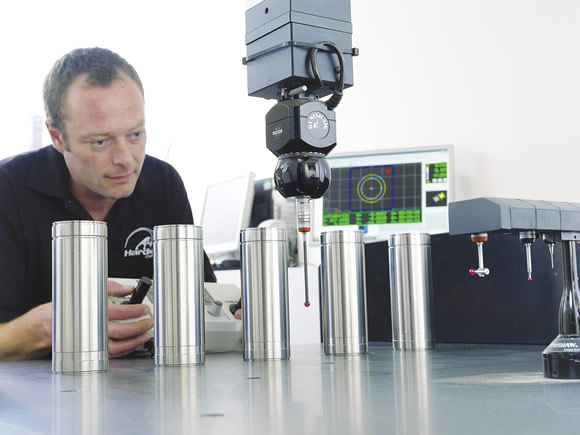
Courtesy of Hardide Coatings
A technician measures parts coated with Hardide-A.
The CVD-coated parts have surface finishes as fine as 0.3µm Ra, but can be ground, honed or lapped, if necessary, Zhuk noted.
The company is working on test programs with customers, including helicopter manufacturer AgustaWestland, Airbus and other aerospace OEMs. According to Hardide Coatings, it has successfully completed the first of two test phases to approve Hardide-A as a replacement for HCP on an AgustaWestland helicopter rotor blade component. The first phase involved testing basic properties, such as corrosion resistance and fatigue life, and the second phase will test actual coated components.
To control quality, the company applies Hardide-A at its coating facilities in Bicester, Oxfordshire, U.K.
For more information about Hardide Coatings Inc., Houston, visit www.har dide.com or call (713) 677-3504. CTE
Glossary terms in this article
Related




Subscribers can use MFGAxis notes, saves and discussion tools with their innoNET account.


