



Robot to the rescue: General Industry Coverage
Produce additional parts without investing in a new machine tool and eliminate manually bending parts. A robot that is flexible and easy to program and move.
END USERS: RSS Manufacturing, (714) 361-4800, www.rssmfg.com. Phylrich, (714) 361-4830, www.phylrich.com.
CHALLENGE: Produce additional parts without investing in a new machine tool and eliminate manually bending parts.
SOLUTION: A robot that is flexible and easy to program and move.
SOLUTION PROVIDERS: Sparkem Technology, (858) 829-6934, www.sparkem.com; Universal Robots, (631) 610-9664, www.universal-robots.com.
RSS Manufacturing, Costa Mesa, Calif., is in growth mode, according to CEO Geoff Escalette. RSS does OEM work for the plumbing industry and its Phylrich unit, which the company acquired about a year ago, makes luxury faucets and other plumbing fixtures. “Same industry, just a couple different sales channels,” Escalette said. RSS Manufacturing also makes parts for other in-house brands, including its RSS Road Sport Supply performance components for Porsche automobiles.
An order for 700 extra plumbing valves a month caused a dilemma. The 5-axis Hurco machine tool dedicated to those parts produces 500 per month with two shifts working 5 days a week. Machining the extra valves would require buying another $225,000 machine even if the company added a third shift.
Instead, the parts manufacturer began examining automation solutions. Escalette noted a Web forum contributor suggested looking at the robot arms from Universal Robots, a Danish manufacturer of industrial robots with U.S. headquarters in Stony Brook, N.Y. After researching UR’s offerings and seeing a couple of them demonstrated at an automation trade show earlier this year, the faucet maker purchased a UR5 robot arm from distributor Sparkem Technology, San Diego. “We just said, ‘This is worth taking a chance on,’ ” Escalette said. ” ‘Let’s buy one and see what it does.’ “
RSS Manufacturing put the robot to work 24/7 and completed the 1,200-part run in about 10 days, Escalette said. “It even freed up capacity on the machine for the rest of the month.”
Courtesy of Universal Robots
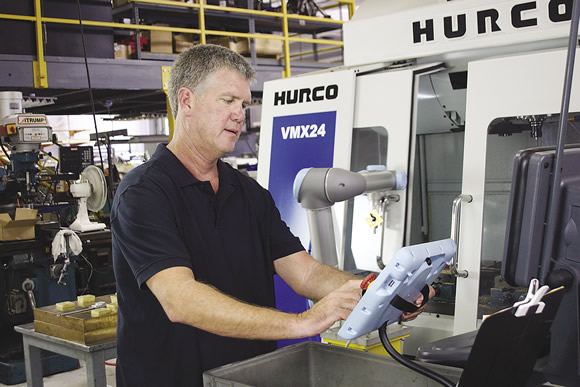
Left: RSS Manufacturing CEO Geoff Escalette programs the UR5 robot arm using the hand-held tablet interface that comes with it.
Courtesy of Universal Robots
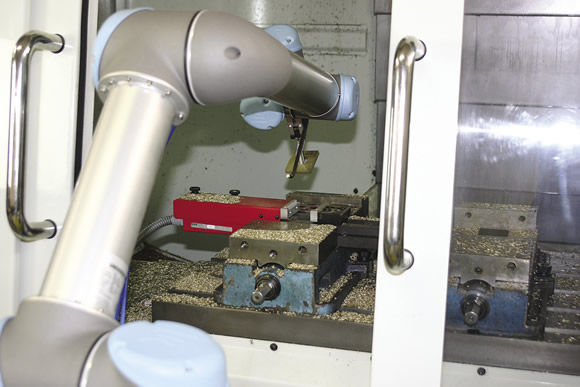
Above: The UR5 robot arm places a workpiece into an electric vise.
The majority of the robot programming involves manual motion recordings, such as moving it from the workpiece pallet to the workholder to the machine door to the cycle start button and starting and stopping the record function for each segment. “The greatest thing is the ability to record the movement,” Escalette said. “You get 80 to 90 percent of your programming done with just a simple series of recordings, and then you just fine-tune it with the keypad.”
The hand-held, touch-screen keypad, or tablet interface, provides significant benefits, according to Shane Strange, the parts manufacturer’s automation and integration specialist. “You’re right there with the robot, troubleshooting as you go. It saves a lot of time when you don’t have to go back to the office, run simulations, go back on the floor, boot it up and watch in real time what it’s going to look like,” Strange said, noting that he performs all those actions with the keypad. “If you can write a to-do list, you can program this robot.”
In addition to easy programming, the robot arm provides flexibility. For example, the company uses the UR5 to bend 1,500 parts on a tube bender in 4 hours, which otherwise takes 3 days using manual labor. That flexibility is enhanced because the robot can operate without safety shielding as long as the end-of-arm tooling isn’t carrying something that can injure a worker. If a worker does contact the robot arm and a force of at least 150 newtons is exerted, the arm automatically stops operating.”In a flexible environment like ours, you need a flexible robot,” Escalette said, “one that can work without safety cages, is portable and can be reprogrammed quickly.”
The robot can be moved on a dolly or by sliding it, Escalette said. The company uses dowel pins in front of a machine to indicate where the robot needs to be positioned. After removing the pins, two bolts secure the robot. “It doesn’t have to be super rigid and doesn’t need to run very fast with a lot of torque because the movements are all predicated on the cycle time,” Escalette said. “If we have a 2-minute cycle time, the robot is sitting most of the time anyway.”
He added that the company plans to use the robot for other applications. One is grinding and polishing using the UR5’s force control feature to exert the exact amount of required pressure. “It’s very hard to find employees who can manually polish brass fittings, applying the right amount of pressure. And it’s a dirtier environment, but we could have the robot do that all day,” Escalette said, noting the robot isn’t 100 percent sealed but can be covered as needed.
Another application is automatic rotary brazing, where the robot picks up a part, places it in a fixture to go around the rotary brazing table, picks off the part, cools it by submerging it in water and places the part in a box.
RSS Manufacturing plans to purchase more UR5 robots, which cost about $35,000 each, in part because of an expected 200 percent increase in company sales in 2014, according to Escalette. He said: “But we’re not just buying robots. I tell all my guys computers don’t think, they only do actions that you give them and it’s the same with robots. You still need people. If we can maximize the time and efficiency of our machines, it keeps us competitive.”
Related



Subscribers can use MFGAxis notes, saves and discussion tools with their innoNET account.


