

Even more tips for operating a CNC mill
Continuing the theme of the previous three columns, here are additional tips for enhancing the operation of a CNC milling machine from Shop Operations columnist Tom Lipton.
Continuing the theme of the previous three columns, here are additional tips for enhancing the operation of a CNC milling machine.
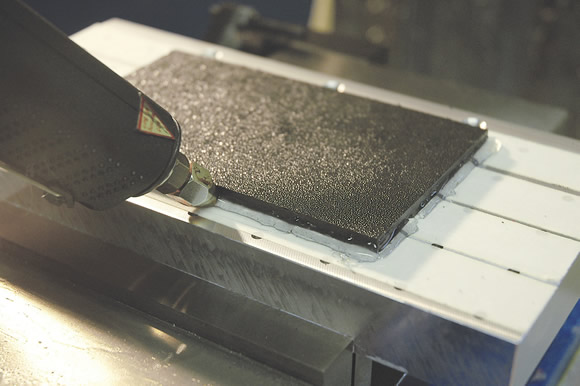
All images courtesy T. Lipton
For a little extra resistance to coolant when holding a part with double-stick tape, run a bead of hot wax around the part using a hot glue gun.
■ Double-stick tape can work well for workholding. Only experience will teach you which kinds of parts can be successfully held this way. I use a double-sided tape called “Permacel.” It seems to be more resistant to coolant than some of the other types I’ve tried. For a little extra resistance to coolant, I run a bead of hot wax around the part using a cheap hot-glue gun. This seems to seal out the coolant just long enough to get the job done.
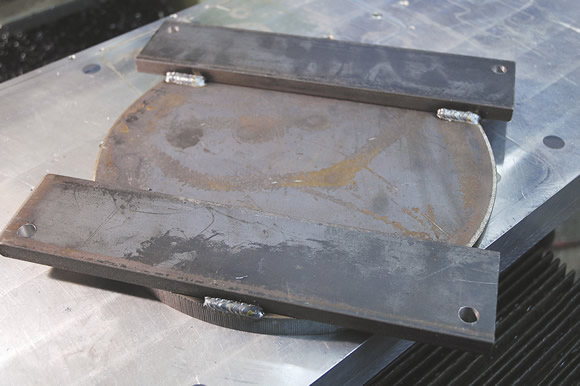
With certain kinds of profiling (above), weld a part to the hold downs without the need for extra holding stock. Welding from the backside (below) also provides a little chip clearance and room for drill penetration under the part.
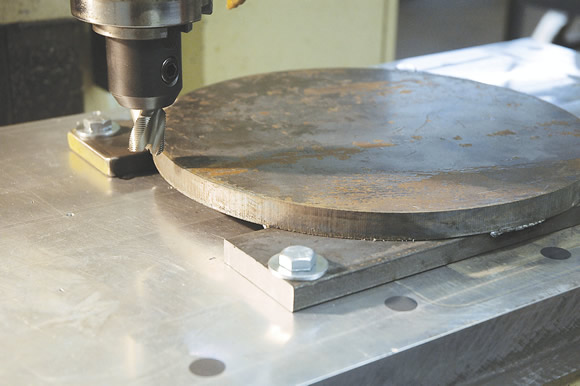
■ Prepare the base plates carefully when using double-stick tape for best results. I like to dovetail the base plates and surface them all at the same time for an accurate Z-axis position like a set of quick-change miniature pallets. Clean the plates with isopropyl alcohol before applying the tape. Position the blank and then go around the blank perimeter with a C-clamp to seat it firmly into the tape. It’s important to press the blank down into the tape. The holding power of the double-sided tape is all about the amount of surface area it contacts. You can prepare the blanks offline while the first ones are in the machine if you have several base plates. I like to use fresh tape for each part to provide the best chance for success.
■ With certain kinds of profiling, you can weld a part to the hold downs without the need for extra holding stock. Once the profiling is complete, remove the hold-down bars or tabs and surface the second side. This technique keeps the blank thickness close to the finish size, eliminating the large amount of holding stock that makes surfacing the second side an effort. This method works well for open shapes like “C” and “H,” which could be distorted from heavy clamping pressure.
■ All of my CNC mills lack rigid tapping, which makes controlling tapping depth a bit of a challenge. I modified the normal tension and compression holders so they have limited compression length by internally inserting a longer pin. This reduces the compression travel to a third of the stock. This approach, combined with a modest spindle speed, provides good tap-depth accuracy.
Review the print ads from this magazine to continue
This quick advertiser review unlocks the rest of the article and keeps the full-screen reader focused on the ads instead of the page chrome.
Advertisers included in this article experience
Print placements connected to this article
Pctcutters
Scan this code
and browse through our Newly Redesigned Specials. General Purpose Available in: 3xD - 12xD Receive a Guaranteed Test Tool including our standard end mills, drills, routers and chamfer mills! We have great confidence in our tools; try them yourself! For more information contact: 24/48 hr. Turnaround.
Scan this code and browse through our Newly Redesigned Specials. General Purpose Available in: 3xD - 12xD Receive a Guaranteed Test Tool including our standard end mills, drills, routers and chamfer mills! We have great confidence in our tools; try them yourself!
Visit Pctcutters View this placement in the issue recordPrint ads from this magazine
and browse through our Newly Redesigned Specials. General Purpose Available in: 3xD - 12xD Receive a Guaranteed Test Tool including our standard end mills, drills, routers and chamfer mills! We have great confidence in our tools; try them yourself! For more information contact: 24/48 hr. Turnaround.
Scan this code and browse through our Newly Redesigned Specials. General Purpose Available in: 3xD - 12xD Receive a Guaranteed Test Tool including our standard end mills, drills, routers and chamfer mills! We have great confidence in our tools; try them yourself!
Continue reading
August 2013
■ I have always liked the 10-ipm rule for tapping. Take any tap pitch at 10 ipm and multiply the pitch per inch by 10 to get the spindle speed. For example, a 10-32 tap run at 10 ipm gives 320 rpm (32×10).
■ Even if you have rigid tapping, you might look at a reversing tapping head for your CNC mill. These have the advantage of instantly reversing, whereas the spindle must slow and actually stop when rigid tapping. If you have to tap huge numbers of holes, this approach can reduce the cycle time. Torque control is usually adjustable with the tapping head, unlike rigid tapping holders.
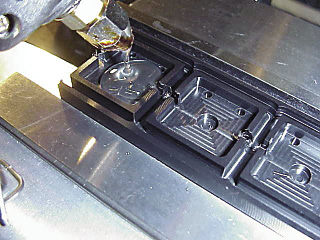
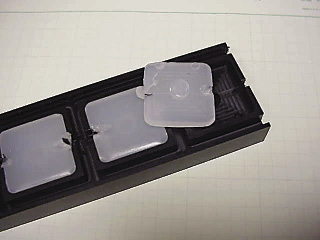
Top: Use hot-melt glue to support a part for secondary operations. Bottom: On most smooth machined surfaces, this glue can be plucked off without leaving a residue. Apply a little spray mold release to make removal even easier.
■ When doing 3-axis contouring with ballnose endmills, a handy trick is to calculate the effective cutting diameter and increase the spindle speed and feed rate to take advantage of this offset. The full diameter of a ball endmill is rarely fully engaged in fine step profiling and surfacing. If the endmill diameter is used to calculate the spindle speed, you are most likely running 50 percent too slow.
■ Try to deburr and finish a part in the machine if possible. The added cycle time can be subtracted from the attended machine time. Use small chamfers on unspecified edge breaks whenever possible. A 45° chamfer is more tolerant of part geometry errors than an equal-sized break using a radius.
■ I’ve been using a trick I learned from a buddy with great results. Use hot-melt glue to support a part for secondary operations. For example, if the part floor is thin and the back was surfaced over the thin floor, chatter results and an unacceptable finish is imparted. By filling and supporting the thin floor with hot glue, the second side comes out flat with an excellent finish. Thin webs, floors and overhangs can be supported with this cheap material. On most smooth machined surfaces, this glue can be plucked off without leaving a residue. Apply a little spray mold release to make removal even easier. Denatured alcohol also helps separate the solidified glue from delicate features. CTE
About the Author: Tom Lipton is a career metalworker who has worked at various job shops that produce parts for the consumer product development, laboratory equipment, medical services and custom machinery design industries. He has received six U.S. patents and lives in Alamo, Calif. For more information, visit his blog at oxtool.blogspot.com and video channel at www.youtube.com/user/oxtoolco. Lipton’s column is adapted from information in his book “Metalworking Sink or Swim: Tips and Tricks for Machinists, Welders, and Fabricators,” published by Industrial Press Inc., New York. The publisher can be reached by calling (888) 528-7852 or visiting www.industrialpress.com. By indicating the code CTE-2013 when ordering, CTE readers will receive a 20 percent discount off the book’s list price of $44.95.
Glossary terms in this article
QR codes and videos from this issue
Print QR codes, video callouts, and in-magazine links for this article now point to the CTE video hub in the HTML version.
Related



Subscribers can use MFGAxis notes, saves and discussion tools with their innoNET account.


