

More tips for operating a CNC mill
Shop Operations columnist Tom Lipton offers additional tips for operating a CNC milling machine.
Continuing the theme of May’s column, here are additional tips for enhancing the operation of a CNC milling machine.
• Permanently engrave important offset and program information directly into your soft jaws. Then you’re not trying to figure it out in 6 months when the job repeats. Extra information available at the machine during setup reduces mistakes and increases setup speed and confidence.
• Cut a pickup feature or features directly into your fixtures and soft jaws. There’s nothing like a good round hole marked X0/Y0 to set up from the next time you use a fixture.
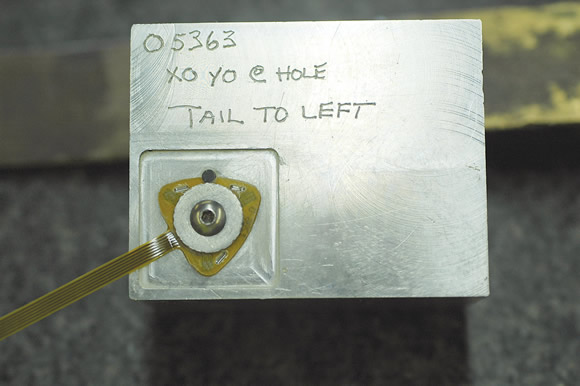
All images courtesy T. Lipton
Engrave important program and offset information directly into fixtures and soft jaws.
• I’ve never had to do it yet, but I have heard about somebody doing a job that was a couple of inches outside the X-axis travel of the machine. The job requirements were such that it was best to do it in one setup. The solution was to align the part’s X-axis diagonally with the machine axis. This put the part axis on the hypotenuse of the machine’s X- and Y-axis travels and provided the extra couple of inches needed to do the job. With modern CAM systems, this is a viable option.
• A silver metallic felt pen provides a quick, easy way to mark a tool offset directly on a black-oxide toolholder. It only takes a second to record an offset and it’s cheaper than tags. Heck, I can’t even buy the nifty little tags for my BT-35 holders, so I improvise like a true cheapskate.
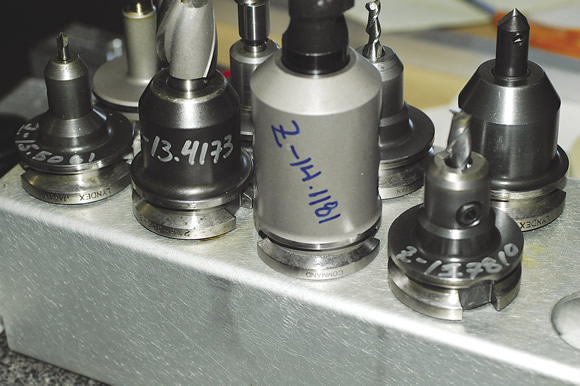
A silver metallic felt pen provides a quick, easy way to mark a tool offset directly on a black-oxide toolholder.
• Engraving is super sensitive to cutting depth. Your engraving will look lousy if the surface is sloped, dished or not where you think it is. The best approach is to establish an accurately known Z position just prior to the engraving operation. An alternative is to cut a shallow pocket for the engraving to reside in. The pocket also helps protect the engraving from damage because it is recessed.
Review the print ads from this magazine to continue
This quick advertiser review unlocks the rest of the article and keeps the full-screen reader focused on the ads instead of the page chrome.
Advertisers included in this article experience
Print placements connected to this article
Kyocera’s M-Series
The latest members of
Milling Cutter Arsenal The M-Four and M-Six Milling Cutters featuring double-sided, thick edge inserts and long lasting MEGACOAT NANO Grades for superior performance t oug h pre c ise unchallenged Experience the M-Series Difference The M-Four and M-Six Milling Cutters are now available as part of the Kyocera Milling Kit Sale
The latest members of Kyocera’s M-Series Milling Cutter Arsenal The M-Four and M-Six Milling Cutters featuring double-sided, thick edge inserts and long lasting MEGACOAT NANO Grades for superior performance
Visit Kyocera’s M-Series View this placement in the issue recordPrint ads from this magazine
Milling Cutter Arsenal The M-Four and M-Six Milling Cutters featuring double-sided, thick edge inserts and long lasting MEGACOAT NANO Grades for superior performance t oug h pre c ise unchallenged Experience the M-Series Difference The M-Four and M-Six Milling Cutters are now available as part of the Kyocera Milling Kit Sale
The latest members of Kyocera’s M-Series Milling Cutter Arsenal The M-Four and M-Six Milling Cutters featuring double-sided, thick edge inserts and long lasting MEGACOAT NANO Grades for superior performance
Continue reading
June 2013
• You can use an M00 or M01 command just prior to a tapping cycle when threading difficult-to-cut materials. Manually dab a little heavy-duty tapping fluid directly on the tap. (Water-based coolants leave something to be desired for tough tapping operations.) M00 is the preferred method because the default machine condition is a safe one, unlike the optional stop where the operator must remember to have a switch set.
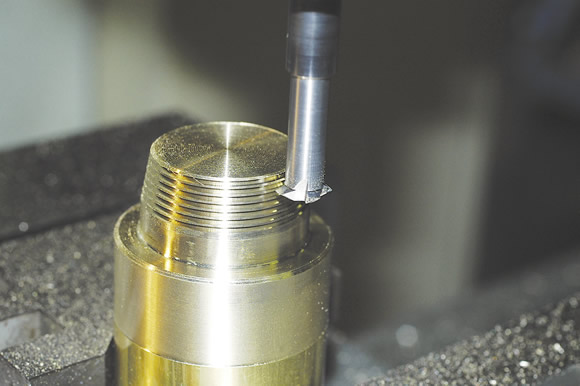
In addition to milling common thread pitches, a single-flute thread mill can mill those oddball thread pitches that come up every once in a while.
• If you haven’t tried thread milling, you should. Sometimes it’s the only way to thread a delicate part. When thread milling, the cutting forces are low and it’s easy to adjust the thread-pitch diameter for a perfect gage fit. You can also cut a full-engagement pipe thread with less than the full depth of hole you would otherwise need, even with a short projection pipe tap.
• Don’t stress too much about ramp-in and ramp-out moves if you are manually programming thread milling. The straight-in approach works fine and is easier to think about than ramping moves the first few times you try it. Most of the time, you are ramping into air or a thread relief. You can use G41/G42 tool compensation if you like to adjust the diameter, but this can be a little tricky to do down the hole of an internal thread. I generally do the entire thread without tool compensation and adjust the X or Y point where the tool starts to orbit for the helix. I put a marker in the program so I can find it easily. With a single-flute thread mill, you can also mill those oddball thread pitches that come up every once in a while.
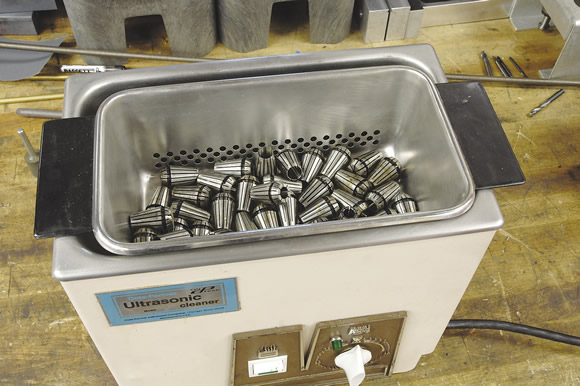
A great way to clean collets is in an ultrasonic cleaner.
• I’m sure everybody has experienced the weird phenomena of an endmill or drill lasting for hundreds of parts and then, after replacing the tool “just in case,” having the new tool last for only one part. Check a few of your ER-style collet setups for runout when that happens. You might be shocked at what you find. These collets are not automatically accurate. This is particularly important with small tools that cannot tolerate much runout in proportion to their diameters. If you find runout, thoroughly clean the collet and holder. The culprit is usually the inside surface of the nut and collets, which have coolant residue or small burrs on them where the nut contacts the collet.
• A great way to clean collets is in an ultrasonic cleaner. Small chips and debris worm their way into the collet slits and ruin accuracy. Use a heated solution of degreaser, such as Simple Green or Omni-All, followed by drying and dipping in lightweight oil, such as M-1 or WD-40. CTE
About the Author: Tom Lipton is a career metalworker who has worked at various job shops. He has received six U.S. patents and lives in Alamo, Calif., For more information, visit his blog at oxtool.blogspot.com and video channel at www.youtube.com/user/oxtoolco. Lipton’s column is adapted from information in his book “Metalworking Sink or Swim: Tips and Tricks for Machinists, Welders, and Fabricators,” published by Industrial Press Inc., New York. The publisher can be reached by calling (888) 528-7852 or visiting www.industrialpress.com. By indicating the code CTE-2013 when ordering, CTE readers will receive a 20 percent discount off the book’s list price of $44.95.
Glossary terms in this article
QR codes and videos from this issue
Print QR codes, video callouts, and in-magazine links for this article now point to the CTE video hub in the HTML version.
Related




Subscribers can use MFGAxis notes, saves and discussion tools with their innoNET account.


